
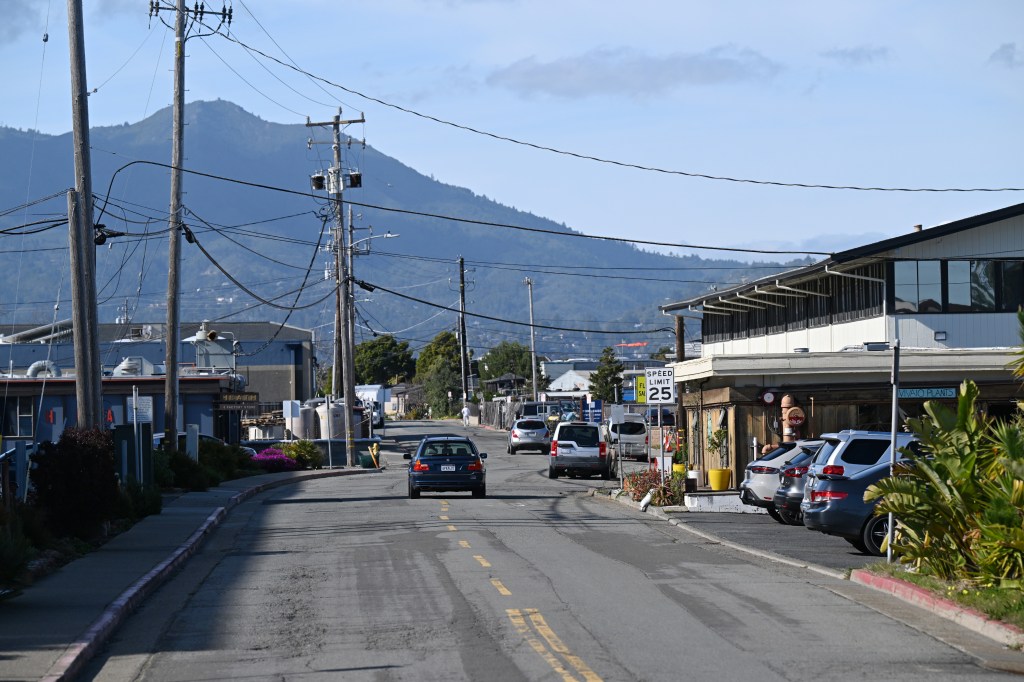
Sausalito voters will decide this fall whether to ease development restrictions in the 215-acre Marinship district.
The City Council voted June 16 to place a pro-growth initiative on the November ballot after the county qualified petition signatures.
The proposal, called the “Arts, Industrial & Maritime Preservation and Improvement Initiative,” would supplant a 1985 ordinance that has barred most new development in the former World War II shipyard. The AIM initiative would alter rules on building heights, footprints, density and uses, replacing previously adopted planning regulations for the Marinship area.
The City Council also authorized two reports on the potential effects of the proposal. The first report, to be prepared by city staff, will assess fiscal, planning, land-use, infrastructure, economic, traffic and community impacts. The second report, to be prepared by consultants, will assess similar issues but be less constrained by state law that prohibits municipalities from advocating for or against ballot measures.
“I think as much information and transparency around this initiative as possible is only beneficial to our community as a whole,” Vice Mayor Melissa Blaustein said.
Councilmember Joan Cox, citing the potential impacts of the proposal, said it is “different from many ballot initiatives.”
“I believe an independent analysis will identify some of these challenges, so between now and when and if this initiative passes, we can be prepared,” Cox said.
“I just want to say that we’re asking for trouble,” Mayor Steven Woodside said. “We’re going to have so much information that the true objectivity, no matter who writes it, will be questioned by the people who don’t like the report.”
The council had no choice but to place the initiative on the fall ballot after proponents gathered sufficient signatures because it would repeal another voter-approved measure.
The only question before the council was whether it would order and receive a report on the impacts first — which would require its production on a tighter timetable — or place the initiative on the ballot and await the analyses.
Councilmember Jill Hoffman wanted an assessment first and wanted it done by outside consultants, not city staff. Councilmember Ian Sobieski said city staff know the intricacies of city zoning and building and could be more thorough. Cox supported the outside report. Blaustein supported two reports. Woodside worried about overwhelming the public.
“This is going to be really hotly debated,” he said. “And we’ve heard really good presentations from both sides tonight with reasons for and against. We’re going to hear more.”
The decision to authorize two reports came after public comments previewed the intensity of the deepening debate and discussion.
The 1985 ordinance, Ordinance 1022, essentially froze development at a time when Bay Area counties were concerned about traffic-fueled development spilling in from highways and spoiling neighborhoods.
AIM proponents said the district is neglected and overdue for revitalization. Opponents said the absence of development necessitates more careful planning and remedies.
“My family owns Sausalito Yacht Harbor,” said Jim Madden. “We have a significant investment in the future waterfront. We would never support anything that harms our businesses or the character of Sausalito.”
“The reality is our waterfront infrastructure is aging and deteriorating because current rules have made reinvestment extremely difficult,” he said. “AIM will help create a path to rebuild infrastructure, address sea-level rise, and support a vibrant working waterfront.”
“We have frozen everything and made it virtually impossible to get anything done whatsoever, whether that be improvements to the infrastructure of our city or thoughtful changes to existing regulations,” said Joel Carr, an architect and resident. “We are all frozen in a block of ice, thanks to the highly overused word no.”
“The misinformation running around the AIM initiative is absolutely stunning,” he said. “This is not about new housing. It’s not about absurd diagrams of massive blocky buildings filling sites on the waterfront. It is not about high-rise hotels, sex shops and all of the other inane suggestions that have come from the no side.”
“AIM is the wrong tool for the right problems,” said Andy Greer, a resident. “AIM attempts to solve multiple complex problems through a single ballot initiative that immediately repeals longstanding protections and dramatically increases development intensity before the community has completed the planning necessary to understand the consequences.”
“The better approach is to plan first and legislate second,” he said. “The Marinship is not just another commercial district. It is a working waterfront with marine industries, artists, fabricators, houseboats, historic shipyard resources and business that have evolved over decades.”
“I think the city of Sausalito first deserves to know who is funding AIM initiative’s marketing,” said Lauren de Remer, who lives on a classic wooden boat. “I’ve seen 1022 help our waterfront grow with slow intentionality and community involvement since 1985. I see this as a pro-development policy grab and one I strongly feel we don’t need.”
In addition to ordering the two reports, the council has applied to an American Institute of Architects program that offers planning and design assistance.