
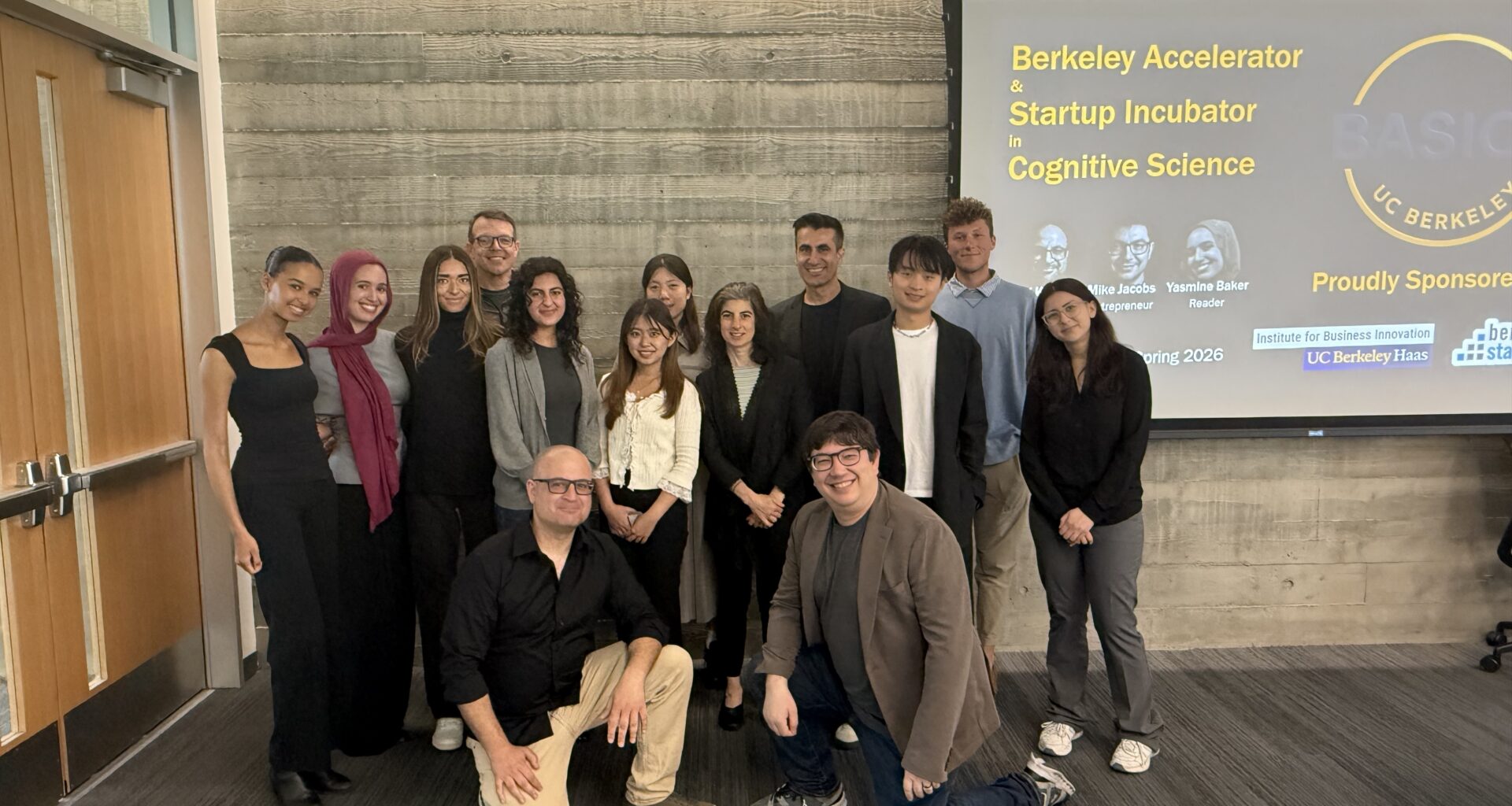
From AI-powered social media content creation to college access platforms, cognitive science student entrepreneurs pitched their startups to potential investors at the Berkeley Accelerator & Startup Incubator in Cognitive Science (BASICS) Spring Pitch Day.
Students presented ventures developed through the BASICS course to a panel of investors and startup experts including Erik Leklem, regional operations director at the Institute for Security Governance; Oguzhan Aygoren, director of the Institute for Business Innovation at the UC Berkeley Haas School of Business; Elizabeth Redman Cleveland, chief strategist of sustainable growth at the City of Berkeley; and Mike Jacobs, a sociology alumnus, entrepreneur and founder of the BASICS program.
Cognitive Science student Naomi Toubian presented her venture, Cognitive Calendar, an AI-powered personalized scheduling platform. She was inspired to create the project after starting college and realizing she felt unprepared to manage all of her responsibilities on her own, having previously relied on her parents to handle most tasks.
“Suddenly, I was responsible for all of my success and all of my schedules, and I was struggling with being overwhelmed, procrastinating and chronic overload,” she said.
Through daily questionnaires, Cognitive Calendar suggests schedules and to-do lists based on users’ mental and physical wellbeing, workload and deadlines. It also tracks cognitive trends and aligns recommendations with natural dopamine cycles to help users build healthier, more sustainable productivity habits.
Another venture, Bobby Pin, presented by cognitive science and data science student Maya Mitchell, offers an AI-powered video editing app for hairstylists that automates the creation of social media content.
“Social media is now becoming a full-time job for hairstylists,” Mitchell said. “What once took less than one hour a week is now costing over six hours a week of work time.” Bobby Pin allows hairstylists to reclaim their time by using a proprietary model trained to understand high-value video content, producing videos designed to truly engage audiences.
For psychology and political economy student Jessica Miller, her venture, Breeze, was born from being misled that her favorite chocolate bar was being banned from the UK. The app is an AI-powered bias detection tool that allows users to paste text into the platform, which then automatically examines it for bias and misinformation.
“In a world where information is power, the content we consume is often shaped by bias, manipulation and out-of-context information,” Miller said. “This is a huge issue for reputation and can result in massive financial losses.”
Other pitches included TheseDays, created by design graduate student Claudius Ma, an AI-powered app that organizes users’ uploaded photos into “chapters” of their life; and New Nav, an AI-powered college-readiness platform that provides 24/7 AI counseling and personalized roadmaps for incoming students, with a focus on first-generation and immigrant students unfamiliar with the higher education system. It was created by cognitive science and data science student Mina Sonmez, who was inspired by her own experiences as both a first-generation student and a volunteer academic counselor for high school students.
Sonmez said her own academic journey was often isolating because her family was unfamiliar with the college system, leaving her to navigate critical decisions with limited guidance. Later, while counseling students, she noticed many faced the same uncertainty and confusion.
“The more I connected with them, the more I realized that my experiences and feelings of self-doubt were not unique to me in the slightest,” she said.
Through her counseling work, Sonmez found that many students were overwhelmed not by a lack of information, but by an abundance of it. While college preparation resources are more accessible than ever, she said students who do not understand the system often struggle to determine which advice applies to them, increasing stress and making the process feel even more daunting.
“I built New Nav because I was that student, and now I want people like me to feel included,” she said.
New Nav addresses this gap by providing personalized guidance and step-by-step roadmaps tailored to each student’s goals and circumstances. Through beta testing, Sonmez has been able to further refine the tool according to real student feedback, tailoring it to preferences such as visual engagement and humor.
BASICS is a hands-on course that blends cognitive science theory with applied entrepreneurship. Students explore how people think while using AI tools to develop startup ideas, leaving the course with practical skills and tangible business plans they can carry beyond graduation.
“The barriers for entering tech have never been lower,” Uri Korisky, one of the program’s instructors, said to the BASICS students. “In order to be a CEO, you never had to be a tech guy — but you guys are perfect for it, because you know how people think.”
The BASICS team is currently developing a digital platform that will expand access to the program, allowing any UC Berkeley student to take the course online and engage with an alumni and founder network.