
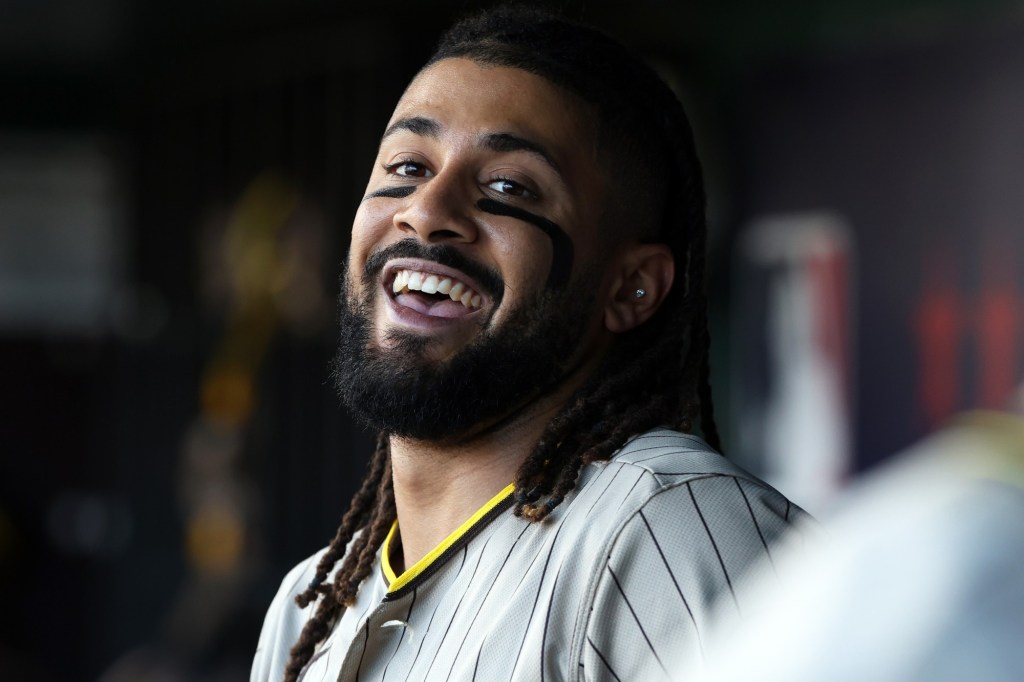
Has Fernando Tatis Jr. become as good a second baseman as he is a right fielder?
“Yeah,” Tatis said Wednesday. “There’s no doubt about it.”
“Yes,” Craig Stammen said.
It’s quite something to ponder.
As a right fielder, Tatis earned two Platinum awards as the National League’s best defender at any position.
At second base, he played in just 38 games going into his start there Wednesday.
While it would take many more games at second base to sway voters, the former shortstop’s gifts and sweat have translated into high-level play at the “lesser” middle infield spot.
“He does things that other guys can’t do,” said Padres infield coach Ryan Goins, a former second baseman and shortstop.
After Stammen gave Tatis, 27, his first career start at second base on April 11, it wasn’t long before he put his own winning stamp on a new position.
Shortstop-side groundballs, coupled with the bunched-up-the-middle emphasis on infield defense in this era of baseball, have revealed a Tatis skill that’s best appreciated in person.
The 6-foot-3 speedster is turning shortstop-side groundballs into outs by several feet.
“It’s just arm strength, athleticism,” said Goins, a big leaguer from 2013 to 2020. “He’s like a superhuman. It’s just fun to see the things he can do.”
Chasing down bloopers was an expected speciality, because Tatis feasted on those plays as a shortstop.
His outfield experience has further refined those efforts, such as two homestands ago, when he blazed far for a flyball to shallow center and gloved it with an over-the-head basket catch a la Willie Mays in the 1954 World Series.
Most importantly, he’s much steadier at second base than he was as a young shortstop who’d been fast-tracked to the big leagues.
“He’s been just really solid at the routine play,” Goins said. “With nobody on, making plays, making it look easy, picking hops, taking good angles – he’s done everything you can ask for.”
When Stammen and staff dared to move the majors’ best right fielder to second base, it was strictly for a situational role meant to increase the roster’s flexibility.
But following Jake Cronenworth’s trip to the injury list on May 5, where the veteran second baseman has remained due to concussion-like symptoms, Tatis earned regular duty at his new spot.
“He said, ‘What if I won a Platinum at second and I won a Platinum at right field?’ ’’ Stammen said. “I said, ‘Yeah, you’d be one of the best defenders of all time.’ ’’
The position change’s fallout hasn’t borne fruit across the board.
The Padres have seen baserunners take liberties against Tatis’ replacements in right field that they would not have taken against Tatis.
But the change has paid off on several levels, benefiting the team on balance.
The success began here: Stammen and staff saw that Tatis, like Mookie Betts, had the athleticism, mental game and desire to make this kind of positional move work out.
A Gold Glove right fielder, Betts has become a premier shortstop, helping the Dodgers win two World Series titles since he went to the infield.
By becoming an ace second baseman and continuing to play right field well, too, Tatis has improved Stammen’s options when making out the starting lineup and adjusting within games.
One of dozens of examples played out in Monday’s 1-0 win against the Braves.
After No. 2 shortstop Sung-Mun Song ran for Will Wagner and replaced him at second, righty Jase Bowen batted for the lefty Song. Accommodating that move, Tatis went to second base so Bowen could play right field.
Among all second basemen, Tatis ranks tied for eighth in outs above average. That’s a lot better than it may appear. He’s played far fewer games than the leaders. And he’s new to second base, while continuing to pull duty in right field.
“As soon as he went to second base, he was as good as anybody in the league,” Stammen said.
“I’m definitely getting better there,” said Tatis, whose throwing error Wednesday was his second in 311 innings at the position. “I’ve been working on it. I’m trying to stay sharp and clean. Definitely, I’ve improved with the more reps I get and the more situations I get during games.”
It has been theorized that Tatis’ return to the infield, where the game is much faster, has benefited him as a hitter.
“I wouldn’t say it’s made me a better hitter,” said the leadoff man, who has batted .366 with 41 hits since May 24. “But in the infield, you’re just more in the game, in the groove. It’s quicker. You have more situations and stuff to do. It’s just a little bit more involved.”
The Padres stand this summer to regain Cronenworth, a good fielder who had a career-best .367 on-base rate last year but had a poor offensive start to this season.
Regardless of what comes of Cronenworth’s return, the Padres now have more positional versatility. And having a two-position star in Tatis can only broaden A.J. Preller’s options when he looks to add positional players.