
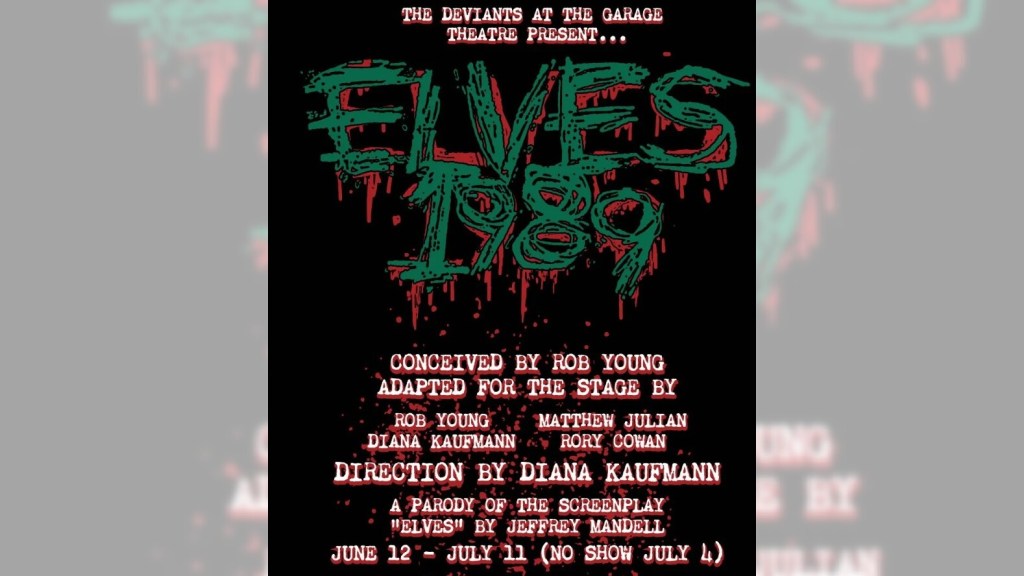
Before it was a Garage Theatre production, “Elves” was a 1989 independent horror movie built for the kind of marketplace in which a title, a monster and a sufficiently deranged poster could do most of the selling. It had Dan Haggerty as a disgraced cop turned department-store Santa, a Christmas setting, neo-Nazis, occult breeding rituals, and a demonic elf.
In other words, it was made because someone correctly understood that “Nazi Christmas elf horror movie” is a sentence people might rent on purpose.
It is not a good movie. But it is a distinctly bad movie: a cheap, confused, ugly little exploitation artifact whose incoherence has, over time, become its only real charm.
That should have made it ideal Garage Theatre material.
This is, after all, a company with a history of knowing how to have fun with theatrical trash. The Garage has staged parody before, including “Love, Thunder, & Dynamite: A Roadhouse Parody”, and it has returned for years to its own rambunctious holiday melodramas, where audiences are invited to boo villains, cheer heroes and participate in the deliciously low-stakes contract of theatrical excess.
The Garage knows camp. Or at least it has known camp, the particular alchemy by which bad taste becomes style, limited means become invention, and absurdity becomes a reason to lean closer rather than check one’s watch.
Which makes “Elves 1989” less infuriating and more sad.
There is a version of this production that should have been a local cult event. The source material contains all the raw ingredients, such as Christmas commercialism as a pagan ritual, family trauma dressed up in tinsel, fascist bloodline fantasies, a mall full of false cheer, and a monster movie too broke and strange to hide its own seams.
A smart parody might have used the film to tease out some sort of grotesque logic behind all of it. It could have made the original movie’s fixation on purity, control and the supposedly sacred family both funny and queasy.
Instead, the adaptation mostly gives us the movie… again.
That is the central confusion of “Elves 1989.” It never seems to know what it is parodying. It knows the film is ridiculous, outrageous and that a heightened tone can produce a laugh. But it rarely goes beyond the first, easiest level of recognition. The show repeatedly says, in essence, “Can you believe this happened in a movie?”
Yes. We can. That was the premise when we bought the ticket.
A parody has to do more than reenact foolishness. It has to make us see the foolishness differently. It has to exaggerate with purpose, mock with precision, or turn the original inside out until some new joke, insight, or criticism falls out.
Here, the jokes often feel pasted on rather than excavated from the material. The evening has energy, certainly. It has performers willing to throw themselves into the fray. It has noise, movement, blood, heightened reactions and enough activity to suggest that everyone involved worked very hard.
But hard work is not a point of view.
The adaptation’s most persistent problem is that it remains too loyal to the mechanics of a film script. Movies can jump from the woods to a house to a department store in the time it takes an editor to blink. Theater cannot.
The set is meager, which is not itself a sin; the Garage has made fine work with very little before. But every change of location becomes a flurry of furniture and set movers, and far too much time is spent watching the production rearrange itself.
That might have become a joke. The same exhausted stagehands might have turned it into a running gag, a visual reminder that this entire story is being held together by tape, tinsel, and bad decisions. Instead, the pauses simply flatten the momentum.
There are flashes of the old Garage spirit in the sheer willingness to embrace something tasteless and bizarre. But camp is not merely vulgarity, violence, or the presence of people in strange costumes — or lack thereof — behaving with conviction.
Camp is craft. It is timing. It is knowing exactly when to push, when to pause and when to let the audience in on the joke. This production seems to confuse broadness with boldness and commitment with comic escalation.
And the clearest symbol of that missed opportunity arrives in the final choice of monster. The original movie’s terrible latex elf — that gloriously pathetic rubber creature, the very sort of bad effect a stage parody could turn into comic gold, has been replaced by a well-painted, creepily cute, eventually nude young man.
A goth twink is not automatically a bad theatrical choice. But here, he is simply a more attractive substitute for a joke the production never bothers to make. But, ya know what? Theater is hard. Parody is harder. So throw ’em a bone…go see it anyway.
If you go
Where: The Garage Theatre, 251 E. 7th St.
When: Through July 11. (No show on Fourth of July).
Cost: General admission tickets are $28.
Info: thegaragetheatre.org.