
Asked whether that connection need be scientifically grounded, Moores says yes, but it also includes a need for nonquantifiable links such as ethics or feelings of beauty and awe. Earth is the basis of our life, he says. “There’s a saying: If you can’t grow it, you have to mine it. Everything is dependent on soil.”
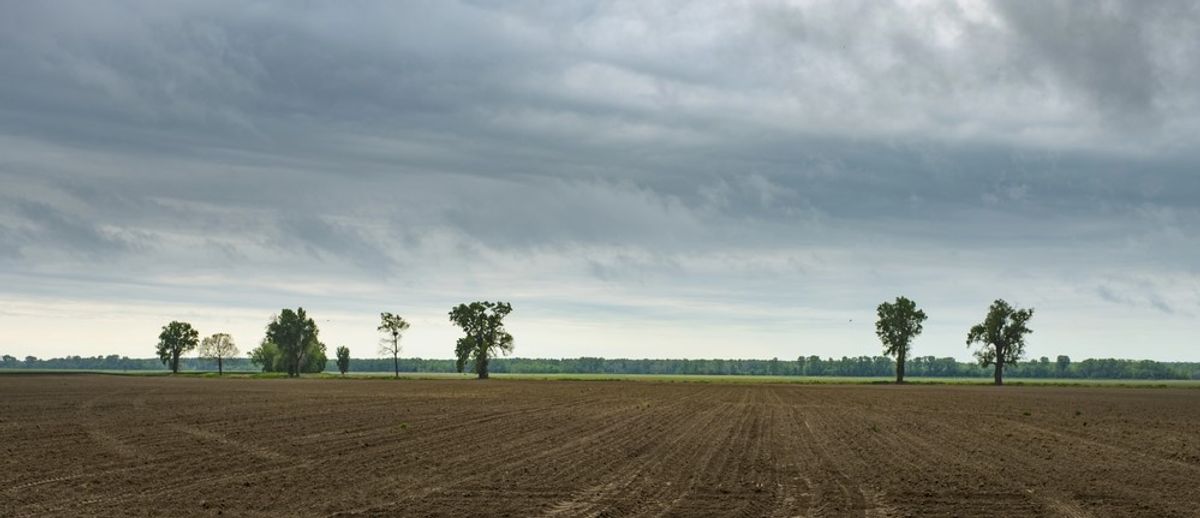
Coming to the piece of soil that concerns this visit, Moores pulls out a digital relief map of California topography. “You can see the Valley’s almost as flat as the sea itself. This is much flatter than the Great Plains. The Valley was created by the uplifting of the coastal ranges and the Sierras millions of years ago.”
With one hand pushing in from the coast and the other pushing in toward the valley from the Sierras, Moores says, “This coastal area is a where the hills are coming up very rapidly, moving eastward and rumpling up the west edge of the Valley. At the same time faults in the Sierra are tilting westward.”
I ask Moores how quickly the coastal ranges are doing this “rumpling.” “Oh, on about an average of two millimeters a year.” Starting to feel claustrophobic, I inquire, “Does that mean the Valley will one day disappear?” Very possibly, he confirms. How soon? Moores makes a quick calculation: “Oh, in about 50 million years.”
When I ask whether something can’t be done to stop this, Moores and his wife laugh heartily. I’m starting to miss the Valley already.
“Still,” Moores proceeds, “the question is, why is the Valley like that? Why is it so low while everything around it is coming up?” This was a question I didn’t even think could be asked.
As it turns out, Nicola Godfrey, a young Englishwoman doing her dissertation at Stanford, had just this past December published what appears to be the definitive answer to that very question. Underlying the Valley is a “basement,” half of which is an extension of the Sierra, half of which is called the Franciscan melange, coming in from the west. For decades this “basement” has exuded a “magnetic anomaly”—that is, a magnetic force which is typical of ocean floor rock, but not the continental shelf rock under the Valley.
Through a series of experiments, which included placing plastic explosives in the ground and measuring their force with seismic meters, Godfrey showed that a large slab of ocean rock material—called ophiolite—sits on top of the continental shelf, from Redding to Bakersfield. Since this ocean rock slab is heavier than the other, it prevents disturbance of the valley floor from below.
“For the first time, we understand why the Valley is here,” Moores says. Without that ocean slab intersecting between the valley floor and the continental shelf, the Valley would probably have a lot more irregular features, like hills and dales, throughout.
A couple of weeks after this visit, Moores was to guide me on a trip to Lake Berryessa, where the ocean rock material can be seen, uplifted by the coastal ranges and sitting vertically to the Valley.
But before I left Eldrige and Judy Moores, I had to ask how they personally had responded to coming to the Valley in 1966 from Princeton, N.J., and New York. Eldridge, who grew up in the Arizona desert, found it oppressive at first, “the flatness, the lack of a place to get up and look out.” Judy says that she went through a period of “bereavement. The feelings of missing the autumnal colors, the change of seasons, were that strong. I was in a state of mourning.”
Both agreed that they had come to love the Sacramento Valley. But it was a matter of adjusting to the subtleties of the changes.
I left the Mooreses thankful to know why the Valley was here and awestruck by the prospect that one day it would not be. Already, I was seeing the the flatness differently. As Moores had told me during our field trip, “If you know how to read the landscape, it tells you its story.”