
Summer is in full swing in Long Beach – with events and community celebrations happening citywide for residents and visitors to enjoy.
And public safety remains a top priority for city leaders during this time. Violence, particularly shootings, often surges in the summer months, according to researchers who looked at shootings in 100 cities over a six-year period. A combination of factors, such as warmer weather bringing more people outside to socialize, an increase in social events, and students being out of school, can increase the chance of conflict arising.
But last year, Long Beach experienced its “safest summer” in the past five years, and city officials say they are anticipating the trend to continue this summer.
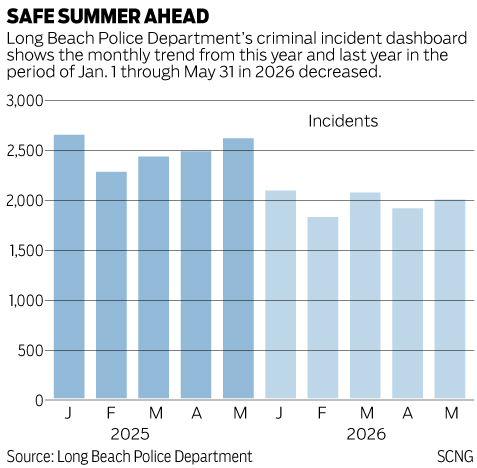
City leaders recently pointed to a 21% decrease in violent crime in the first five months of 2026 compared to the same time last year, as well as continued violent crime prevention strategies and staffing progress in the Police Department, as ways a “safe summer” this year may be possible.
“It’s great to see the correlation that connects our focus on staffing our city, hiring public safety and civil service, and the direct outcomes to seeing this trend of crime reduction continue into 2026,” Mayor Rex Richardson said in an interview. “Last year, we saw a five-year low in violent crime in our city. The data has shown that the trend has continued in the first few months of 2026.”
Reported offenses from Jan. 1 to May 31, according to the LBPD criminal incident dashboard, show an approximately 9% decrease in crimes against people, a 27% decrease in crimes against property, and a 14% decrease in crimes against society compared to the same time last year.
“We’re seeing continued reductions in most crime categories, and those are year after year reductions in some of the most violent crime categories, like murders and gun violence or gun crimes,” Long Beach Police Department Chief Wally Hebeish said in an interview last month. “We’re also seeing reductions in robbery, vehicle theft and residential burglary. This is exactly what I want to see as we start approaching the summer months: a trend downward and continuing to work our strategies and operations to address crime. We’re looking pretty good moving into the summer months.”
There were, for example, eight homicides so far this year compared to 12 in the same period last year, according to the LBPD — which is a 33% decrease. For residential burglary, there have been 351 this year, compared to 379 last year in the same period, a 7% decrease.
This continued reduction in violent crime for the last five years has allowed the Police Department to focus and utilize resources on addressing other areas of community needs, Hebeish said.
Take human trafficking, for example. While human trafficking remains rare — two offenses this year compared to one at the same time last year — the City Council, with support from several city departments, including the police department, has taken steps to increase efforts to address human trafficking and public safety concerns in North Long Beach along Long Beach Boulevard.
But crime trends change throughout each police division across the city based on various factors, Hebeish said. Each division commander is tasked with addressing those crime trends and the police chief sets the mission and vision for the entire city, he added.
“If you break down the different geographic divisions, each one has different issues,” the police chief said, “but we adjust to those and try to lean on one another within the organization to address various issues that pop up.”
In the North Division, one of the focus areas is commercial sex work and human trafficking. In the South Division, there is the entertainment district of downtown Long Beach, and in the East Division, there is the coastal dining experience of Belmont Shore and Second Street.
“Obviously, we’re not going to use the same tactics and strategies to combat commercial sex work as we would to combat intoxication in public related to entertainment or something of that nature,” Hebeish said. “Overall, all of the divisions are seeing a reduction in crime, so I’m very happy about that.”
City leaders attributed the decrease in violent crimes to Police Department staffing and continuing to invest in violent prevention programs, such as the city’s “STRONG Beach” initiative that expands summer youth opportunities. Long Beach has gone from a 26% vacancy rate in the Police Department to 13%, Richardson said.
“We have cut our vacancy rate in half by focusing on hiring and bringing on 248 police officers in the past three and a half years, which hiring at that pace has never taken place in the history of our city,” Richardson said. “It shows that when we focus, we can deliver results.”
It was the resilience of those working at the Police Department that contributed to being able to address public safety in Long Beach, Hebeish added.
“Crime is fluid and you have to be adaptable and adjustable and I think that’s the department we are, in continuing that model and having the right people in the right place is instrumental in reducing crime,” the chief said, “and we’re seeing the results of that because of the people who work in this organization.”
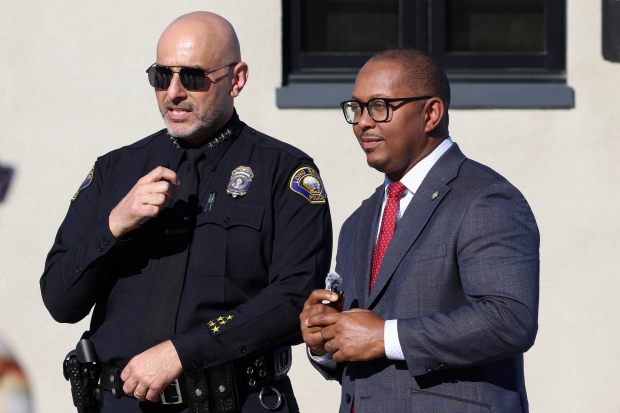 Police Chief Wally Hebeish, left, and Mayor Rex Richardson greet the media on Saturday, Jan. 10, 2026, at the grand opening and ribbon-cutting of the newly completed Long Beach Police Training Academy in Long Beach. (Photo by Howard Freshman, Contributing Photographer)
Community-based organizations also play a critical role in addressing community needs, building trust and advancing public safety. ONE Long Beach Collaborative, for example, brings together more than 30 community organizations, institutions, agencies, advocates, researchers and residents to advance a coordinated, community-led approach to violence prevention and long-term public safety in Long Beach, organizers said.
Reestablished in 2023 by Centro CHA, the ONE Long Beach Collaborative has strengthened community-based violence prevention through intervention, youth development, victim services, workforce development and healing efforts, said Cindy Sahagun, community violence intervention and prevention program coordinator at Centro CHA.
Sahagun presented the collaborative’s community violence intervention data and safety report roadmap to the City Council during its June 9 meeting. ONE Long Beach recognizes community safety is a collective responsibility, she said, and the report was developed by and for the community through deep collaboration grounded in the lived experiences of those impacted most by violence.
“While the city has reported an overall decline in violence in recent years, lived experience in historically impacted neighborhoods remains significant,” Sahagun said, “with Long Beach experiencing 20 days of violence in May of 2026 alone.”
To reduce community violence, Long Beach must invest in coordinated long-term strategies rooted in holistic community-based solutions, Sahagun added, and the city’s progress depends on a sustained investment in those solutions. Organizers said that local and state leaders have to work to offset federal funding cuts for community violence intervention by increasing support and investment, while philanthropic partners also help diversify resources.
“As many public health and violence prevention frameworks remind us, safety is not simply the absence of violence,” Sahagun said, “but the presence of justice, opportunity and conditions for people to thrive.”
Richardson agreed. Violence is a public health crisis, the mayor said during the council meeting, and the city has to work together with community partners to prevent violence in Long Beach. The mayor once again shared that last year was the city’s safest summer in five years, and that was because of the community and city working together to invest in violence prevention strategies.
“I can understand if a resident may feel frustrated if their daily experience doesn’t match the overall crime data,” Richardson said in a recent interview. “That’s why we have to continue to work until the experience in every neighborhood, every part of our town matches what the overall data is telling us.”
To help Long Beach residents feel safer in their neighborhoods and communities, Hebeish said, the Police Department has to not only reduce crime but also enhance safety – which is done through building trust with people, he said.
“Statistics are one part of policing,” Hebeish said. “It’s trust, it’s relationships, it’s recognizing and acknowledging when someone doesn’t feel safe, because they’re directly impacted by something.”
This summer, the Police Department is once again partnering with other city departments, such as the Parks, Recreation and Marine Department, to provide programming for youth and community engagement, Hebeish said.
“We’re heading into the summer with great momentum on safety, with a focus on engagement in our community,” Richardson said, “and we’re not going to remove our focus on safety until everyone’s daily experience really matches the data.”