
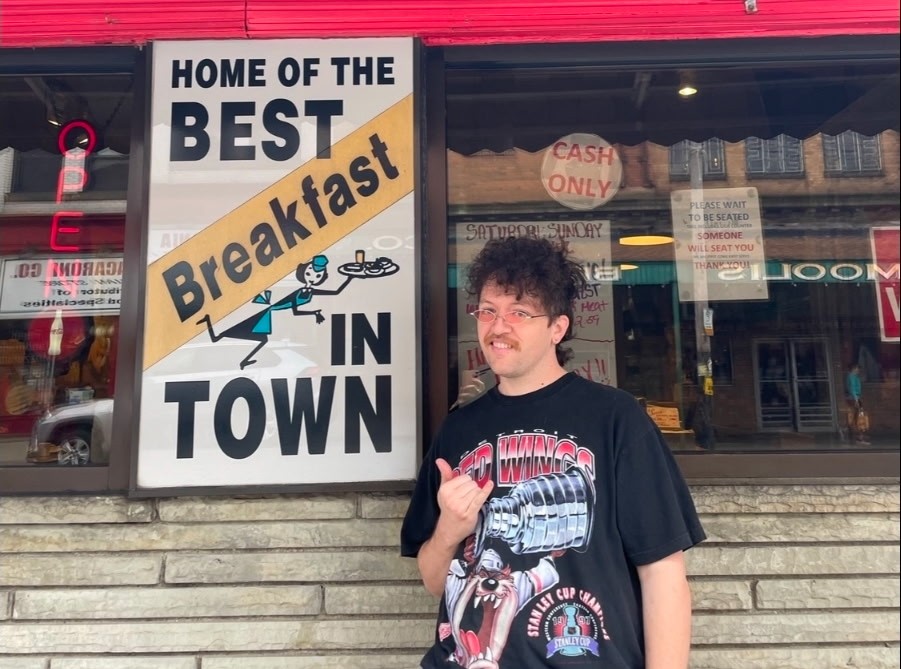
In recent years, the Los Angeles food scene has largely become known for restaurants covertly hiring influencers for TikTok, pop-ups with egregiously long lines and overpriced small plates are what the Los Angeles’ food scene has become known for.
Also, the closure of long-time L.A. institutions Angelenos have frequented for decades.
Practical Historian and native Angeleno Jake Hook has documented these sorts of classic L.A. dining spots for around three years. After finishing his PHD in New York, Hook traveled across the country from New York to the San Francisco area by car and became fascinated with America’s most identifiable roadside attractions: classic diners.
In 2023, Hook started his Instagram account @dinertheory to document these institutions across Southern California. His account, adorned with photos of neon signs and dark old-school Hollywood interiors, includes detailed captions about an establishment that are honest yet empathetic. From East-meets-West celebrity hangouts like Formosa Cafe, to midcentury relics like Cindy’s Coffee shop, Hook has documented it all.
“The Formosa was one of the most popular of these landmarks, but its reputation was as a place where the rich and famous could sort of lay low. While spots like Perino’s or Chasen’s was where celebrities went to be seen, the Formosa was where they let their hair down and relaxed over mai tais and Chinese food.”
That said, Hook doesn’t really do much influencing. His fascination with documenting restaurants goes back at least a decade. He began keeping a list of places he wanted to try, or had already tried and enjoyed, and shared it with his friends. They urged him to use this information for good, so during the COVID-19 pandemic, he created a map marking locals’ favorites, cult classics and what he deems “101 L.A. legends.”
“All these places were closing and I wanted to, once I was able to go out, experience these places,” Hook said. “I wanted to track the ones that were still open.”
Everything Changed After 9/11
When Hook isn’t sitting on some form of a leather cushion at home or a restaurant, he’s off teaching at a job completely unrelated to porcelain plates and country fried steak: associate professor of philosophy at California State University, Fullerton. Although not explicit, you can tell how the study influences the way he observes dining history.
Scroll to continue reading
Hook has a (sometimes) strict pre-21st century policy when it comes to reviewing restaurants. He claims that the way that people relate to food, restaurants and culture has “dramatically changed with the course of the internet.” And it’s not in a good way.
Hook attributes the homogeneous character of uncomfortable chairs, white walls and exposed brick seen in so many restaurants these days to the shift in culture after the 2001 New York terrorist attacks.
“There was a turning point [with] 9/11 where culture in America became wildly distorted from what it was before,” Hook said, citing his argument to the work of theorist Mark Fisher.
On the other hand, he added, the 21st century became heavily nostalgia-based, and it soon bled into dining culture.
Careful not to further beat a dead horse, Hook spoke about how some restaurants like Donna’s in Echo Park lack authenticity. While he doesn’t think the food is inherently bad, it attempts to capture the feeling of what a homestyle Italian red-sauce restaurant looks like. However, he says, the difference with Donna’s is that there isn’t anything Italian about it.
“There’s no Italian family behind it, you don’t even have a nona in the kitchen,” Hook said. “It all feels focused, grouped. [It’s] what people would want to see from something like that without really an understanding of why that image exists in the first place.”
In this case, it really isn’t about the food, but what the food is trying to convey. In some regard, the same goes for diners. The difference is a diner and many other historic eateries aren’t going to try and convince you it’s the best thing you’ve ever eaten. A trendy restaurant will.
“I’m interested in looking for the inspiration behind [the restaurant], the things that really have that substance,” Hook said, recounting the tacky sock-hop diners from the ’80s during his travels. “It always comes down to the personal human touch, the guy who doesn’t know how to paint, hand painting his sign for his restaurant just because it’s out of necessity.”
Historically, Diners Are Political
During the Civil Rights Movement, young Black men and women conducted “sit-ins” as a form of nonviolent protest. Waitressing in diners became a viable option for women to make money. Politicians making their campaign rounds are usually pictured enjoying a full American breakfast while chatting with the everyman blue-collar worker. Hook argues that diners hold just as much historical significance and influence on society as any other cultural institution.
However, they’ve lost popularity over the years. There isn’t one overarching reason as to why this may be, but instead a number of factors, including: chain fast-food on every corner, increased access to delivery, rising costs to dine out, dishes with debateably-deserved social media hype or the demographic of a neighborhood changing.
Hook attributes one of the reasons that these institutions lack business is that regulars have disappeared, that there isn’t the same micro-community mentality anymore and loyalty isn’t what it used to be.
“Diners are really a kind of living museum of American culinary history,” Hook said. “It’s just a place where you can kind of slow down and gather with people, it’s a unique third space.”
To combat this alienation, Hook started the Diner Preservation Society, a monthly association where individuals meet up to patronize a classic L.A. institution. The society is a mix between an advocacy group and a supper club, although leaning more toward the latter than the former. Its purpose is to bring that community back to diners while learning about why the business is important to L.A.
“The diner contains a lot of promise and a lot of potential, and to that extent that we’re all still grappling with alienation and loneliness, I think the Diner Preservation Society can help fund a place for yourself in the modern urban landscape,” Hook said.
The Unspoken Language of Who Really Belongs
Incongruous restaurants, coffee shops or bakeries popping up across L.A. is not inherently a bad thing, but it does send a message. Unfortunately, it isn’t about bringing wealth into the neighborhood by means of overpriced seared cabbage, but instead, signaling to those who can afford it, “Hey, you belong here. They don’t.”
One restaurant in particular, Hook says, that portrays this vibe is Sqirl, the trendy Virgil Village cafe that rose from the ashes after its 2020 moldy jam scandal.
“If outlets that just a few short years ago were willing to condemn the restaurant for their refreshingly relaxed, easygoing approach to food safety are wowed enough to change their tune, perhaps this little bistro is worth revisiting after all.”
“You can do whatever you want to bring people in, but the way you designed your restaurant contains nothing familiar to the people who lived in that neighborhood before [gentrification].”The working Salvadoran mother could go in and buy some toast, but they don’t. Why is that? Part of it is because it’s expensive, and part of it is the visual language of the place.”
In other words, Hook argues that places like Sqirl communicate to longtime Angelenos that this place isn’t for you. You can come, but just know it isn’t for you.
“Nothing about Sqirl is intentionally saying, ‘Previous residents, you’re not allowed to come here.’ But they don’t, and I think there are very identifiable reasons for that,” Hook explained, not wanting to harp too much on transplants.
The difference with classic diners, he says, is that they are explicitly catered for the neighborhood they reside in, and oftentimes evolve with the neighborhood. While diner food is usually considered to be pancakes and patty melts, it would be difficult to find a diner in Los Angeles that doesn’t serve chiliquilies.
The “I Am The Gatekeeper That Lets You In” Mentality
Hook doesn’t believe in hidden gems because a seemingly off-the-beaten-path place to one person is another local’s go-to spot for years. He noted that people are conditioned to relate to food as a way of interacting with a community, but the extent of their interaction ends after they pay the check at establishments not neighborhood-minded.
“You might not spend much time in the community walking around, patronizing local businesses or talking with locals,” Hook said. “You’re just there to tick off the box, take the Instagram picture and get out of there.”
Because of this mindset, people overlook the commerce diversity L.A. has to offer. That said, Hook noticed that people are no longer afraid to go below the 10 freeway, something that was once unthinkable for L.A. yuppies.
Additionally, he says that people are more willing to branch out, and that they’re “not afraid of their neighbors anymore.” Unfortunately, it isn’t enough. “It’s still fairly surface level engagement that ultimately plays a role in gentrification, if [a restaurant] becomes about the hotspot and not about the community which it originally served.”
Hook isn’t a pessimist and does believe it is okay for a neighborhood to change. However, when something evolves, it still has the remnants of what it once was. New diners interacting with longtimers is a good thing — just don’t pretend you discovered where to get the best fried fish in the city.
Out of the hundreds of places Hook has patronized, he finds himself consistently returning to Original Tommy’s off Beverly Boulevard. He also has a mission to try every item on Musso & Frank’s menu (which, unfortunately for him, includes calf’s sweetbreads). And if you are interested in saving old-school L.A. and meeting the diner connoisseur himself, consider checking out his Diner Theory Instagram and the Diner Preservation Society. You may just find your new spot to become a regular.