

San Francisco’s Hispanic population is growing faster than any other large racial or ethnic group in the city, according to newly released U.S. census data.
From April 2020 to July 2025, the number of people identifying as Hispanic or Latino in San Francisco grew from about 138,000 to 142,500, an increase of more than 3%. During the same period, the city’s overall population declined, and nearly every other major racial or ethnic group shrank. The only other group to grow was people who identified as two or more races.
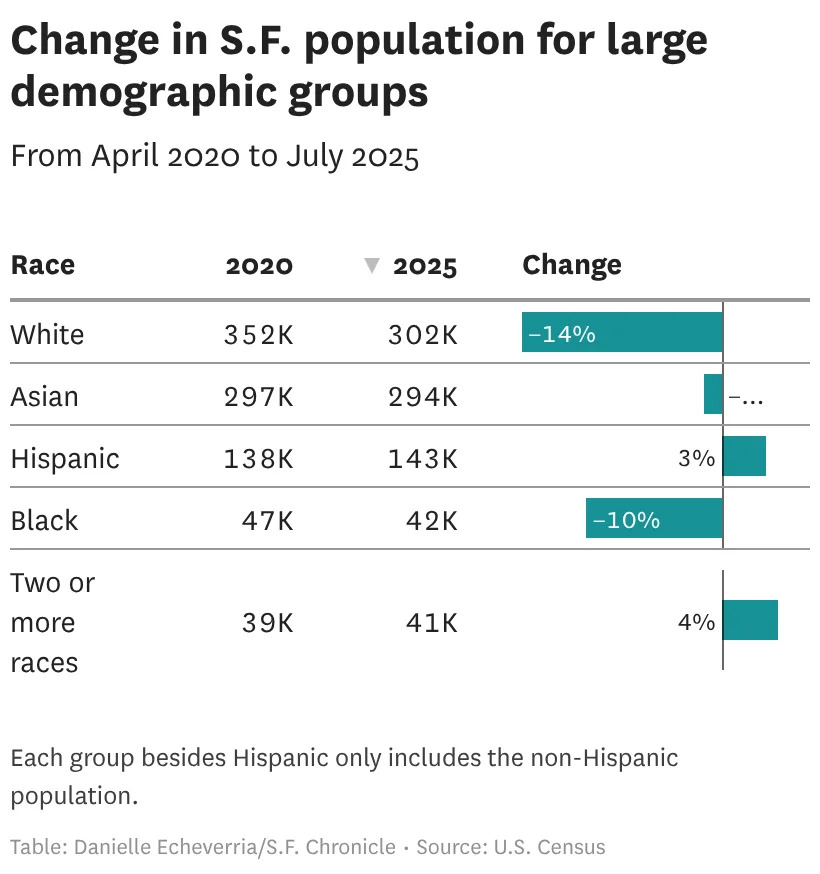
The census does not treat Hispanic origin as a race. Instead, people of any race can also identify as Hispanic. To avoid double-counting, the Chronicle analyzed Hispanic residents of any race as one category and excluded them from counts of other racial groups, an approach commonly used by demographers.
While people of Hispanic origin saw the largest numeric increase since 2020, both people of Asian descent and those of two or more races saw increases as a share of the city’s total population.
Though there are fewer total non-Hispanic Asian people compared to 2020, they made up 35.6% of San Francisco’s population in 2025, compared to 33.9% in 2020, inching closer to becoming the plurality group in the city. The number of people who identify as two or more races increased very slightly in raw numbers as well as a share of the population, going from 4.5% to 4.9%. The non-Hispanic white and Black shares both fell. The American Indian, Native Hawaiian and Pacific Islander populations were too small to show meaningful changes.
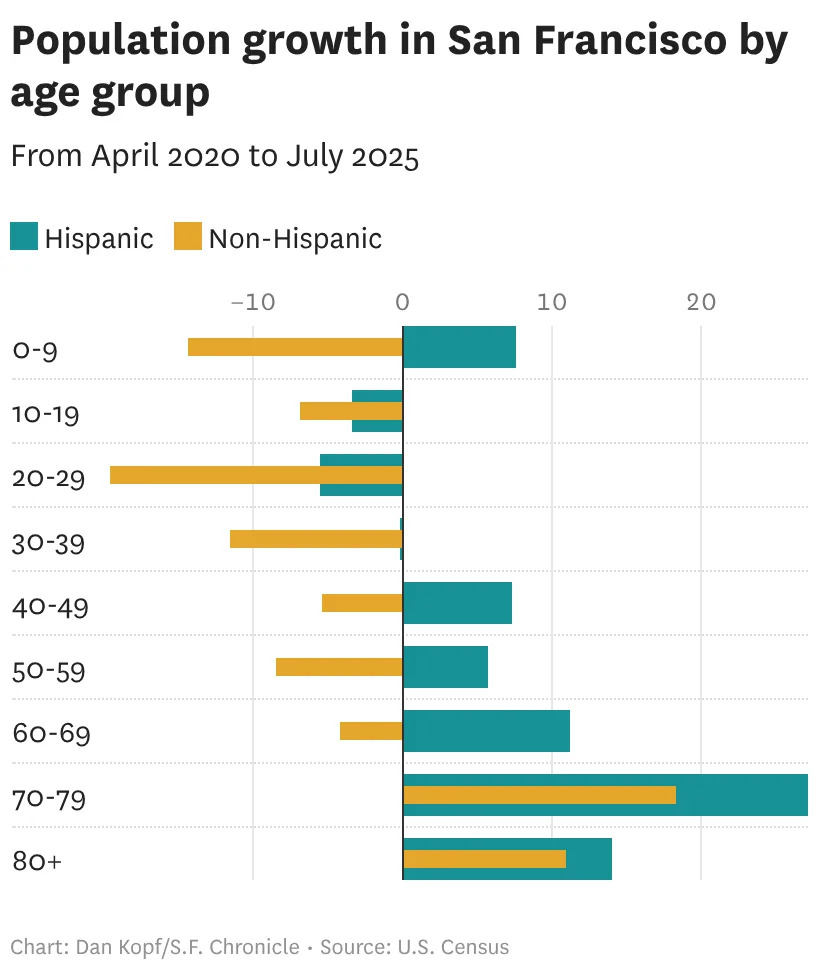
The rise in the Hispanic population is fueled by large rises among both young children and middle-aged people, the Chronicle found. Over the same period, the number of Hispanic children under the age of 9 in San Francisco increased by 7.6%, while the same age group in every other race declined. Similarly, the number of Hispanic people in their 40s, 50s and 60s saw increases, while the same age groups saw declines in other major racial groups.
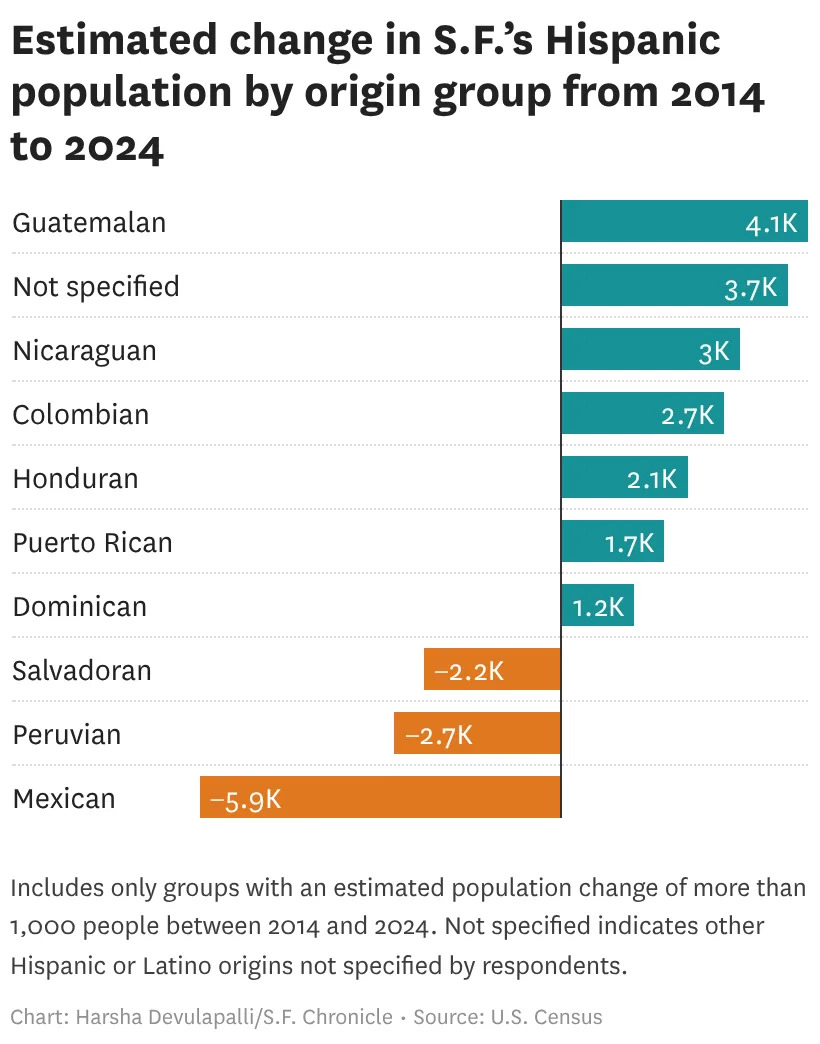
The makeup of San Francisco’s Hispanic population has also changed over the last decade. Data from the American Community Survey, an annual census survey that asks more detailed population questions, shows that the number of Hispanic residents who identify as Mexican had decreased as of 2024, while the number from Central American countries such as Guatemala, Honduras and Nicaragua had increased compared with 10 years earlier.
Meanwhile, all racial groups continued to see a decline in people in their 20s, with the exception of multiracial, which saw a 1.7% increase. And on the flip side, all racial groups saw increases in the number of people in their 70s and 80s – part of a broader trend as the Bay Area’s population ages.
Subscribe
There’s more to San Francisco with the Chronicle. Subscribe today for just 25¢.
This article originally published at This ethnicity is growing fastest in San Francisco.