
The sounds, images and fears of war are not usually seen as materials for art. Survivors’ memories, echoes of past trauma and hopes are often things that they try to get past and forget.
Instead, for some they can be used as tools to connect with and educate others, preserve history and heal.
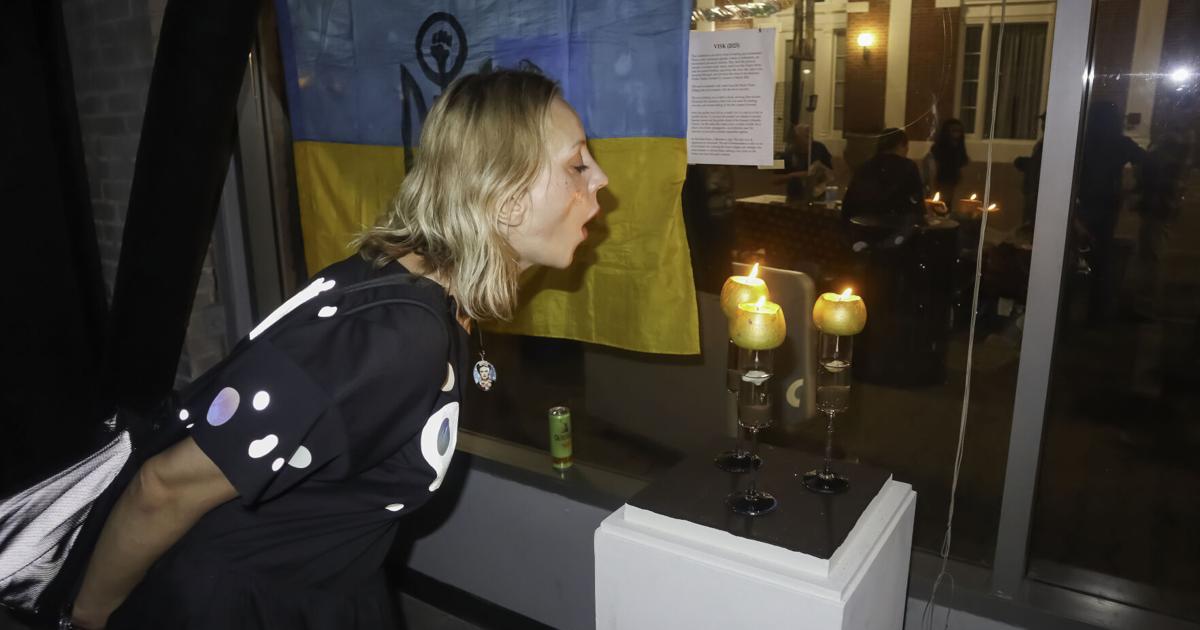
Diana Berg fused the sounds of sirens, explosions and missiles flying overhead along with symbolic sculptures and rituals to take visitors through the journeys, testimonies and realities of war at her pop-up exhibition at Grand Central Art Center’s storefront artist-in-residence studio space in Santa Ana on Saturday.
Berg, a conceptual artist, activist and curator, was displaced from both Donetsk and Mariupol during the ongoing Russian invasion of Ukraine and is now living in Kyiv. Her exhibition, “The Alchemy of Memories and Traumas,” is the result of a one-month residency at the center, a part of ArtsLink International Fellowships, a CEC ArtsLink program supporting transnational arts and social practice.
What started as one piece for Berg expanded to feature five physical installations that each were accompanied by a message from the artist. Berg created these works to tell the story of not only herself, but of everyone who faces these realities.
“I wanna shout out my story — not my story, but the story of Ukraine, the story of what we are going through, the story of how we are surviving,” Berg said. “I’m so ready to talk about it, about Mariupul, about how people were dying in front of us, how bombs were — it was a survival horror.”
One of the pieces called “The Treasure Box,” is in collaboration with local artist, Antonio Palomo. The two met just two weeks prior and Berg shared the impact that working together can have on creation and herself.
“Collaborative works are much more powerful than individuals, it’s more complex and it involves much more energy, but very powerful,” Berg said. “I have my background, but I also want to dive into your background, into your context, and there was someone special who helped me do that.”
Palomo, who fled El Salvador with his family when he was 8-years-old, worked with Berg to assort a collection of personal and symbolic items including children’s toys, pictures and religious heirlooms paired with bullets, broken glass and other debris in a sandbox.
“It’s basically about some of the things that happen, some of the traumas that war and being displaced by war brings upon a person,” Palomo said. “I felt like this was a representation of some of the things that I lost as a kid — some of the things I remember like playing with marbles, playing with my top.”
With other installations showcasing the absurdity of war, the exhibit worked to inform and educate attendees. Cailyn Ladanyi, a psychology graduate student at CSUF, visited the exhibit with her friends and shared which exhibit stood out to her the most.
“They have a veil and flowers on the stairs, but then underneath it’s a bomb shelter and I read the little old sign that was basically saying how it’s supposed to be beautiful, yet scary at the same time,” Ladanyi said. “Something as simple as stairs can be a bomb shelter and that’s something that Ukrainians would need to know.”
Berg’s pieces were able to introduce visitors to some of the horrors connected to her own story and how she persevered through these experiences. What she cherished most were the interpretations shared by others.
“Although some — probably many — things were apparent to others, many people processed it differently or from different angles and it was so cool,” Berg said. “They’ve seen something personal in there and they saw what we meant, but also some more angles and interpretations and that was amazing.”