
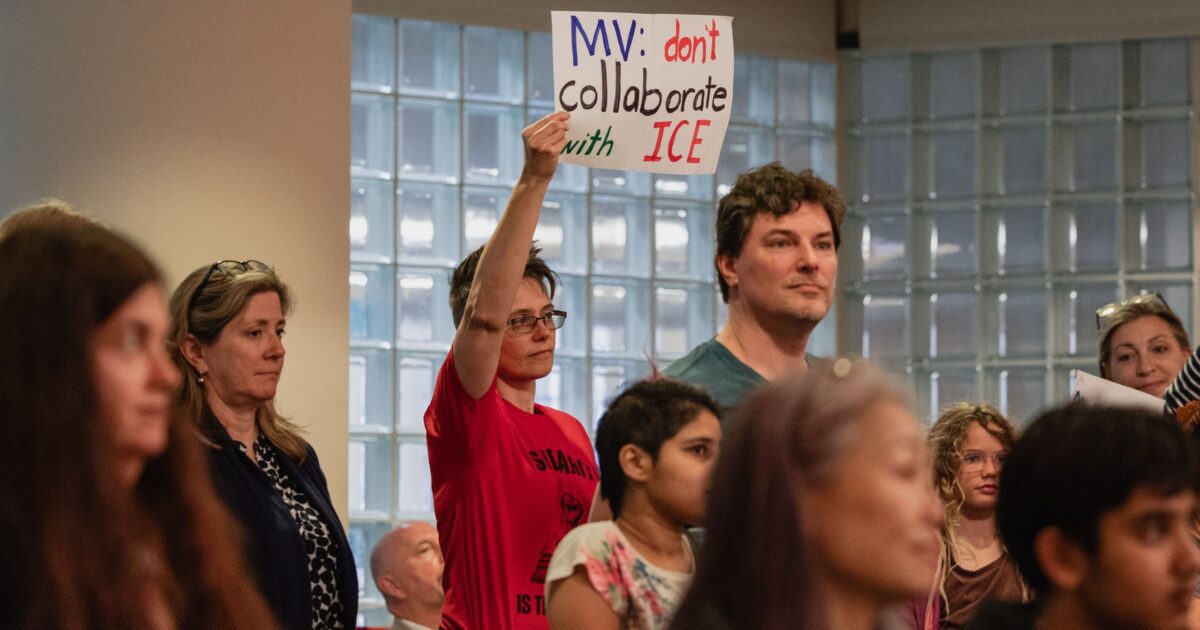
During public comment, Erik Poicon, a member of the Human Relations Committee who is currently running for City Council, thanked council members for passing the policy, which he said mattered to immigrant residents.
“Many others and I are glad to see this policy passed on tonight’s consent calendar, keeping the city property off limits for immigration enforcement, protecting our neighbors and our city employees,” Poicon said.
He then asked audience members who supported these efforts to stand. Dozens of people in the council chambers rose. He added that joining the legal brief “adds real legal weight to a case that could keep the facility from ever opening.”
California Attorney General Rob Bonta and Santa Clara County allege in their lawsuit that the project violates federal and state laws.
During public comment before the closed session, a Mountain View resident urged the council to join the amicus brief supporting the lawsuit and thanked the city for drafting the “no staging policy.”
Another speaker, who said he has lived in Mountain View for more than 20 years, also urged the city to join the legal effort, in addition to prohibiting ICE from using city property.
“I’m asking you to do more,” he said. “As a citizen, I know what I’ll be doing. I’m going to be there with my sign, and I’m thinking, ‘Garlic, Not Gulags.’”
What the city property policy does
Tuesday’s vote to restrict the use of city property for immigration enforcement came after council members voted 5-2 on May 26 to direct staff to draft such a policy. At the time, Clark and McAlister were opposed, but both voted in favor on Tuesday.
Under the new policy, city-owned or city-controlled land isn’t allowed to be used as staging areas, processing locations or operations bases for civil immigration enforcement.
The policy is limited in scope. It does not apply to enforcing criminal laws or executing judicial warrants. Federal agents also can’t be banned from being in public spaces, according to a city staff report. The city has not specified how its new restrictions would be enforced.
Mountain View joins several nearby jurisdictions that have adopted similar policies, including Santa Clara County, the Valley Transportation Authority and the cities of Campbell, Santa Clara, San Jose and Sunnyvale.
The new policy builds on a protocol Mountain View developed in October 2025 governing city employees’ interactions with federal agents. The protocol instructs employees who encounter federal agents at a city facility, park, event or program to ask what agency the agents are with, seek their contact information, ask whether they have a request of the city and contact a manager before proceeding.
City employees are also warned not to interfere with federal law enforcement operations, noting that doing so could result in being charged with a federal crime.
Beyond the lawsuit and the policy, the council also used Tuesday’s meeting to proclaim June as Immigrant Heritage Month in Mountain View. María Marroquín, executive director of the Day Worker Center of Mountain View, accepted the proclamation and urged the council to consider the impact of its decisions on immigrant residents and workers.
“As you move into today’s agenda, you will have the power to make decisions that directly impact the stability and prosperity of our community’s most vulnerable members, those who are too often overlooked, but yet form the very backbone of Mountain View,” Marroquin said.
She asked the council to make decisions that “protect, lift up and guarantee the dignity of our community.”