
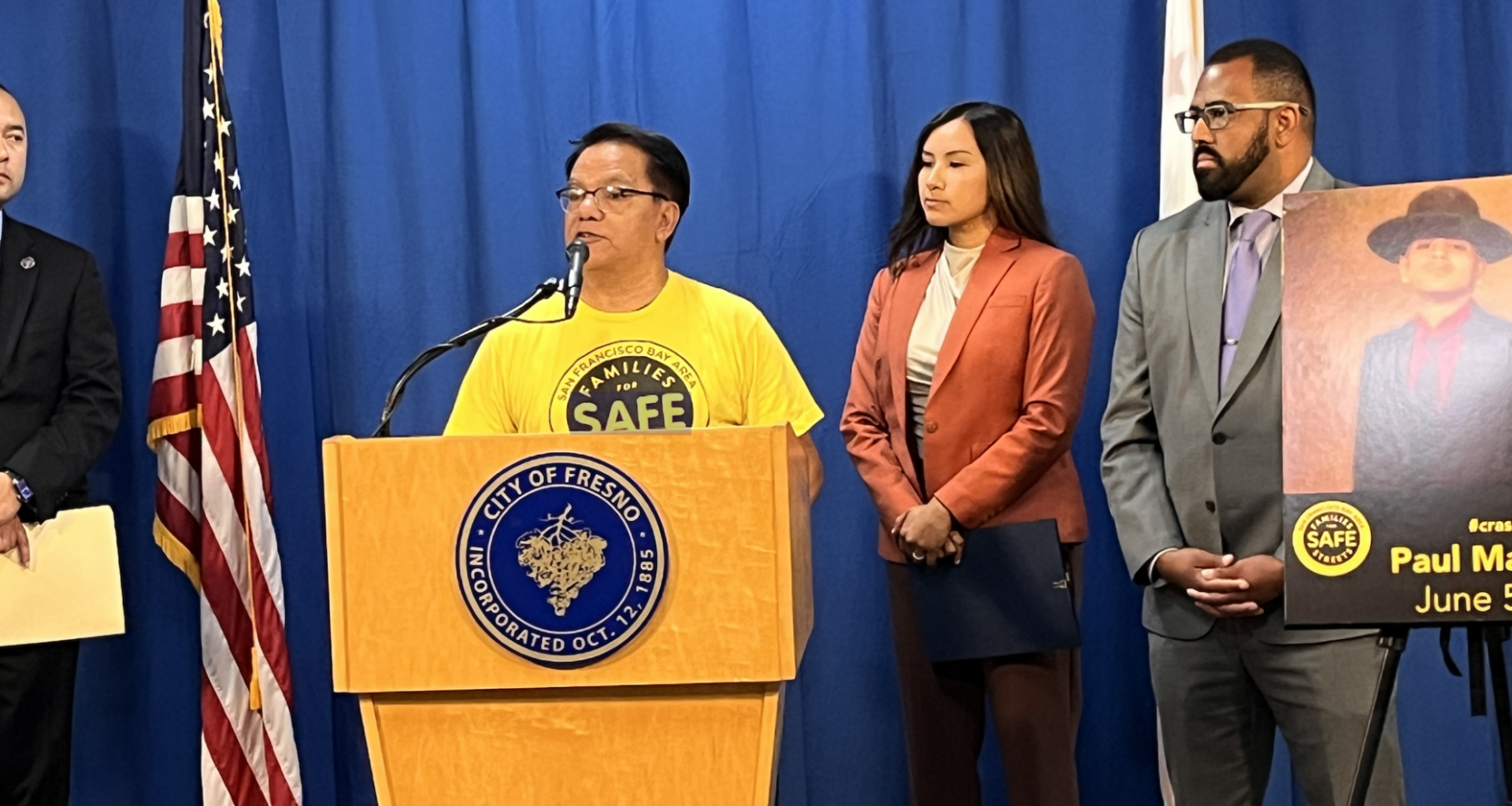
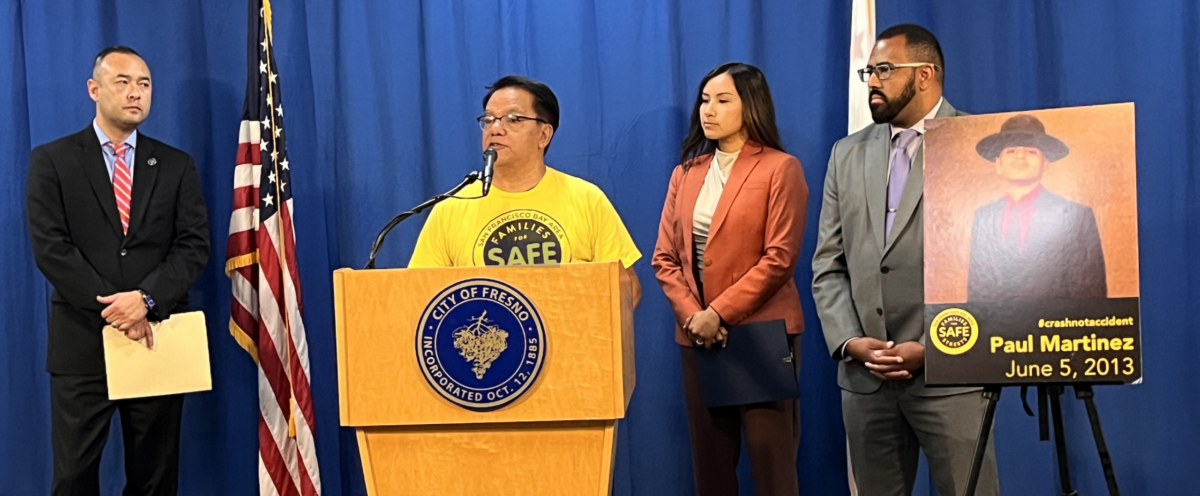
Photo by Frank Lopez | Joe Martinez, a member of Families for Safe Streets, spoke in support of the red light camera resolution, becoming an advocate for the families of loved ones killed in car crashes after his son was struck and killed by speeding driver in 2013.
published on June 26, 2026 – 3:35 PM
Written by Frank Lopez
The City of Fresno announced Thursday that it is moving forward with plans to bring automated red-light cameras back to some of the city’s most dangerous intersections after the Fresno City Council unanimously approved the first step toward a three-year pilot program.
City leaders, including Council President Nelson Esparza and Councilmember Annalisa Perea, announced the initiative during a news conference at City Hall following the council’s 7-0 consent agenda vote earlier in the day.
The pilot program is intended to reduce traffic deaths and serious injuries by installing automated red-light cameras at intersections identified as having the highest crash risk. City staff will now evaluate potential locations, prepare cost estimates, identify performance measures and begin the process of selecting a vendor before returning to the City Council for final approval.
The proposal comes as Fresno continues to confront high rates of serious traffic crashes. According to the city’s Vision Zero Action Plan, 217 people were killed and 629 others suffered severe injuries in crashes on Fresno streets between 2019 and 2023.
In addition, the Dangerous by Design 2024 report ranked the Fresno metropolitan area seventh in the nation for pedestrian danger.
“Fresno consistently ranks among the most dangerous communities in California for serious intersection crashes,” Esparza said during Thursday’s news conference.
The city’s Vision Zero Action Plan, adopted in May, outlines strategies and policies aimed at eliminating traffic fatalities and serious injuries through a Safe System approach.
The proposed program would operate under Senate Bill 720, which California lawmakers approved in 2025. The law authorizes cities to establish automated red-light enforcement programs under new statewide standards, including privacy protections governing the collection and retention of images and data.
Unlike previous red-light camera programs, violations issued under SB 720 are civil penalties rather than moving violations and will not add points to a driver’s DMV record. State law also requires revenue generated through the program to be used for traffic safety and related transportation improvements rather than general government purposes.
“We do not want to write more tickets. We want to change behavior and save lives. Every red-light violation prevented is a potential crash that is prevented,” Esparza said.
Fresno previously operated a red-light camera program that ended in 2005 amid financial challenges and concerns over privacy and data retention.
Perea said the program is intended to improve safety for everyone using Fresno streets.
“This program is about an opportunity to create a culture of safety throughout Fresno. One where slowing down, following traffic laws, and looking out for one another becomes the norm. No one should lose a loved one, suffer a serious injury, or have their life changed forever because someone was in a hurry to beat a red light,” Perea said.
Implementation costs have not yet been determined. Esparza said the city must evaluate proposals from vendors, negotiate a contract and return to the City Council for approval before any cameras are installed.
Among those speaking in support of the proposal was Joe Martinez, a member of Families for Safe Streets, an advocacy organization made up of traffic crash survivors and families who have lost loved ones in traffic crashes.
Martinez’s 21-year-old son, Paul, was killed in a Fresno traffic crash in 2013 after being struck by a driver while walking home from school.
Martinez urged reporters to use the terms “crash” or “collision” rather than “accident,” saying crashes are preventable and imply responsibility.
“Today I’m here in support of the red-light camera ordinance resolution. This technology is proven to change driver behavior and save lives,” Martinez said.