
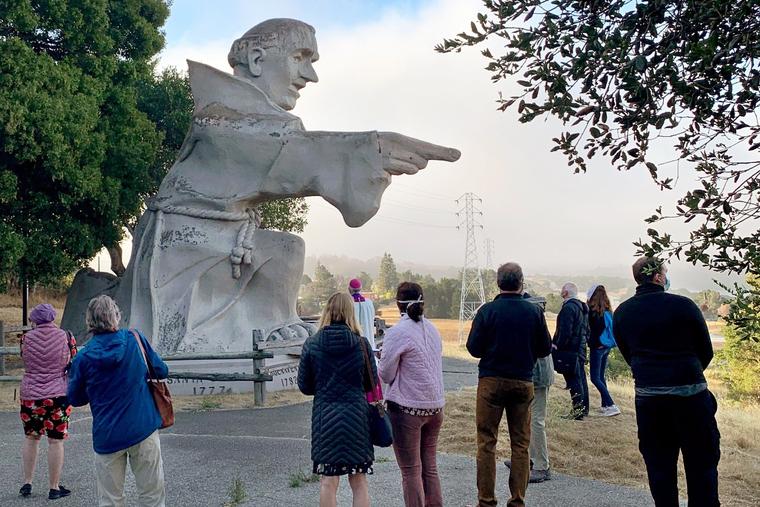
California state officials who reportedly have said they informed San Francisco Archbishop Salvatore Cordileone about their intention to remove a 22-foot-high statue of St. Junípero Serra from a rest area off Interstate 280 aren’t telling the truth, the archbishop told the Register.
“They said they spoke to religious organizations, but they didn’t speak to us. They didn’t get our input in it, and we’re the ones most affected by it,” Archbishop Cordileone said in an interview. “So, you know, once again, we’re cut out of the equation and treated unjustly and discriminated against. This is a repeated pattern going on here in California.”
The statue, which the state removed in August, commemorated Serra (1713-1784), a Spanish Franciscan priest who founded missions to spread the Catholic faith to indigenous peoples throughout California.
The archbishop’s statement contradicts a report in a story published by The San Francisco Chronicle on Oct. 8, which quotes unnamed officials from the California Department of Transportation as saying “that they conducted an ‘extensive outreach campaign’ that began in spring 2024 to spread the word about plans to remove the statue. Officials said they contacted 15 distinct organizations, including Cordileone personally.”
Asked by the Register about the claim that state officials informed him, Archbishop Cordileone replied: “That didn’t happen.”
Asked if it would be surprising for a spokesman for a state agency to tell a newspaper that the agency contacted the archdiocese if it weren’t true, the archbishop replied: “Well, not really, because my repeated experience with institutions in California when they’re dealing with the Church, is they lie to us, they discriminate against us, they deprive us of our rights. That’s been my repeated experience. So it’s fitting a pattern here.”
The Register asked the California Department of Transportation late last week for comment on the archbishop’s statements, and for evidence that the agency contacted the archdiocese about the statue before removing it. The department has not responded to that request, nor to a dozen other questions the Register asked about the statue’s removal several weeks ago.
The Register has obtained an email message to a local resident from a spokesman for the state agency from early October saying that the statue of Serra, which stood for 49 years, was destroyed.
“Due to the use of shot-crete and rebar in its construction which made moving it untenable, the statue was demolished,” the agency spokesman’s email message states.
Archbishop Cordileone said the state agency’s decision to get rid of the statue failed not only on process but also on substance.
“I don’t know why they would want to remove a statue of someone who was such a great defender of the indigenous people here against his fellow Spaniards. He’s one who needs to be recognized as a hero,” Archbishop Cordileone told the Register.
Cultural Flashpoint
St. Junípero Serra has become a flashpoint in American culture, spawning two starkly different views of a man whom Pope Francis canonized in September 2015 as a saint of the Roman Catholic Church.
Supporters say the saint lived a life of heroic virtue by bringing the Gospel to indigenous peoples and defending them from Spanish government deprivations, while critics say he furthered a corrupt colonial system that deprived indigenous people of freedom and needlessly led to many early deaths among them from communicable diseases.
Admirers say Serra sacrificed comfort and safety to try to save souls and protect indigenous people. Opponents say he presided over harsh physical punishments of indigenous people over petty matters and perpetuated a system that took their land from them.
The current dispute over St. Junípero, which has led to protests and vandalism of public depictions of him, is the latest in the friar’s circuitous route to fame.
Though well-known in California during his day, Serra all but disappeared from historical notice after he died, until he was rediscovered during the late 19th century by Californians newly interested in the state’s Spanish history.
By 1927, near the height of the state’s Spanish Revival period, Serra was so popular that the state legislature picked him for one of two statues representing California in the United States Capitol. The other candidate drew opposition, but not Serra, “on whom everybody seems agreed,” The San Francisco Chronicle reported in May 1927.
Likewise, in September 1967 the California State Assembly approved a concurrent resolution naming the then-forthcoming Interstate 280 between Route 1 at the southern end of San Franscisco County and Route 17 in Santa Clara County “the Junípero Serra Freeway,” with no recorded opposition.
The Junípero Serra Freeway was dedicated in May 1971, according to a story in The Peninsula Times dug out for the Register by a research librarian at the San Mateo Public Library.
Louis DuBois (1910-1988), a Catholic general contractor and artist who became fascinated by Serra when he toured missions that the friar founded, was 65 when he started making at his own expense a statue of Serra for a rest area off the new highway, according to newspaper accounts of the time. The statue was finished in 1976, the country’s bicentennial year.
The statue showed an oversized Serra in a brown Franciscan habit genuflecting and pointing west, meant to represent the missions. His pointing hand and the hanging sleeve of his robe formed “the outline of a donkey’s bowed head,” The San Francisco Examiner reported in July 1976 — a nod to Serra’s mode of transportation on land when he wasn’t walking.
Around the base were the names of the missions St. Junípero founded — including some that are now the most famous cities in California — and the years he founded them.
No Public Hearing
But around that time some indigenous peoples in California began publicly expressing opposition to Serra, said Gregg Castro, a critic of Serra.
Castro, principal cultural consultant of the Association of Ramyatush Ohloni, which represents indigenous peoples on the San Francisco Peninsula, is one of two signers of a letter the association sent five years ago to the California Department of Transportation that eventually led to the removal of the Serra statue.
The letter argued that having a statue of a Catholic missionary on public land violated the separation of church and state, and that Serra’s involvement in founding the missions isn’t something to be celebrated.
“Our ancestors lost not only their lives, but we lost nearly all of our traditional language and culture, as well,” the letter states.
Castro told the Register that the state’s Transportation Department did not hold a public hearing on the association’s request for the Serra statue to be removed, but kept him apprised of developments.
While he acknowledges that Serra didn’t intend to harm indigenous people, Castro said his actions nevertheless led to disaster, which he said was predictable, since similar results occurred in earlier missions in Mexico.
“They didn’t necessarily come here — unlike the Americans later — to commit genocide. The Spaniards didn’t do that. But they knew it was going to happen,” Castro said.
In 2021, public criticisms of Serra’s actions provoked California lawmakers to pass a bill mandating the replacement of a statue of St. Junípero at the state legislature with one honoring local Indigenous populations.
In the wake of the bill’s passage, Archbishop Cordileone and Archbishop José Gomez of Los Angeles strongly defended the saint. In a joint op-ed published by The Wall Street Journal, titled “Don’t Slander St. Junípero Serra,” they said that while he was a “complex character,” he “defended indigenous people’s humanity, decried the abuse of indigenous women, and argued against imposing the death penalty on natives who had burned down a mission and murdered one of his friends.”
The archbishops’ op-ed also noted that as an old man in ill health, he traveled 2,000 miles to Mexico City “to demand that authorities adopt a native bill of rights he had written.”
Complicated Story
Robert Senkiewicz, co-author of a 2015 biography Junípero Serra: California, Indians, and the Transformation of a Missionary, told the Register he admires Serra but doesn’t find him faultless.
Unlike some colonizers, he said, Serra treated American Indians as human beings who had immortal souls worth trying to save. But to do that, Serra and his fellow missionaries felt they had to civilize them in European fashion, to keep them close to churches and priests and sacraments and a more regular (and regulated) way of living.
“They were trying to make them Catholic and Spanish,” Senkiewicz said in an interview.
“They were trying to protect native people from the worst aspects of the colonial system, but they were part of that system themselves,” he said.
The story is complicated, Senkiewicz said.
“Public history doesn’t have a lot of room for ambiguity. You’re either all one thing or all the other,” Senkiewicz said. “I understand why he’s criticized, and I understand why he’s honored. Both are valid.”
An admirer of St. Junípero told the Register that Spanish colonialism must be distinguished from Serra’s personal holiness.
“My standard response is that he was a very, very good person in a very, very bad situation, and that was Spanish colonialism,” said Andrew Galvan, 70, an Ohlone Indian and curator of Mission Dolores in San Francisco and Mission San Jose in Fremont.
Galvan, a Catholic, said the mission system hurt indigenous people, including his ancestors.
But having studied Serra’s life, he said he is convinced Serra acted from love.
Galvan told the Register he began working on Serra’s cause in 1978, and stayed with it up until Serra was canonized in 2015. He is grateful to Serra for bringing Catholicism to his ancestors — and, by extension to himself.
“One thing I always say to Father Serra’s detractors: Hey, I worked 40 years to make that guy a saint,” Galvan said. “There’s one thing they can’t do. They can’t take his halo away.”