
One poet’s journal entries during the 2025 L.A. fires. Did you know LARB is a reader-supported nonprofit?
LARB publishes daily without a paywall as part of our mission to make rigorous, incisive, and engaging writing on every aspect of literature, culture, and the arts freely accessible to the public. Help us continue this work with your tax-deductible donation today!
Jan. 7
8:00 p.m.
I AM SUPPOSED to go see Babygirl at the theater, but I cancel at the last minute because EXTREME LIFE THREATENING WIND WARNING.
I listen to my plants toppling outside, their pots shattering. I move from the window, like an animal, toward the center of the room.
The washing machine is halfway through a wash cycle when the power goes out. The Christmas tree goes dark.
In his office, L cries out.
I fumble my phone, trying to look again at the wind warning, which I believe said “100 mph Santa Ana winds”—but it’s disappeared.
My jaw fuses; my heart palpitates. I begin exercising on my elliptical in the dark room, hoping movement will calm my nerves.
9:00 p.m.
A friend texts: there is a fire in Altadena. I live on the border of Arcadia and Monrovia, about nine-and-a-half miles away, up against the same mountain range that touches Altadena, the San Gabriels. Not long ago I moved here from a little cottage in Altadena because my rent went up again for the second time in two years.
I go to my front door and peel back the curtain. Although the electricity is out all around me, a yard two streets over jammed with Christmas decor is still garishly lit. It looks like a Disney cruise ship at dark sea. A part of me wants to take comfort in this cheery sight, but they look strangely vulnerable, the inflatable gingerbread man with an even smaller gingerbread man (boy?) on his back, the snowman with lights techno-ing inside his belly. All banging violently in the wind. There is also a face-down flattened reindeer. How are the lights even on? It makes no sense.
The hillside is dark: no fire.
In a group chat, a friend texts about the Watch Duty app. I download it, understanding it only as a map of fires that some nonprofit made, nothing official from the “government.” I already know from the San Bernardino blizzard in 2023, from the forest fires up north in Santa Rosa that burned my father’s childhood home in 2017, I know from the Northridge quake in 1994 when I was just a child, which was a day the Earth cracked open and cars fell in, that California doesn’t give a shit about you when there’s a disaster. You’re on your own, kid.
9:15 p.m.
I cannot see the fire itself, but a freaky red glow fills the sky at the curve of the hillside. Because everything else is dark, the glow is all there is, other than the bonkers Christmas yard.
Every 10 minutes, I dart to check, then fall back to the center of the room. Large indecipherable things bang against the house. Car alarms shriek. The sound of the wind itself is hard to describe. I guess it is really not the wind that makes the sounds, but the things the wind carries.
10:00 p.m.
“Are you okay?” my dad texts. “Yes,” I lie. When the fire finally appears, actual flames, I send a blurry photo to the family group chat. Every 30 minutes, Dad asks for another photo. He wants to see if the fire is coming toward us or going away. “Take the picture from the same spot every time,” he says, and I obey, thinking of the scene in Melancholia when Kiefer Sutherland’s character keeps measuring the distance between Earth and the rogue planet with that little wire loop, the trick of it. As the fire spreads across the ridgeline, it makes a zigzag pattern, like an extraterrestrial hieroglyphic.
After three blurry fire pics in a row, he texts triumphantly: “It’s moving away!” My dad now mansplaining the fire. “It’s getting closer,” I reply, feeling guilty, and annoyed about feeling guilty. As if I’m being negative by stating reality. In my youth, my parents were climate change deniers (they aren’t anymore, but now they deny that they were deniers). “I think it’s not,” he says. “But you could pack just in case.”
I realize then how worried he is.
11:30 p.m.
I gather a bunch of photo albums from my youth into a duffel bag. I shine my phone light across my closet and, overwhelmed, grab only two sweaters.
In the midst of packing, L asks, his voice dazed, “Should I take out the trash? Tomorrow is trash day.”
I consider the possibilities. It may all burn, and then there will be no more trash. Or we have three overfull trash cans for two weeks since our landlord has hired a contractor who has been overfilling them with materials for the granny flat out back. And if this house and street are still here tomorrow I know that even though they will not help us in the fire, they will still somehow come and take the trash.
“Yeah, we’d better take the trash out.”
Jan. 8
12:00 a.m.
L is exhausted. Sleep, I tell him. I will keep watch.
Evacuation zones start popping up on the app. One two blocks to the west. Another two blocks north. Then, we finally receive something official from “the government”:
BE PREPARED TO LEAVE GATHER PETS AND PEOPLE.
3:00 a.m.
The streets are like a nightmare inversion of our streets.
This is not a normal wind, remember? This is a “wind event.” My small, overloaded, ancient Fiat rattles as L carefully leads it down the road, which is littered in twigs and trash and giant palm fronds from the trees, which are being shook and shook. You can’t see the curb, or the white line in the middle of the road. It does not feel safe to be out here. I notice several signs that have been yanked out of the ground by the wind and flung into the street. One is still embedded, but bent in half, like a person bending at the waist.
On our left, the hill with fire.
There are no streetlights. The few cars on the road, including us, drive slowly, struggling against being pulled sideways by the wind. We creep past an apartment complex. The structure is unlit, but there is a fire truck in front blinking its lights, and no firemen, no people. A large tree has fallen through the building’s roof.
“Should we go to Stephen’s?” I ask L. They said we could come stay with them, but for some reason it scares me, the thought of trying to get on the freeway and go all the way to Echo Park. “There are already two big fires,” I say. “What if another starts there?”
We come to a dark intersection. There is a Shell gas station with the light on. It’s the only light we’ve seen since leaving the house. Inside, someone in a blue jacket, a worker, is hunched over the bright counter looking at their phone, like a mirage of capitalist normalcy in a desert of darkness.
“Turn there!” I say, frantic. I watch from the car as L goes up to the little shop to buy snacks, but the door is locked. The worker does not look up as he knocks on the glass, ignoring the man outside in the terrible wind. This disturbs me, although I realize they are probably just following orders, or scared.
We drive the blacked-out streets of Monrovia, on the other side of the freeway. We pass another gas station (a Chevron) with the lights on, but this one has a scrawled sign in its window: GO SOMEWHERE ELSE.
“Let’s go to the mall,” I say, uneasily. “I feel like the mall will not burn.” The Arcadia mall, with its ocean of parking lots, seems to me, in my fried-brain state, “safe” even from embers launched miles by this gale force wind.
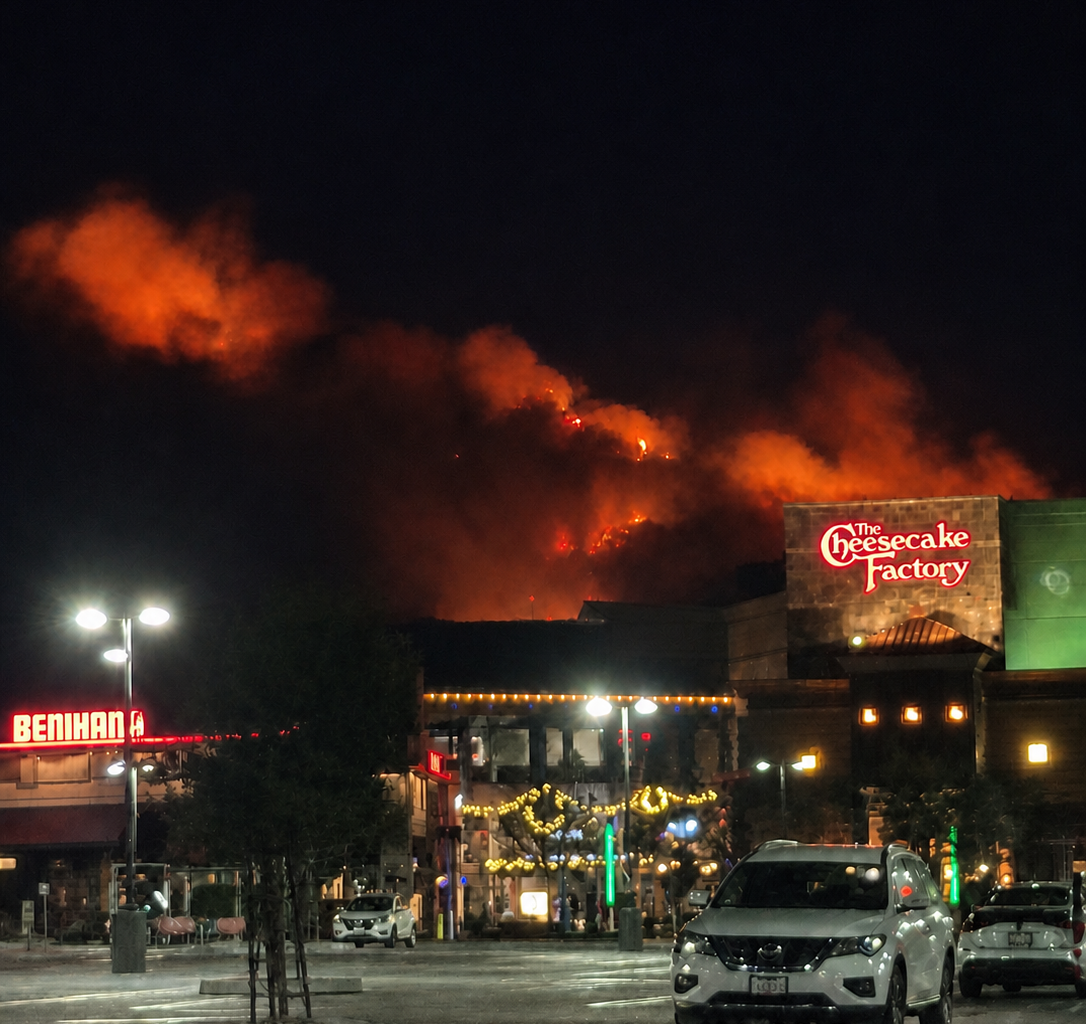
We park across from the Cheesecake Factory near a cluster of other cars with people in them all staring ahead at the mountain on fire. Against the dark shape of the mountain, the Cheesecake Factory sign remains illuminated, glowing red, and so it looks like we are all staring at the Cheesecake Factory.
The wind wooooos against the car.
I take a snapshot of the Cheesecake Factory sign against the fiery peak and impulsively post it to my Instagram story, then immediately feel gross. Friends and acquaintances send worried messages to check in, which makes me feel better, but I don’t have enough phone battery to reply to everyone yet.
I notice that the people in their cars are not just looking at the mountain/Cheesecake Factory, they keep looking down at their phones. Phone, mountain, phone, mountain. I wonder if they are looking at the fire app. Phones feel so small right now, this square of light that is supposed to tell us what to do in the face of this much more powerful, ancient, inexorable light.
A guy in a Tesla next to us clutches his steering wheel. Tesla man watches L get out of the car and then gets out of his car too. I watch them speaking to each other. The man’s eyes are bright red.
L gets back in the car: “He fled Pasadena. He said it was filled with smoke, and the fire was coming down Lake fast.”
We watch the fire eat the mountain. The Cheesecake Factory sign goes out. The entire mall goes dark. “Let’s go east,” I say. “The fires are to the west, and the wind is blowing southwest. Maybe no fires will come east.” It’s superstitious logic, but I am starting to feel like the fire, or fires, have a will, just as the wind has a will, and I must read the signs to survive.
We drive past unlit Chipotle, unlit Chili’s, unlit Outback Steakhouse, unlit Chick-fil-A, unlit McDonald’s, unlit Burger King, unlit Panera Bread, unlit Popeyes, unlit Denny’s, unlit Jamba, unlit Wendy’s, unlit Mimi’s, unlit BJ’s, unlit Panda Express, their vast carless lots filled with wind litter and palm debris. The stores are intact, but there is something apocalyptic about the sight of these darkened chain restaurants, as if they have been cast into a shadowworld.
We nearly crash into a police car parked diagonally with its lights off, obstructing the road. “Probably downed power lines,” says L. “We should be careful.” At a certain point, I decide we should go to Stephen’s after all, but every time we try to turn south, the streets are barricaded. I watch the fire on the app, and out my window on the mountain, trailing us.
After blocks in gloom, I see lights in the distance. My heart leaps. “There,” I say.
“I think that’s … Costco,” L says.
“Oh my god, it’s a fire,” he says a second later, and sure enough, I look over and see flames leaping across the wind-flung brush near the 210 overpass. I open the app for the millionth time: a little fire symbol right where we are. The “Vegetation Fire.”
“How can there be this many fires at once?”
“No rain. Drought conditions. Extreme life-threatening wind,” he says. “Hurricane-force winds.”
It takes us 45 minutes to crawl through the intersection while the small(ish?) fire burns next to us. I watch people illegally U-turn ahead, looping through an Arco to pull in the drive-thru for a McDonald’s that is somehow open. Directly across the street from the McDonald’s, more brush is on fire.
“Are those people safe?” I ask L.
“Probably not. I want an Egg McMuffin.”
“Please just go to Costco.”
But before we turn into Costco, we spot a Starbucks that has just opened. Across the street from the Starbucks, the power is still out, all the storefront faces on that side blank.
L goes into the lighted, “on” Starbucks. From the car, I watch a man with gray hair and pajama pants whose truck bed is filled with gasoline canisters wander over to a closed Jersey Mike’s. He stares intensely into its dark windows. He looks back and forth between Starbucks and Jersey Mike’s several times before finally going over to Starbucks. A girl in a Starbucks uniform and kitty earphones lugs a trash can as the wind whips her ponytail across her face. Another man in sweatpants and blue Crocs follows her to the dumpster and helps her lift the trash can. They are laughing.
L returns to the car, carrying egg bites for himself, a bagel for me, and a coffee. “It felt really good and normal in there,” he says, his voice cracking a little. “The music was playing.”
“It feels like we’re in that computer game from our childhood, SimCity 2000. It’s like things are normal in some zones while in zones right next to them the ‘disaster’ simulation is running, everything crumbling to pixels. But in the normal zones we are all ignoring it. Did you see that girl?”
“I talked to her. She said she decided to just come into work because she didn’t know what else to do. She seemed kind of embarrassed about it. She was really scared driving on the freeway. She saw two fires on her way here.”
“Fuck.”
“These egg bites are terrible. I’m getting an Egg McMuffin.”
“I don’t want to drive over by that fire.”
“Okay, I’ll walk.” While he’s gone, I’m worried about him breathing the smoke, worried about the gas station blowing up. He returns 30 minutes later with an Egg McMuffin wrapper, the McMuffin already consumed.
At Costco, we park in the middle of the lot, away from trees, some of which have fallen. The store is not yet open for the day. I keep opening the app to track the red spread over Altadena, Pasadena, Sierra Madre, Arcadia, its tendrils reaching into Monrovia. Why aren’t they stopping it? I scan a headline that is a quote from a firefighter: “With This Wind, Nothing We Can Do.” We watch a man with big muscles in a Costco manager’s uniform point to fallen trees while another man stands next to him holding a measuring tape. The men lift the fallen trees with syncopated movements into the back of a large truck. Several new trees wrapped in some kind of wire or cellophane come out of the back of the truck and are planted in the ground. I cannot believe this.
“Can Costco fight the fire?” I ask. “It would literally be out by now.”
L tries to sleep. I watch the sun rise in the clear sky over Taco Bell. Behind us, the other second sky is thickening with smoke.
6:00 a.m.
L wakes up after an hour. “I’m still hungry. I’m uncomfortable,” he says. The wind rattles the car. L often gets hungry when he’s stressed out.
“There’s that Target in Azusa with a huge parking structure. It has those giant red cement balls out front.” The large red Target balls feel impervious to time and disaster and human folly, like the Statue of Liberty jutting up from the sand in Planet of the Apes. “Can we go there? It will be darker, easier for sleeping, out of the wind. And maybe we can get another breakfast on the way?” I want to comfort him somehow, but all we have is Carl’s Jr.
It’s absurd, I know it’s absurd, to bounce from chain store to chain restaurant to chain store, looking for safety from the encroaching, and increasing constancy, of climate change. It’s not that I think capitalism will save us—capitalism is, obviously, how we got here in the first place—only that, because the billionaire oligarchs love their money so much, maybe if we hide in the shadow of their infrastructure, we will be passed over.
Carl’s Jr. has never felt better. The inside is sparkling clean, beautifully clean. The music is old-timey, like Bing Crosby. Behind the long counter, a woman with her arm in a sling is lifting a large machine. It smells like coffee and disinfectant. I go pee while L orders. At a standing table, we eat the Carl’s Jr. equivalent of Egg McMuffins while Frank Sinatra sings “I Get a Kick Out of You.” I only take three bites as it is incredibly salty, but L wolfs his down.
“She said she still had to come in,” L says softly, speaking of the woman behind the counter who prepared our order. “She’s had three surgeries, and if she has any more, she will have to replace her shoulder. How do you replace a whole shoulder?”
We park in a murky corner of the Target garage, across from a Tesla charging station. “Sleep,” I tell L again, knowing I will not. With my sleep disorder, there is no way I will be able to sleep in a car under any circumstance. I am already starting to feel sick, though, from exhaustion.
L sleeps lightly, his sweatshirt bundled against the steering wheel as a pillow. The wind rushes through the garage in strange ways I don’t understand. A woman in a white Tesla pulls in and plugs in her car’s charger. In the backseat is a panting, poofy white Shiba Inu. The woman is carefully made-up, wearing white athleisure, matching her dog and car.
A rickety old Honda Civic careens in, loudly playing Ace of Base’s “The Sign.” The Civic parks next to us, perhaps sensing brotherhood. The athleisure woman looks over, irritated. L stirs; we decide to move across the garage to escape the music so he can try and sleep some more.
9:00 a.m.
On the app, the evacuation order has switched back to just a warning near our house. The fire is right there still, though, on the hill. I trace its outlines, a massive area, and think of the people, the plants, the animals, the buildings, the objects inside the red. I can barely take in the Palisades fire, though its red spill is in my peripheral.
A new fire symbol appears over Riverside, puncturing my illusion that farther east at least will stay free of fire. My phone battery now two-thirds dead.
“Should we go to a hotel?” I ask, rousing L. “Evacuees will be there, people whose houses are gone. We also can’t afford it and they’re probably already price gouging.”
“You might not sleep either,” he says. “And you definitely won’t sleep at a friend’s house. Let’s risk it and go home.”
It feels eerie driving back into the fire. On the way home, we pass many people walking. Contrary to popular opinion, people do walk in L.A.: people who can’t or don’t drive for various reasons, or who can’t afford cars. I see a man in shorts and green Crocs burst out of a mom-and-pop donut shop holding a sprinkled donut. He is smoking a cigarette. (Today seems like a good day to be a smoker, actually?) A woman with a small boy in a blue puffer jacket waits for the bus. She is carefully combing down his hair. An old woman shuffles down the sidewalk with a grocery cart.
The power in Monrovia is still out. We glide through the blacked-out lights, dodging the mess in the road. The wind is whipping the car, the air milky gray, tumescent. The daylight makes it look dingy, like we are moving through filth. I can smell the smoke now. It smells horrible. We start coughing. I tug on a COVID mask.
We lug our things back into the house, including the heavy desktop computers we use for work. Although the power is out, I see the contractor doing things in the granny flat out back, which currently does not have a front door, so a bunch of wind clutter, including the Halloween candy wrappers he leaves in our yard, has blown into the flat. He nods and grins at us. He is not wearing a mask, and is smoking a cigarette. A good day to be a smoker, my tired mind repeats. He keeps stealing items from L’s garage studio, shovels and sawhorses, which L has to go ask him to give back, and he sheepishly obliges. As we go inside, I hear him shouting on the phone with our landlord. He must be desperate if he is working right now, in the elements, through this. Given how cheap our landlord is, never fixing anything on our house with its peeling paint, oven with one working burner, and leaking sink, I cannot imagine she is paying him enough.
Inside, the house reeks of smoke. I can’t stop coughing. I am so tired I am starting to feel scared.
“I’m going to sleep,” I say.
“I’ll keep watch,” says L, though I know he will fall asleep too. If we die, we die, I think. But of course I don’t mean it. In the bedroom, I plug my noisemaker into a lone battery pack L found in the garage, and collapse. In my dream, I am in a small plane with my brother and sister, who live in another country. The plane barely lifts off before it is crashing into some tropical ocean. My brother and I escape in the sea water, which turns out to be not that terrifying. I mean, it is still scary, and deep, but it is bright blue and warm, and there is something odd about the sky. It looks bowl-like, and the clouds don’t seem real. Like The Truman Show. My sister is still in the plane, on the ocean floor. I tell my brother to go get her. He dives down, then pops back up. “I knocked but she didn’t come out,” he says. “There’s some air in there. I think she’ll be okay. There’s still time for her to decide.” My brother turns from me, and when he turns back he is wearing L’s face. “Are you insane?” I scream.
10:00 a.m.
I sleep fitfully, coughing myself awake because I can’t breathe. At least five times, I climb out of bed and go to the front door and fold the curtain back to see if the fire has come farther down the hill, but the smoke is so opaque that I can’t see the mountain anymore. There is no fire immediately in front of me, on the lawn, so that’s all I have to work with. In bed, I put my hand on my heart and breathe deeply, like a stranger taught me to do when I was having a panic attack on an airplane once.
It’s night when I fully awaken. The power is still out. L is dozing on the couch.
I trip over my pile of evacuation items and look out. Dark humps of cars and campers are parked along our street—evacuees—but I don’t see any people. The wind still lashing. Now that it’s evening, I can see the fire again, through gruesome smoke, burning burning. Later I will read that the fire “backed up” into our canyon where it got stalled, so what I’m witnessing is the fire’s ass. There is a FedEx package leaning against the front door. L ordered art supplies some weeks ago.
“They took the trash,” L mumbles, awakening. “You were right.”
“So they are sending workers into the inferno to deliver Ben Nye makeup and take out house trash, while the streets are filled with crap and the fires must rage untouched? Got it.”
The food in our fridge will last a day or two if we keep the doors shut, says the internet. L goes out and returns with a buttercream cake from Trader Joe’s. “Survival cake,” he writes in Sharpie on the plastic container. I take a snapshot of him holding it with a headlamp strapped to his forehead and send it to my sister, who shows my little nephews. My phone battery now at 10 percent. L watched the workers in their cheery Hawaiian shirts moving behind the glass and thought they would not open, and so when they opened the doors at 7:15 p.m. he ran inside weeping. People were filling their carts with odd things in large quantities, he told me, many cans of artichoke hearts and bags of all-purpose flour. He saw a mom and a boy with a cockatoo on his shoulder and asked if he could take a photo. In the pic, the boy has smoke-red eyes, and is puffing his chest like his cockatoo. He looks proud.
“People were going to the gym,” L says. “The other stores were closed, the power was still out, only Trader Joe’s was somehow open. The air was all smoky, everyone was wearing masks, but then people were wearing gym clothes and going into Crunch.”
“So Crunch was open?”
“Crunch and TJs.”
“We are occupying the threshold between two worlds.”
I eat the survival cake, I go into the pitch-black bedroom, and, still exhausted, try and sleep again. As I drift off, my mind reaches toward Altadena. I try not to think of the death and devastation, or the horrors that will come next, the speculators who will buy up the land, the permanent displacements. Instead, I think of what it was like to live there: the broad trees along Christmas Tree Lane; the graveyard near my cottage with coyotes that trotted over to me, unafraid; the chicken shop with bright murals on the walls.
Then I remember the UFO. It’s not that I had forgotten it, but I hadn’t thought of it in a while. I used to shop at the Ralphs in Altadena on Lake Avenue, where I would look up to admire the Ralphs sign against the mountain; there was something so Southern California epic about it. That day, a brilliant sunny day, I saw a silver almond-shaped ship against the blue sky and the very same mountain that would, years later, burn in the Eaton Fire. It’s difficult to gauge size, but the ship was low, lower than an airplane, and larger than an airplane too. It had no visible propulsion systems, made no sound that I could hear, and had no windows. The silver sky object was completely still. I stared and stared, and soon another person in the parking lot saw me staring and looked up too. “Is that a UFO?” she asked. “I think so,” I said. More people joined. We were all very quiet, staring up at the ship, which was not doing anything except being a UFO. There were no laser beams or abductions occurring, as far as I could tell. A couple people took photographs. After some minutes, how long I could not say, my neck began to ache. “I have to get my groceries,” I said. After all, I had errands to run, work to get done. I had to pay rent. “Me too,” said the woman next to me, tearing her eyes reluctantly from the ship. We looked at each other, embarrassed to be casually walking away from a UFO. Slowly, we all shuffled into the store, where we passed each other with our carts without acknowledgment. When I got back into the lot, I again looked up and the ship from another world—or perhaps it is a ship from this world, we just haven’t known it—had removed itself from my sight.
Jan. 9
Kids are riding bikes at the school across the street, inside the smoke. They look like they know they are not supposed to be doing this, grinning at each other as they loop across the sidewalk. Something about their recklessness is comforting, kids wanting to fuck around in whatever reality they wake up in. But I am also worried that they can’t breathe.
On the app and on the hillside, the fire hasn’t moved from its current spot in over 24 hours.
“I want to not see fire,” says L.
The smoke and darkness feel all-encompassing, forcing me into hibernation. Moving from the kitchen to the bedroom is hard. Even switching positions in my sleep feels hard, so I let my neck harden in a weird way. L goes back to Costco and buys battery packs so we can charge our devices, and bottled water because a friend texts that the tap is not safe to drink. I pour powdered milk into instant coffee. I barely eat, having no appetite. The computers use too much juice, and I try to complete a freelance gig on my phone so we can pay rent.
Now that I have full access to the internet, I almost wish I didn’t. The sheer volume of fire-related posts and articles is harrowing, overwhelming, like the internet itself is on fire. I scroll through GoFundMe after GoFundMe, people whose homes have burned. Of course there is no immediate help from the state, of course they have to do this instead. On Instagram, people are using the Notes feature to signal “Childhood home gone” or “Still safe.” Then there are posts that are pure spectacle: palm trees jerked sideways by wind, the blaze raging behind; a VW van parked by the Getty Villa that somehow made it through the fire untouched, everything around it blackened. “How do we know they didn’t drive the van back after the fire?” someone writes below. A photo of the Hollywood sign burning that turns out to be AI.
I read a news article about the state accidentally sending out evacuation texts to people who don’t need to evacuate. Meanwhile, a Facebook group is responsible for many people fleeing the Eaton Fire. A Ring camera video of someone’s doorstep in Altadena, a person carrying a laundry basket full of evacuation items into his blowy yard to put in the car as embers rain over him, the fire like a tidal wave looming over the other houses, just right there. “Oh no babe, we gotta go,” the man says.
People are sharing mutual aid: what masks to wear, how to filter your own water. These are mostly helpful, but the more I scroll, the more I start to see conspiratorial thinking, filling in the hole where official knowledge should be. These conspiracies span political parties, although their flavor changes. Someone claims that the air in Los Angeles will not be breathable for three years. “That’s not how air works,” says L. “The air here is connected to the other air.” I know this of course, but I feel bad, thinking of our bad air infecting other people’s air. Another person posts a photo from Oregon, an orange glow over forest. “We can see the L.A. fires from here,” they write, which also seems not possible but feels correct. Right-wingers are posting that the governor and L.A. mayor started the fires to hide secret pedophile tunnels. The governor starts an official website to correct them. My brother in rural Colombia sees the fires on the news there and messages me. Friends in Australia see it on their news. My mom, who is usually pretty checked out, but somehow self-aware of being checked out, texts: “Even I am watching this.”
Jan. 10
I wake to the chop-chop of helicopters. I have never heard a more beautiful sound. Because of the wind, they couldn’t fight the fire from the air, so I’ve been listening for them as I lay in my bed for a hundred years.
I call my nephew for his birthday. Although he is getting bigger, he still has a tiny Mickey Mouse voice. “How old are you, Greyson,” I ask. “Four, but soon I’ll be five.” He is panting. It sounds like he is running. “And then I’ll be seven, like brother”—his brother Wyatt is seven—“and then I’ll be 10, and brother will also be 10 … and I don’t know how old I am.” He sounds emotional. “I don’t know what I’m saying,” he whispers. I hear my sister laughing. I am starting to see children’s existential confusion as a response to this rapidly changing world they have been thrust into.
“He has ears for his birthday party, animal ears.” My sister takes back the phone. “He’s wearing them all right now, all over his body.” I picture animal ears sprouting all over Greyson and I think maybe they will help him somehow, maybe the ears will be an advantage, to hear it sooner, to get away, be safe. I say to my sister, “Good.”
I set down the phone; the power turns back on.
The washer sputters to life and continues its wash cycle, with no memory of the preceding three days.
They used to give children to the gods, in the old days. They thought that was how they could stop the mountain from growing angry, how they could prevent the chain of fire, make the rain pour down, the crops spring forth again from the dry earth.
It’s easy to judge now that we know better. As I move the clean clothes from the washer to the dryer, in my mind’s eye bursts a banquet of flames: Greyson’s small body engulfed. “Why are you sacrificing me to Moloch?” says the smallest voice that is still a voice.
¤
Featured image: Courtesy of Kate Durbin.
LARB Contributor
Kate Durbin is a writer and artist from Los Angeles. Her most recent book, Hoarders (Wave Books), was named a best book of 2021 by NPR, Lit Hub, and Electric Literature.
Share
Copy link to articleLARB Staff Recommendations
Sesshu Foster reports from a mutual aid center in the aftermath of the Los Angeles wildfires.
Losing home and rebuilding, reluctantly, in the year after Los Angeles’s Eaton Fire.