
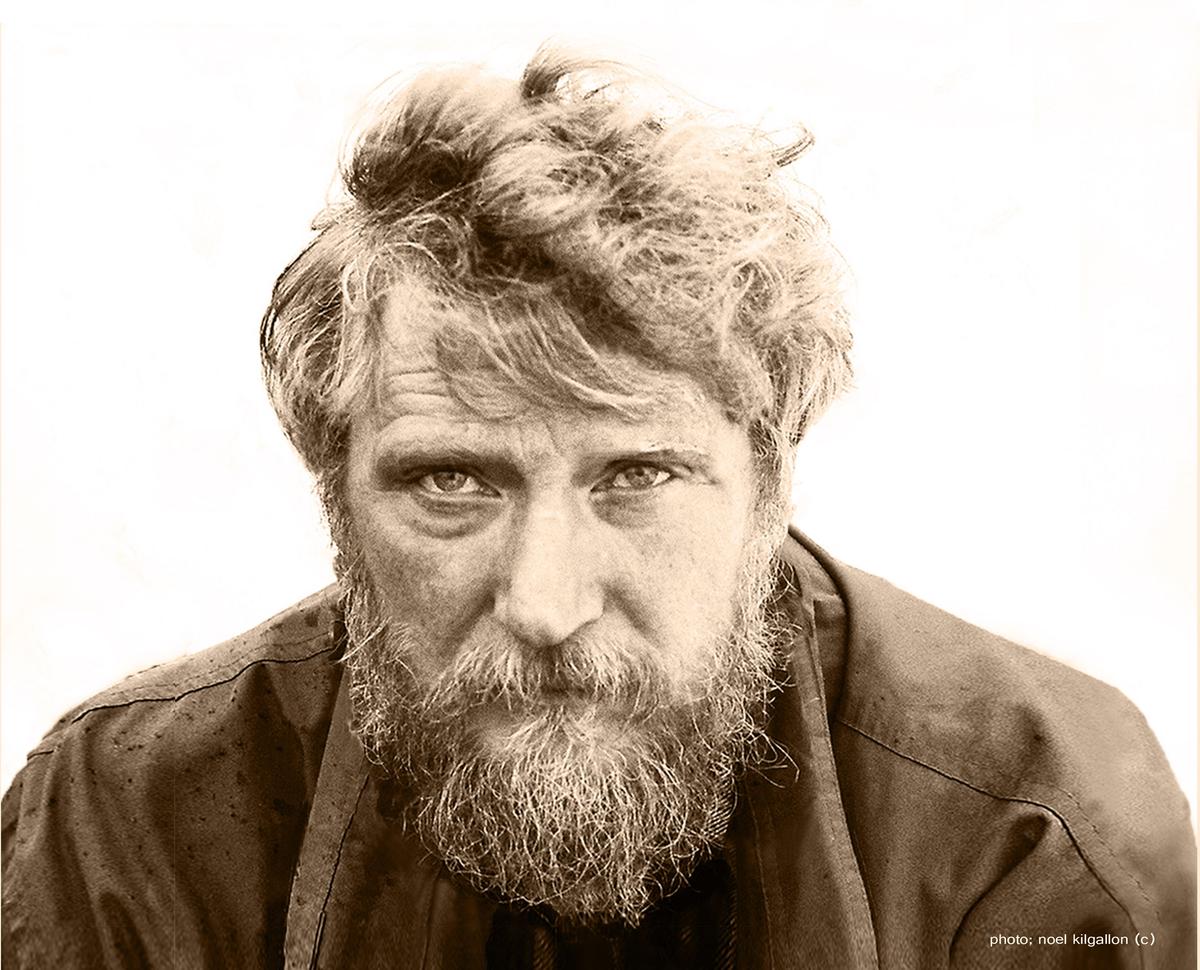
Remembering the friendship and legacy of Irish writer Dermot Healy. Noel Kilgallon-1.jpg) Did you know LARB is a reader-supported nonprofit?
LARB publishes daily without a paywall as part of our mission to make rigorous, incisive, and engaging writing on every aspect of literature, culture, and the arts freely accessible to the public. Help us continue this work with your tax-deductible donation today!
IN 1990, I WAS living in Rosses Point, a coastal village in County Sligo, a few miles west of Sligo town. I was 26 years old and had come to Ireland from Oregon the previous year. I’d intended only a brief visit but had decided to stay for a while and had rented an old three-room cottage at Rosses Point. I was waiting tables and trying to write short stories. I had heard there was an actual writer living nearby and that he edited a literary magazine. So one soggy day, my pages in hand, I trudged up the road and knocked on Dermot Healy’s door.
I see him as clearly as if it were yesterday: standing barefoot in his cottage doorway, blond and bearded, wearing a loose Aran pullover. He is tall and his corduroys are a bit too short, so although he is in his forties, he has the look of a schoolboy in britches he’s outgrown.
Dermot was sober then, having emerged from a particularly hellish period that included a stay in the local mental hospital and doses of Librium. He was about to embark on a life with Helen. They had bought a cottage on a peninsula in north Sligo, and he was moving there that week. He had the air of a man to whom good things were happening.
And he was kind, the way one can be very kind to a young writer. He said that he would be happy to read my story. Then he gave me a lift to Sligo town in his Lada.
My story was slight—an impressionistic tale of new love titled “August at the Point”—but a couple months later, I recorded gleefully in my diary that Dermot had written across the bottom of it: “Will certainly publish!”
The magazine, Force 10, had grown out of a writers’ workshop Dermot started at the Markievicz Unemployment Centre in Sligo town. Its sensibilities were democratic. Poems by Seamus Heaney and John Minihan’s iconic photos of Beckett in Paris shared space with poems from prisoners and interviews, in the form of oral history, with a local thatcher or shopkeeper.
The mix of high art and anti-elitism was pure Dermot. He’d grown up in Cavan, a county bordering Northern Ireland, with his mother and aunt, who ran a tearoom. His father, a garda (policeman), had died when he was young. It was an era of toxic Catholicism, high unemployment, and mass emigration. Formal education didn’t suit him, and in the mid-1960s, he left college and went to England, where he spent 15 years. He worked as a night watchman in factories near Heathrow Airport, reading Dylan Thomas and writing poems. He labored on building sites and painted houses. He dropped acid. For a time, he squatted in Brixton.
His big boost came when he was 27. Seamus Heaney featured 12 of his poems in an issue of the magazine Soundings, which Heaney was editing. Eight years later, in 1982, Dermot published his first book, a collection of stories called Banished Misfortune, and moved to Belfast. A novel, Fighting with Shadows, followed in 1984. The Troubles were raging, and the novel concerns itself with their grim propulsion and psychological fallout. It’s not an easy read—associative, poetic, prone to twisty sentences that seem to double back on themselves. Other writers saw something unique in the early work—Neil Jordan called the language “frothy, bubbling, ironic, and almost spookily magical”—but critics mostly neglected it, and many readers didn’t know what to make of it.
By the late eighties, Dermot had moved to Sligo and was writing plays and poetry and editing Force 10. After my first story, he published two more in subsequent issues. I’d see him at launches and very occasionally when he visited the Markievicz writers’ group. But I didn’t really get to know him until 1993. I had entered a short story competition, and Dermot selected my entry as the winner. The stories were submitted anonymously, but by the American setting and the autobiographical details, he would have known it was mine.
I went to Mayo for the awards ceremony. I had gotten married the previous year to a local man, and my husband was with me. Dermot was with Helen, and the four of us went for a pint. Dermot had recently started drinking again. I’d never seen him drinking, but his collapse of a few years back was legendary, and I eyed him warily. Helen was grounded, matter-of-fact but a bit mischievous, a combination, as I would learn, essential to her navigating life with Dermot.
After that, I started going regularly to the pub with Dermot and other local writers. Drinking with Dermot was its own genre of experience, listening to him pronounce on books and writing in that gnomic way of his until we toppled into senselessness. His speech, as the session wore on, could be peppered with chirrups or bird trill, as though he’d lapsed into a kind of world-tongue, plain human speech being insufficient to what he needed to convey.
Leland Bardwell, a writer in her seventies who had recently moved to the same peninsula where Dermot and Helen lived, would often join us. Born in India to an Anglo-Irish family of certain artistic distinction, she’d been raised in Ireland, but had become pregnant at 16 and fled to England, where for many years she lived a ramshackle existence in Soho. She and Dermot had known each other since time began. Their relationship was mind-bendingly complicated, loving and devoted but prone to pique and the occasional fit of rage.
One afternoon, I was grumbling about having to leave the pub and go to work. I had a job in the hotel my husband owned. “This is the life you’ve chosen,” Dermot said airily, as though I’d doomed myself to an arid existence among the mercantile class. That wasn’t what I wanted. But how? How to be a writer? How to choose that life?
¤
His own life changed upon publication of A Goat’s Song. The 1994 novel propelled him from the status of a writer’s writer to a lauded—and accessible—novelist. It was long-listed for the Booker Prize and won the UK’s Encore Award, for second novels. Catriona Crowe wrote in the London Review of Books that reading A Goat’s Song after reading Fighting with Shadows was “like seeing an out-of-focus image suddenly slide into crystalline clarity.”
The novel draws on Dermot’s years in Belfast in the 1980s and a devastating love affair he’d had with a Protestant journalist. Borders abound—between north and south, sanity and madness, ecstasy and despair. It offers a sympathetic portrayal of a member of the Royal Ulster Constabulary—virtually unheard-of for an Irish Catholic writer, given that the RUC was a heavily militarized, overwhelmingly Protestant police force frequently accused of collusion with anti-Catholic loyalist paramilitaries. The novel also told a story from inside the asylum. It is one of the few Irish novels to treat alcoholism as something other than the grim, inevitable backdrop to life on that island. Dermot tracked the seduction, the craving, the insidious demolition of the psyche—something like Malcolm Lowry had in Under the Volcano (1947).
When I told Dermot how glad I was for him that A Goat’s Song was doing so well, he said, “It’ll happen for you too.” I couldn’t imagine anything like that ever happening to me, but Dermot’s casual remarks often had an air of prophecy, and he made a future full of laurels sound like my inarguable destiny.
Another issue of Force 10 came out, and we went together to Dublin for the launch. We stayed out late and landed in a bed-and-breakfast in a South Dublin suburb. In the morning, we were both still woozy with drink. My diary notes that we were into the cooking sherry by 10:00 a.m.—had we raided the pantry?—before heading out into a sun-splashed autumn day. I see us still, ambling up the road, and this much I know: in whatever skittish, desperate key, I was happy.
We needed money, and ATMs weren’t really a thing yet, so we found a bank. Dermot waited outside and I went in. As I stood in line, I started to sweat, my heart was palpitating, and my hands were shaking. At the counter, I had trouble signing my name on the withdrawal slip. I glanced up and saw myself in a mirror—one of those convex mirrors placed on dangerous corners. It was like an out-of-body experience. I felt split in two, as though I were forging my own name, trying to pass myself off as me.
I got the cash and we went to the pub. As we settled in, Dermot said, “You know what you are? You’re a drinker.” His tone suggested that this was serious, but more like a fate to be tussled with than a condition in need of treatment. He sounded like a clan elder telling me I had the gift.
This wasn’t exactly news to me; my diaries were full of fear and lamentation on the subject of my inability to control my drinking. But Dermot made the failing feel profound—not the key to creativity or any of those silly clichés, but psychologically demanding and existentially revealing. He took the thing I felt most debased by and imbued it with meaning.
By then, I had already professed my love for him. He’d said, “I don’t think you’re in love with me; you’re just on a journey.”
A friend of ours had a less generous reading. Lois Gould had decamped from Manhattan and wound up in Sligo, an exotic creature set down among us. In the 1970s, her first novel, Such Good Friends, had been a New York Times bestseller. Otto Preminger had adapted it for film. Lois had rented a rambling 18th-century house overlooking the sea in south Sligo that belonged to Bertolt Brecht’s granddaughter. She sped around in her green Triumph convertible, her silk scarf flying. I felt about 12 years old in her company.
Lois had the air of someone who knew things—about life and love and Freud—so when she said to Dermot that I was ambitious and that my affection for him arose, unconsciously, from that, it gave him pause. He repeated it to me, sounding like he wanted reassurance that she was wrong. (By then, I had imbibed the Irish ethos that honor lay in self-effacement, and what embarrassed me most was the accusation of ambition.) She was wrong. There was something juicier and more primal than ambition going on. That feeling I’d had in the bank—Is that me? Who am I?—was, in fact, the journey. But I was looking for someone else to provide the answers, and I had found in Dermot the perfect foil. Whatever his faults, he knew who he was. Surely he could tell me who I was?
I kept writing stories and won a couple more small competitions. Somewhere along the line, Dermot said to me: “You’re a writer.” Stated with that same air of bestowal and irrefutability with which he’d said “You’re a drinker.” But one day I was struggling with the question of why I wrote and whether I had the right. He said I hadn’t yet earned the right to ask. The comment had the koan-like quality of his more memorable throwaway lines: it made no sense and perfect sense. And it was a blanket warning against self-indulgence. One more stage along the journey.
¤
My husband and I bought a house in the countryside, in the general direction of the peninsula. Our marriage was already in trouble. My husband was a good man, but we had little in common and were both drinking too much. I felt a creeping paranoia and a patina of shame. Marital breakdown was still a scandal then. Divorce wasn’t even legal. And in those insular days, to be a stranger in rural Ireland was to be suspect. Not that much was said to me directly. My husband was a well-known businessman, and in town our troubles were fodder for gossip, but indirection is an Irish art.
In a way, not voicing things made life easier—you were spared having to account for yourself—but it also trapped you. The subterranean stories were the ones you couldn’t rewrite or defend yourself against, because you couldn’t admit that they even existed.
Dermot and Leland led me through the thicket. They were not the most sober of guides, but between them they had been around the block tens of times, and they sheltered me like a runaway.
¤
By the autumn of 1995, I had left my marriage and moved to the peninsula—known locally as Cape Neurotic. I rented a tiny cottage for £100 a month, where the walls were wet with condensation.
A couple months later, I won the Francis MacManus Award, the national short story prize sponsored by RTÉ, Ireland’s public service broadcaster, akin to the BBC.
Dermot said, “You’ve crossed the Rubicon now.”
Later, at home, I looked up “Rubicon.”
I had enough stories for a collection, and Dermot introduced me to his editor at Harvill. The editor didn’t take the stories, but soon an agent approached me and I got a contract with a different London publisher. I received a grant from the Irish Arts Council to support my work. Dermot was on the panel.
I felt briefly elated about my new circumstances—This was the life I was choosing!—but the winter turned nightmarish. The day after Christmas, I went to fetch my car from town, where I had abandoned it days before, too inebriated to drive home. Along the sloping curve of the Donegal Road, under bare Ben Bulben’s head, my leg, the one pressing my foot to the gas pedal, began to judder. I couldn’t still it. In a panic, I pulled over and abandoned the car, again. I walked to a nearby pub, where I borrowed 20 pence off someone and called Dermot. When he answered, I began to cry.
While I was on the phone, my husband walked in—this was Sligo, the size of a toenail—and the three of us agreed that my husband, disinclined to take too much responsibility for me, would drive me to another pub, halfway to the peninsula, where Dermot would pick me up and take me to his house. I was a human baton.
The exchange accomplished, I asked Dermot if we could stop for a drink to steady me. We pulled into Jordan’s, one of our locals, and he bought me a pint. But I was shaking so badly that I wasn’t able to lift it without spilling. He gallantly carried the pint to the pub’s back room where, in privacy, I managed to get it down, and we set off again.
Dermot and Helen’s cottage was up a laneway, perched on a low cliff overlooking the Atlantic. It took the full force of every storm that rolled in, and protecting it required the repeated replenishment of sand and rocks along the embankment. There was always a light-at-the-end-of-the-world feeling to coming up the lane.
Leland and Helen were there, enjoying a roast. Helen, the still point in all this, sat me by the fire with a plate and a glass of red wine. I couldn’t manage the fork for the shakes and had to eat with my hands.
The next morning, Dermot and I made a decision: we would go to AA. It was time. He had been before, and it had helped keep him sober for a while. He contacted someone we both knew, who agreed to bring us to a meeting the following night. Dermot told me this over the phone when I was back at Jordan’s with Leland in the early afternoon. “Now you need to go home,” he said firmly.
But the next day, an ice storm hit and we were stuck on Cape Neurotic. We could hardly walk the streets, let alone drive them.
“Nobody’s going anywhere,” Dermot declared, as though we were all under arrest.
By the time the ice cleared three days later, we’d thought better of the idea. We weren’t that bad.
¤
The next several months were that bad. I seemed to tremble from the inside out, as though perpetually cold. Nights when the heebie-jeebies got the better of me, I would sleep on Leland’s sofa.
Dermot, who was fighting his own battles, suggested gently that I might take it a little easier.
“Come home to yourself,” he said, as I flailed about in my life.
In the midst of that hell, though—the hangovers streaked with panic, the lurk of self-loathing—there were snatches of a marvelous delirium. I have an image of him standing in the lane in front of his cottage, howling at the moon. Did this happen, or is it apocryphal? It is certainly plausible. He was attuned to the spirits and as earthy as a satyr. There are times I think of him and cannot keep the image from morphing into Pan. Elegy and ironic merriment were yoked. He spoke in bird trill and kept two donkeys. Seamus Heaney, in a fit of understatement, once casually remarked: “I’ve always considered him sui generis, really.”
I see us like two lines on a grid intersecting. Dermot was on his way deeper into alcoholism and I was about to max out, but for a moment in time, we worked. He was a permissive force just when I needed one. He had a way of chuckling ruefully, mornings after, when I’d danced on the furniture the previous night or embarked on another rash liaison, as though he really had to hand it to me. In our symbiosis, I felt like a bit of id he recognized and whose demands he understood. At a time when I didn’t want to look closely at myself, when the days I couldn’t avoid that were excruciating, Dermot was witness to my life, friendship without judgment.
¤
That September, I gave up. I called that same person Dermot had spoken to the previous December and asked him to take me to an AA meeting. I said nothing to Dermot. I was afraid my resolve would falter, that the undertow would be too strong. That even saying it out loud would guarantee my failure.
In my diaries of that fall, I reminded myself to be wary of him. It wasn’t that he wished the worst for me—one night in some pub he’d remarked wistfully, “There’s a good woman going to loss in there”—but it was complicated. On the phone not long after I quit, he said, his tone oddly reassuring, as though I shouldn’t be alarmed when it happened, “You’ll drink again, because that’s what alcoholics do, they drink again.”
I was speechless. It was like he’d put a curse on me. And yet, a spell had been broken. His pronouncement lacked the force of prophecy. And in time, I got it. I didn’t blame him. That’s what alcoholics do, I thought, we want other alcoholics to drink with us.
He had tried, in his way, to help me survive alcoholism. Telling me when to slow down—Come home to yourself—and making sure I was fed when we were on the tear. Telling me to work first and only then to reward myself. But I couldn’t survive it the way he survived it. I couldn’t think straight anymore, let alone offer disquisitions on Kafka at 2:00 a.m. So I quit and didn’t tell him. I kicked the ladder out from under me.
I thought of him sometimes at meetings, aware that he had sat in those very same rooms with some of those same people. (It’ll happen for you too.) I heard it said that when he got sober, he used to eat a whole pie at one sitting, to slake the sugar craving.
¤
Dermot’s memoir came out in 1996. I read galleys of The Bend for Home sitting in front of the fire in my cottage. The cover was a close-up of his face. His beard is full and his fair hair thick and unkempt. He looks like Lear in the moment of clear seeing, quietly devastated. The final section, “It’s Lilac Time Again,” is one of the most beautiful things he ever wrote. It describes his time in Cavan in the early 1990s caring for “the dolls”—his mother, who had Parkinson’s and dementia, and his aging aunt Maisie. As he chronicles their indignities, he also interrogates the impulse to record them—the “faithlessness and duplicity” of consciousness itself, personified by the writer who takes notes as a loved one is going to ruin. At one point, Maisie emerges from the bathroom after a fit of retching and allows Dermot to put on the radio: “Yes, she says, at least let’s have music.”
“Why am I recording this?” he writes. “Because it’s worth while telling that at the end of awfulness there’s always a generous spirit who says: At least let’s have music. The music would not mean what it does if we had not been in the bad places.”
¤
My first book was published in 1997, six months after I got sober. Dermot had provided a blurb; this, he made clear, was not something he did for many people. I knew nothing about the currency of the blurb: that writers who are having a moment (as he was then, on the heels of A Goat’s Song and the memoir) are besieged by blurb requests, and that refusals are common, and that, even if one agrees to blurb, there are ways of discharging the duty while conveying something less than full-throated support. One can fall back on generic language; one can describe rather than praise. Dermot’s blurb was detailed, beautiful, generous, sincere. And I completely took it for granted.
Our intentions toward each other were still good, but without the havoc of drink to ferry us, the old ease was gone. With others, I felt sharper and funnier. But with Dermot, I felt humorless and uptight. The brittleness between us was worse than if we’d been lovers. And always my sense of having betrayed him—less, I thought, because I’d quit drinking than because I hadn’t consulted him before making such a momentous move.
A diary entry from 1998 recounts a Sunday morning I scarcely remember. It’s 6:00 a.m. and Dermot and I are sitting on his sofa talking to the cat. Dermot is drinking sherry and raging against the curse of addiction. I note that I’m disturbed seeing him in such straits, unable to yank him free of his predicament, but also that I’ve grown impatient of the esoteric laments. I did want to help him, but the desire left me feeling, of all things, embarrassed. Our roles had flipped, and I wasn’t confident enough to play mine. I left him finally at 9:00 a.m., the look on his face, I wrote, betraying everything: “the pain & the moment, the pain the thing ahead that needs doing.”
¤
In 1999, I left Sligo and moved to Dublin. For a few years, I held on to my cottage and would go down for long weekends and in the summer.
One night at about 1:00 a.m., my landline rang. It was Dermot. He was drunk but coherent. Helen was away, and he wanted me to come to the house and sit with him.
I understood the need. There is a kind of loneliness—claustrophobic and dreadful—that can set in when one is in a bad state. It had been one of my own last straws.
But I also knew the drill. Eventually, he would fall asleep, at which point I would either doze off on the sofa or go home. Around late morning, whether I was there or not, he would head up the road to the pub. I would be left feeling resentful and having lost a night’s sleep.
And so, when he asked if I’d come down to the house, I said no.
He said, “Then they haven’t taught you much in AA.”
We went back and forth, and eventually he hung up.
About 20 minutes later, he called back and asked a second time, and a second time I refused.
He said, “Well, then I’m never speaking to you again.”
I said, “Fine.” I didn’t really believe him. I put it down to the drink-induced melodrama I knew well. I had starred in it myself.
I didn’t see Dermot for a few years after that phone call, though when I visited Sligo, I would meet Leland, and I always asked about him. I was certain I’d done the right thing. AA had taught me when to be wary. It taught me the limits of both my power and my responsibility. It was only much later that I thought, Had I gotten it wrong? The drill isn’t always the drill. Sometimes there’s a window, and if you miss it, it might not come again. We’d had a window that awful December when we both felt at the end of our tethers. But then the storm had hit and we’d convinced ourselves that we were fine. Did that mean we hadn’t really been ready? Or that if the weather had allowed us to execute the plan, we would both have gotten sober then?
In 2009, I went to the funeral of David Marcus, an editor who had published the early stories of virtually every writer in Ireland over a certain age. Before the service started, I went into the pub near the church. It was about noon. Dermot was there, drinking a double gin.
We greeted each other, some minimal chitchat. Then he said, “I’m sorry our friendship had to end.”
I said, “It was your decision. I didn’t want it to.”
And that was that. We were speaking again.
About a week later, we emailed. Leland had had a stroke and Dermot was catching me up on how she was, and I was making plans to visit her in the Sligo hospital.
Then, in that elliptical way of his, in which he could convey a depth of friendship and feeling with a few words, he signed off: Bed here always.
¤
I spent the winter of 2012 in Philadelphia. I was pondering a move back to the United States and wanted to see what it felt like. A friend got me an adjunct gig at Villanova University, to teach creative writing. One day, I was told that Dermot would be coming to campus. The Irish studies program had invited him. It was my students he’d be speaking to.
I prepped them for his visit as though he were just another writer they’d never heard of. They had no idea that I had a long, tangled history with him. Just as when I’d met him 20-plus years before, I had no idea that everyone I encountered on that small island had long, tangled histories with each other. I thought what was new to me was new, when in truth it was one big green field of trip wires.
Before class, I stood on the path talking to Dermot and Helen. It was a dusky late afternoon in early December. He had just turned 64, the yellow-white hair and once-thick beard now thinning. He was smoking a cigarette, and when I spoke, he would cock his head to one side in that way of his, like a tracker listening for twig snaps.
The mood between us was gentle, if a bit stilted. And then I felt it stir: the old wish for validation, a vestigial impulse, uncertain of its relevance. This is the life you’ve chosen. Was it the right one?
It was the last time I saw him.
¤
In February 2014, Dermot and Helen were in a serious car accident. Dermot’s shin and breastbone were broken, and he was in the hospital for five weeks. When he got out, he was mostly housebound and needed a cane to help him walk.
I was teaching in Washington, DC, that year, still bouncing back and forth between Dublin and the States. I heard about the accident but didn’t get the details and failed to grasp the seriousness of it. I emailed Dermot in May. An Irish friend had sent me a photo of him with Heaney, taken after a reading they’d given years before. Heaney had died the previous summer, and I thought Dermot might like the photo. I attached it to the email. At the time, Dalkey Archive Press was putting together an essay collection on Dermot’s work, and the editor had contacted me. Dermot had included my name on a list of contributors. I told him I’d be honored to write something, then added breezily, “Hope all is well, and that you and Helen are recovering from your accident …”
.jpg)
Dermot Healy (left) with Seamus Heaney in 2005. Photo by Noel Kilgallon, used with permission.
He said he was “getting back to ground slowly.” Regarding the collection, “the honour goes both ways.”
Come June, I was back in Dublin. I had finally decided: I was moving permanently back to the United States, packing up my house, my life of 25 years.
My final contact with Dermot was in late June. An American writer I knew was looking to rent a place on the peninsula and I wondered if he knew of anything.
Ever the fixer, Dermot got back to me quickly with a couple names.
A few days later, he was watching a World Cup game and began to feel unwell. That evening, he had a heart attack in bed. Helen called for an ambulance, but he was dead before they arrived.
I got a text from a mutual friend the next morning. Dermot would be waked at the house. I couldn’t bear to go, to see him laid out, though now I wish I had. I went to the funeral. All the old friends were there, and I had that awful, funny thought one has at a funeral: What a shame the deceased couldn’t join us.
The following week, I left Ireland for good.
¤
I go back to Cape Neurotic now and then. I stop by all the old haunts, and it feels like the Stations of the Cross. Leland’s house, now empty. My cottage, empty too and half-swallowed by briars. The pier at Raughley Harbour where I’d once sat drinking cans and resolving anew to quit. The three beaches I used to walk. Dermot and Helen’s place. Helen sold it after Dermot died, and whoever lives there has installed a metal gate at the bottom of the laneway. That house, once so open, now has the air of a roped-off mausoleum.
From that final reckless summer, before I was exiled back to sanity, I remember cobalt blue days, evening skies of tangerine and copper, nights when the light stretched nearly into dawn. An intensity of feeling that accompanied the merest things. Dermot perched on my knee one afternoon while we shot pool in Ernie’s pub and yodeled along to Hank Williams. Epiphanies and lofty nonsense and, strangely, something innocent.
Recently, reading Carlos Manuel Álvarez’s novel The Fallen (2018), I thought of those days. Álvarez writes of the “transcendental maelstrom” to which we’re subject in our twenties, an absurd excess of new signs, signals, and feints to interpret—an avalanche of incident and sensation that comes so thick and fast that there is no way for us to live it all fully: “Honestly, a thousand things have happened to me that I did not truly experience.”
One of the tragedies of our asynchronous lives is that the conversations we’d been incapable of having when we had the chance we now know how to have but cannot. No one is there to hear us. There are questions I didn’t ask Dermot because I didn’t know they were the ones that mattered or because I thought there would be other, better times for asking them. But there never were. There was never a better time than the one we had.
¤
Featured image: Portrait of Dermot Healy. Photo by Noel Kilgallon, used with permission. Image has been cropped.
LARB Contributor
Molly McCloskey is the author of five books of fiction and memoir, the latest of which is Straying (2018), a novel published by Scribner. She lived in Ireland from 1989 to 2014.
Share
Copy link to articleLARB Staff Recommendations