
California’s Secretary of State has certified the questions Californians will see on the ballot in November. The 14 propositions were placed on the ballot either by state lawmakers or through the citizen initiative process, which requires signature collection and verification. Five of the measures are related to taxes, three are related to elections and campaigns, three ask voters to borrow money for specific issues, and three make changes to state laws around spending, saving and environmental-related construction rules. Here are the issues voters will decide: Voter ID requirement: Requires government-issued ID at the polls or last four digits of the ID number for mail in-ballots. Elections officials would also be required to annually report percentage of voters with verified citizenship.The billionaire tax: A one-time, 5% tax on the assets of California residents with a net worth of a billion dollars with the goal of raising $100 billion to fund mostly healthcare programs. A ban on retroactive taxes and new personal property taxes: This is meant to defeat the billionaire tax and if both pass the one with the most votes becomes law. Mandatory audits of how new taxes are used: This proposal is in response to the proposed billionaire tax, requiring strict oversight into how new taxes are used and prohibits any new taxes that are exempted from the state’s spending limit required under the state constitution, meaning it would cancel out the billionaire tax. The measure with the most votes becomes law. Making it harder to raise taxes in cities and counties: This would require all new, local special taxes proposed by a citizens initiative to pass by a 2/3 vote of the people instead of a simple majority. Middle income home loans: Through $25 billion in bonds, would establish a program to offer fixed rate mortgage for up to 17% of purchase price for homes that qualify. Borrowers must be California residents for one year, plan to occupy the home, earn less than 200% of area median income, and pay at least 3% down. Requires that bonds be repaid by homeowners’ mortgage payments, not the state. Affordable housing bond: Allows the state government to borrow $11.25 in bonds to fund affordable housing construction and to help veterans buy homes. Immunology bond: Allows the state government to borrow $8.4 billion to fund research for immunology and immunotherapy. Community health clinic rules: Requires non-profit community health centers to spend 90% of their revenue on their charitable causes and patient services as opposed to management and overhead expenses. Permanent Tax on higher-income earners: Makes permanent the existing 2012 voter-approved tax rates for high-income Californians for education including K-12 public schools and community colleges. It’s currently set to expire in 2031. Rates apply to personal income over about $360,000 for single filers, $721,000 for joint filers, and $490,000 for heads of household.Fast-tracking environmental review for construction: This would change parts of California’s Environmental Quality Act to speed up environmental review of housing, transportation and other infrastructure projects. It would also limit the ability for lawsuits to stop or slow a project. Ramp up the rainy day fund: This would change the California constitution to increase the maximum amount of money allowed under state law to be in the state’s rainy-day fund from 10% of the general fund to 20%. It would also require larger mandatory deposits into reserves. The measure would also update the list of eligible debt repayments that can be made using the fund.Recall election changes: In a recall election for a state officer, California currently asks voters to first decide if the official should be recalled and then immediately decide who should replace them. This would make it so there would be a separate election of the replacement. Public campaign financing: Would allow politicians running for public office to have their campaigns funded with taxpayer money if the candidate can meet certain thresholds showing the viability of their campaign. KCRA 3 Political Director Ashley Zavala reports in-depth coverage of top California politics and policy issues. She is also the host of “California Politics 360.” Get informed each Sunday at 8:30 a.m. on KCRA 3.
California’s Secretary of State has certified the questions Californians will see on the ballot in November.
The 14 propositions were placed on the ballot either by state lawmakers or through the citizen initiative process, which requires signature collection and verification.
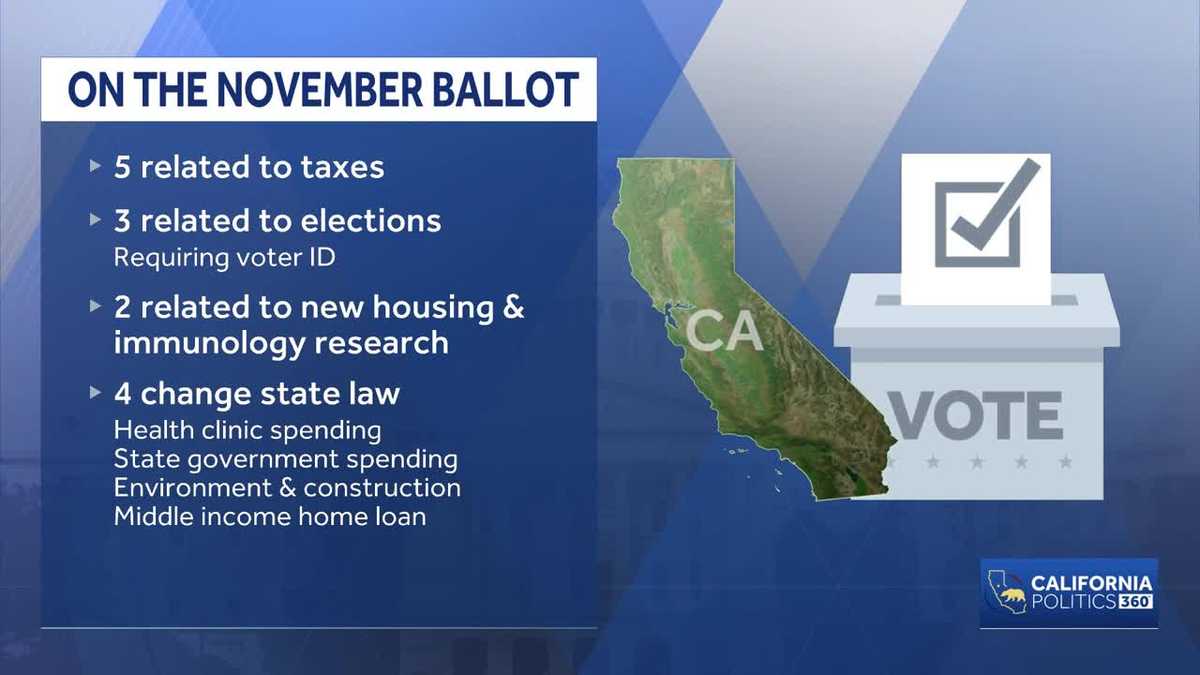
Five of the measures are related to taxes, three are related to elections and campaigns, three ask voters to borrow money for specific issues, and three make changes to state laws around spending, saving and environmental-related construction rules.
Here are the issues voters will decide:
Voter ID requirement: Requires government-issued ID at the polls or last four digits of the ID number for mail in-ballots. Elections officials would also be required to annually report percentage of voters with verified citizenship.
The billionaire tax: A one-time, 5% tax on the assets of California residents with a net worth of a billion dollars with the goal of raising $100 billion to fund mostly healthcare programs.
A ban on retroactive taxes and new personal property taxes: This is meant to defeat the billionaire tax and if both pass the one with the most votes becomes law.
Mandatory audits of how new taxes are used: This proposal is in response to the proposed billionaire tax, requiring strict oversight into how new taxes are used and prohibits any new taxes that are exempted from the state’s spending limit required under the state constitution, meaning it would cancel out the billionaire tax. The measure with the most votes becomes law.
Making it harder to raise taxes in cities and counties: This would require all new, local special taxes proposed by a citizens initiative to pass by a 2/3 vote of the people instead of a simple majority.
Middle income home loans: Through $25 billion in bonds, would establish a program to offer fixed rate mortgage for up to 17% of purchase price for homes that qualify. Borrowers must be California residents for one year, plan to occupy the home, earn less than 200% of area median income, and pay at least 3% down. Requires that bonds be repaid by homeowners’ mortgage payments, not the state.
Affordable housing bond: Allows the state government to borrow $11.25 in bonds to fund affordable housing construction and to help veterans buy homes.
Immunology bond: Allows the state government to borrow $8.4 billion to fund research for immunology and immunotherapy.
Community health clinic rules: Requires non-profit community health centers to spend 90% of their revenue on their charitable causes and patient services as opposed to management and overhead expenses.
Permanent Tax on higher-income earners: Makes permanent the existing 2012 voter-approved tax rates for high-income Californians for education including K-12 public schools and community colleges. It’s currently set to expire in 2031. Rates apply to personal income over about $360,000 for single filers, $721,000 for joint filers, and $490,000 for heads of household.
Fast-tracking environmental review for construction: This would change parts of California’s Environmental Quality Act to speed up environmental review of housing, transportation and other infrastructure projects. It would also limit the ability for lawsuits to stop or slow a project.
Ramp up the rainy day fund: This would change the California constitution to increase the maximum amount of money allowed under state law to be in the state’s rainy-day fund from 10% of the general fund to 20%. It would also require larger mandatory deposits into reserves. The measure would also update the list of eligible debt repayments that can be made using the fund.
Recall election changes: In a recall election for a state officer, California currently asks voters to first decide if the official should be recalled and then immediately decide who should replace them. This would make it so there would be a separate election of the replacement.
Public campaign financing: Would allow politicians running for public office to have their campaigns funded with taxpayer money if the candidate can meet certain thresholds showing the viability of their campaign.
KCRA 3 Political Director Ashley Zavala reports in-depth coverage of top California politics and policy issues. She is also the host of “California Politics 360.” Get informed each Sunday at 8:30 a.m. on KCRA 3.