
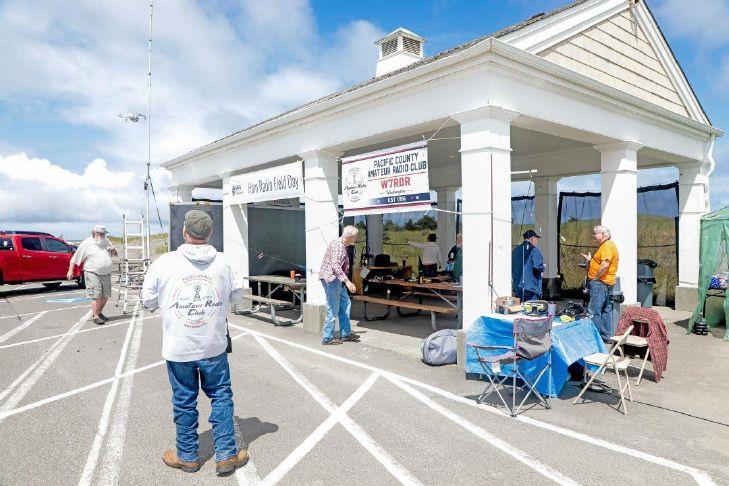
LONG BEACH — On a clear June afternoon, Dick Santoro and Arved Grass hunkered around a microphone and radio transmitter in a dimly-lit trailer under the Bolstad Pavilion.
“Alpha…Bravo…One Delta…Alpha…Bravo…copy,” Grass said into the ham radio microphone.
“Roger that,” Santoro replied.
“What’s his call sign?” Grass asked.
“I’ve got V-E-6-F-I,” Santoro said, jotting the contact information on a notepad before logging it into a computer.
The exchange was a simple interaction on amateur, or ham, radio, a two-way radio system that operates free of the internet or cell towers, relying instead on radio waves, personal transceivers and antennas.
The small, dedicated group of amateur ham radio operators — including Santoro and Grass among roughly a dozen others — were contacting each other as part of the national Ham Radio Field Day, held nationwide on Saturday, June 27, including participation from the local chapter, the Pacific County Amateur Radio Club.
What is ham radio?
Ham radio, or amateur radio, established in the 1960s with the first orbital satellite with two-way contact, is a two-way radio system used for non-commercial communication, technical experimentation and emergency response, according to the National Association for Amateur Radio, allowing people to communicate all around the world, or even into space, all without the internet or cell phones.
The system could play an important role in areas more susceptible to natural disasters, particularly for rural or isolated communities like the Long Beach Peninsula.
“If there’s a natural disaster and there’s no cell service or electricity, we are the people who can communicate,” said Pacific County Amateur Radio Club vice president Kevin Proett during the Ham Radio Field Day last Saturday at the Bolstad Avenue Pavillion in Long Beach. “We can bring emergency services and resources in off of our radios, send an e-mail or text message to family, where otherwise you wouldn’t be able to communicate.”
The point of having a ham radio is to communicate globally or locally without relying on the internet, cell towers, or commercial infrastructure, serving as a vital emergency lifeline, a decentralized communications network and an engaging technical hobby, according to the National Association for Amateur Radio.
‘We want to make this grow’
The Pacific County Amateur Radio Club, formed in 1996, currently has 35 members, but is looking to expand and grow with a new generation of enthusiasts.
“We want to make this grow,” Proett said, adding that he was first introduced to ham radio by his father before officially joining the group a couple years ago. “The stereotype is that ham radio is just a bunch of old guys, that we’re all 90 years old. But it’s a lot of fun and there’s so much you can do.”
The ‘friendly, rural club’ specializes in digital modes, DX, general interest, public service/emergency, repeaters, school or youth group, VHF/UHF with entry-level license classes, general or higher license classes, license test sessions, mentor and repeater, featuring an emphasis on operating and emergency communications.
The club’s activities involve staffing the RACES radio stations at the two Pacific County emergency operation centers as well as several local emergency relief centers located mostly in fire stations. The group supports statewide quarterly exercises, weekly local and district drills and monthly state/FEMA radio exercises. Field Day is held each June. Amateur radio instruction and monthly exams are generally available through the club, with sessions usually offered following the club’s monthly meetings.
There’s no age requirement to acquire a ham radio license, which includes technician, general and advanced levels, issued through the FCC (Federal Communications Commission).
“There’s kids that get their license at 10 years old,” Proett said. “You just have to pass a 35-question multiple choice test.”
The cost of the test is $35, and the license is legal for 10 years.
“There’s three levels: technician, general and advanced,” Proett explained. “Technician is limited in what you can talk to, with general you can talk on high frequencies (more nationwide) and advanced is even more. If anyone has any questions, we welcome them to attend one of our club meetings.”
The group is also participating in more community events to help spread awareness, including supporting the upcoming GrassRoots Garbage Gang beach cleanups and Long Beach Peninsula 4×4 Rescue.
“We’ll have a radio net set up on the beach cleanup, so we can communicate where stuff is needed,” Proett said. “We’re also working to integrate with the 4×4 club.”
Ham Radio Field Day
By lunchtime on Saturday, June 27, group members had established contacts with fellow ham radio operators in several surrounding states.
“It’s all based on solar, we’re ricocheting signals out into the atmosphere,” Proett said, detailing the sometimes fickle nature of ham radio and the ionosphere — the upper area of the atmosphere that acts a giant refractor, bending high frequency radio waves back to Earth and allowing operators to bounce signals and communicate globally.
“Yesterday, in the pouring rain, the frequencies were going nuts. Every time we turned the dial, there was another station. This event is international (U.S. and Canada). It’s about getting as many contacts as you can, but the main purpose is to create interest in ham radio.”
MORE INFORMATION
Pacific County Amateur Radio Club
Keith Hanson, President
Kevin Proett, Vice president
503-915-9400
Call sign: W7RDR
https://www.qsl.net/w7rdr/
Meets second Saturday each month, 9 a.m. at Hunter’s Inn, in Naselle