
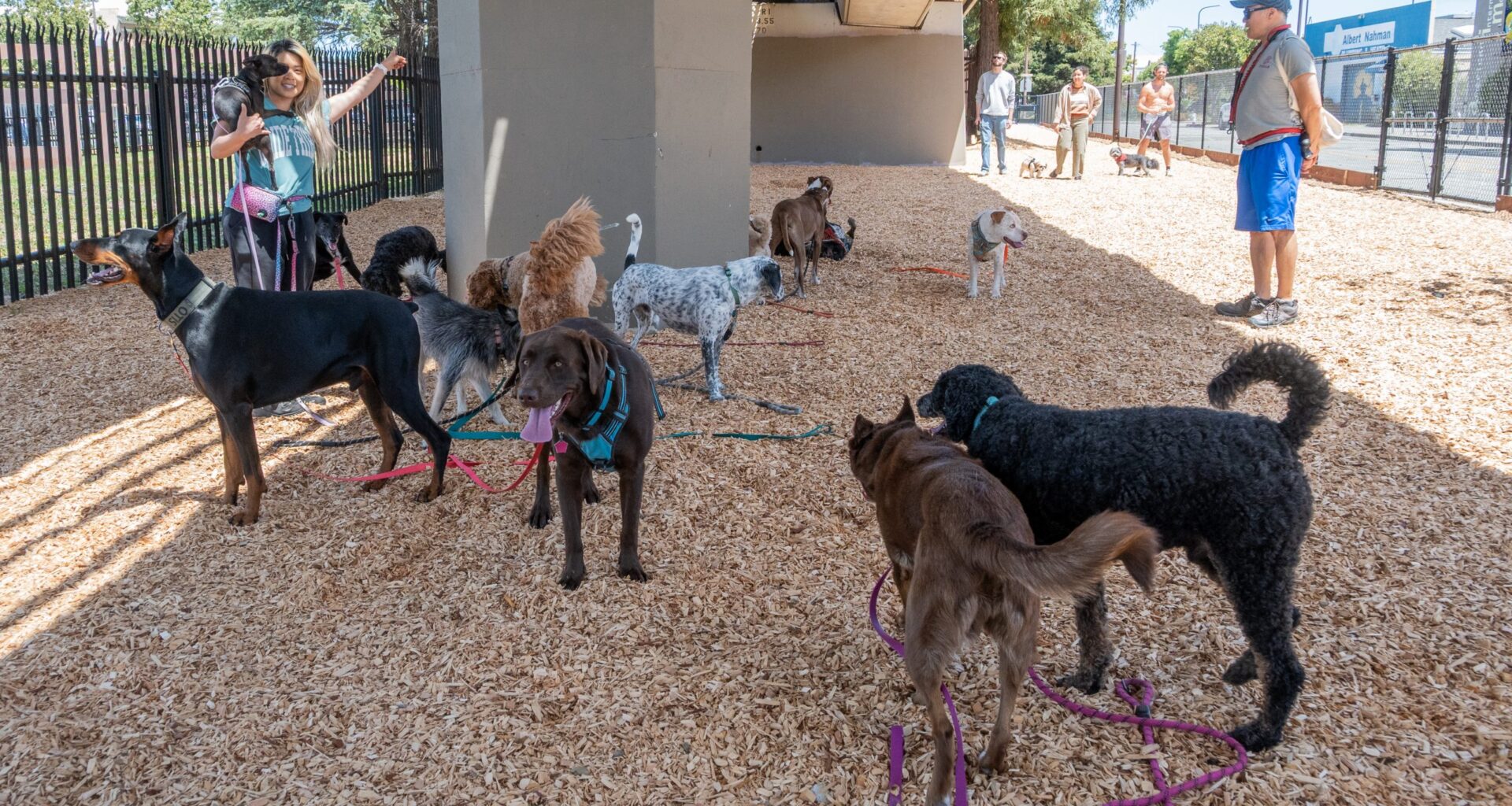
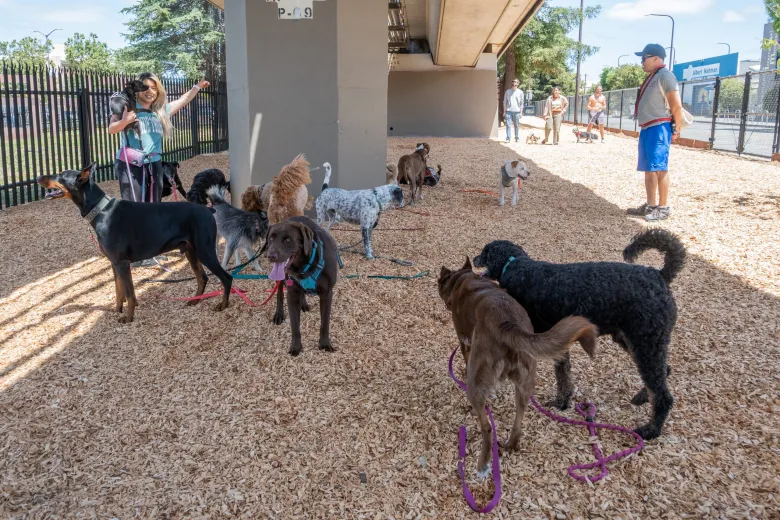
 Dogs explore the new Adeline Street dog park on Saturday. Credit: Hope Muñoz/Berkeleyside
A new dog park has opened under the BART tracks in South Berkeley — near the site along Adeline Street and Martin Luther King Jr. Way where the “Here There” homeless protest encampment put down roots for six years until it was shut down by the city in 2023.
The 8,000-square-foot, as-yet-unnamed dog park is part of a suite of landscaping work around the intersection.
Across the street to the south, next to the Buslab auto shop, the city has planted a Miyawaki forest — a type of “pocket” forest, popularized by a Japanese botanist, that first came to the U.S. through projects in Berkeley schools.
The dog park includes a drinking fountain, garbage cans and benches. Other landscaping additions around the intersection include native and pollinator-friendly plants, decorative fencing and boulders.
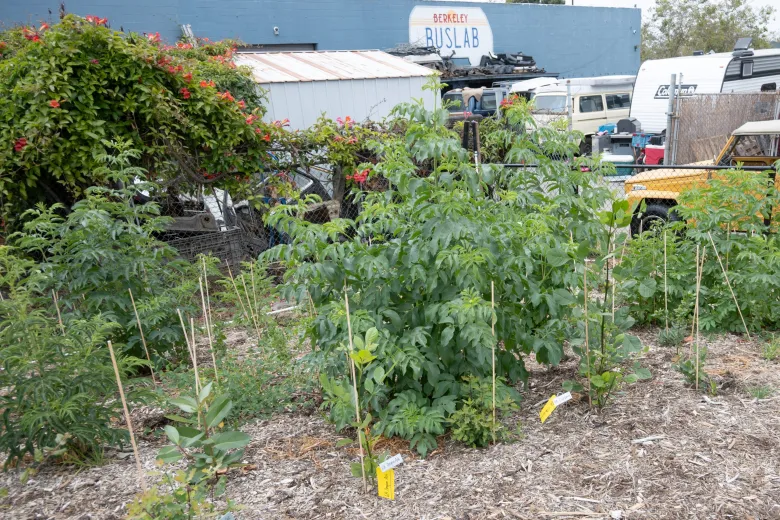 A Miyawaki forest at the corner of Adeline Street and Martin Luther King Jr. Way Jr. on Tuesday. Credit: Hope Muñoz/Berkeleyside
According to parks director Scott Ferris, the cost of the changes around Adeline and MLK totals about $650,000, funded by Measure T1, the parks tax and the general fund. They follow a string of transportation and other changes in the area that the city says are meant to improve safety and create more green space.
“These improvements provide the South Adeline area, which lacks appropriate park and open spaces, with long overdue needed landscape beautification, environmental enhancements and recreational amenities,” Ferris said.
The “Here There” sculpture, which is right on the Berkeley-Oakland border, was installed by artists Steve Gillman and Katherine Keefer in 2005 and is a riff on writer Gertrude Stein’s famous description of Oakland, her hometown, as having “no there there.” The area around the sculpture had been fenced off since the city closed the encampment.
The Here There camp was established in protest of the city’s criminalization of homelessness amid a housing crisis. Members of an activist group called First They Came for the Homeless sued the city and Bay Area Rapid Transit, claiming the city unfairly seized campers’ belongings and suppressed their political expression, but the case against BART was dismissed by a judge and the city prevailed in a jury trial in 2019. After the deaths of the protest camp’s founders during the pandemic, conditions deteriorated. Residents struggled with a buildup of trash, rodents and mold, and only six people were left at the time of its closure.
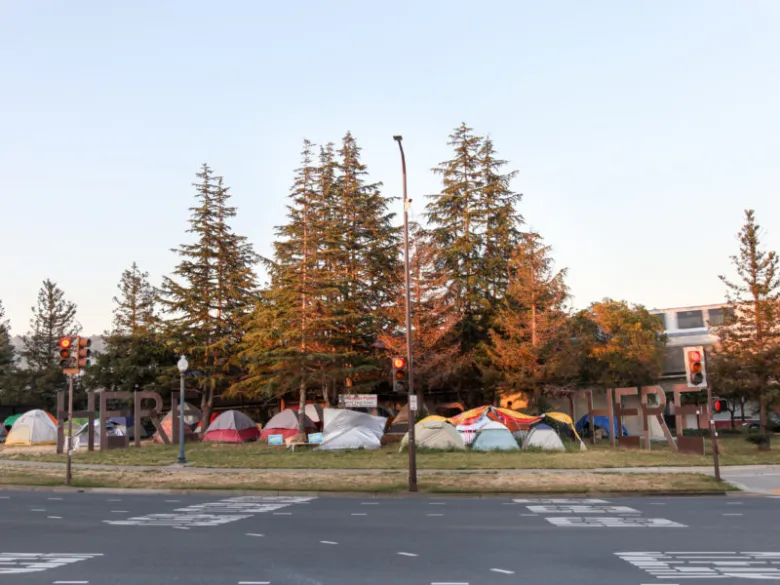 The encampment in the shadow of the “Here There” sculpture in 2017. Credit: Kelly Sullivan for Berkeleyside
Osha Neumann, a retired civil rights attorney and longtime activist for those without resources, said putting up a dog park on the site was part of a pattern of the city mistreating and deprioritizing its homeless residents.
“There is no space where homeless people can have a sanctioned place where they can live without being constantly swept and criminalized,” he said. “So we have dog parks, but not places for homeless people. Places for dogs, but not people.”
City officials made little mention of the former encampment at the grand opening ceremony on Saturday, in which Mayor Adena Ishii used a giant pair of scissors to cut through a shiny blue ribbon. Afterward, officials brought guests on a tour that included the dog park. Over a dozen dogs played on its woodchip-covered floor.
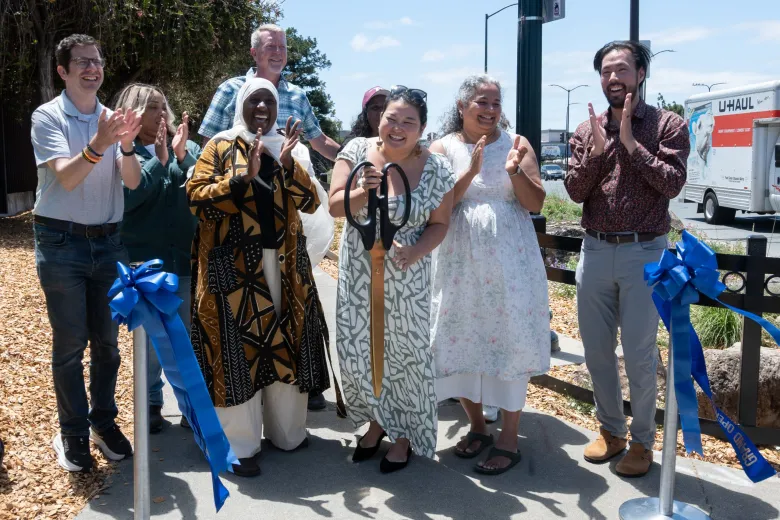 Mayor Adena Ishii cuts a ribbon commemorating a new dog park and landscaping improvements at Adeline Street on Saturday. Credit: Hope Muñoz/Berkeleyside
At the Miyawaki forest are rows of maple, elderberry and other saplings leaning on supportive sticks and labeled with white signs and yellow tags.
“Miyawaki forests grow 10 times faster than the traditional tree planting method,” said Neelam Patil, founder of Green Pocket Forests. “They are designed to address urban heat islands and biodiversity.” They use densely planted native species, have high survival rates and need less water.
The forest is already successful, said Patil. The trees are growing quickly, and a great amount of biodiversity is moving in, such as the monarch butterfly, California sister butterfly and ladybugs.
Berkeley resident Nina Lopez brought her shih tzu Jupiter to the ribbon-cutting. “He loves being out, and I think this area needs some love,” Lopez said. “We’re very excited about it.”
“I love seeing this kind of investment in South Berkeley,” said Susi Marzuola, who has lived in the neighborhood since 1989. “It makes a huge difference. I’m looking forward to seeing this in bloom year after year.”
We know that most readers don’t get to the end of the article. But you did! To support our in-depth, rock-solid reporting, please consider making a donation to our nonprofit newsroom today. We rely on our readers — particularly the ones who read the whole story!
“*” indicates required fields