
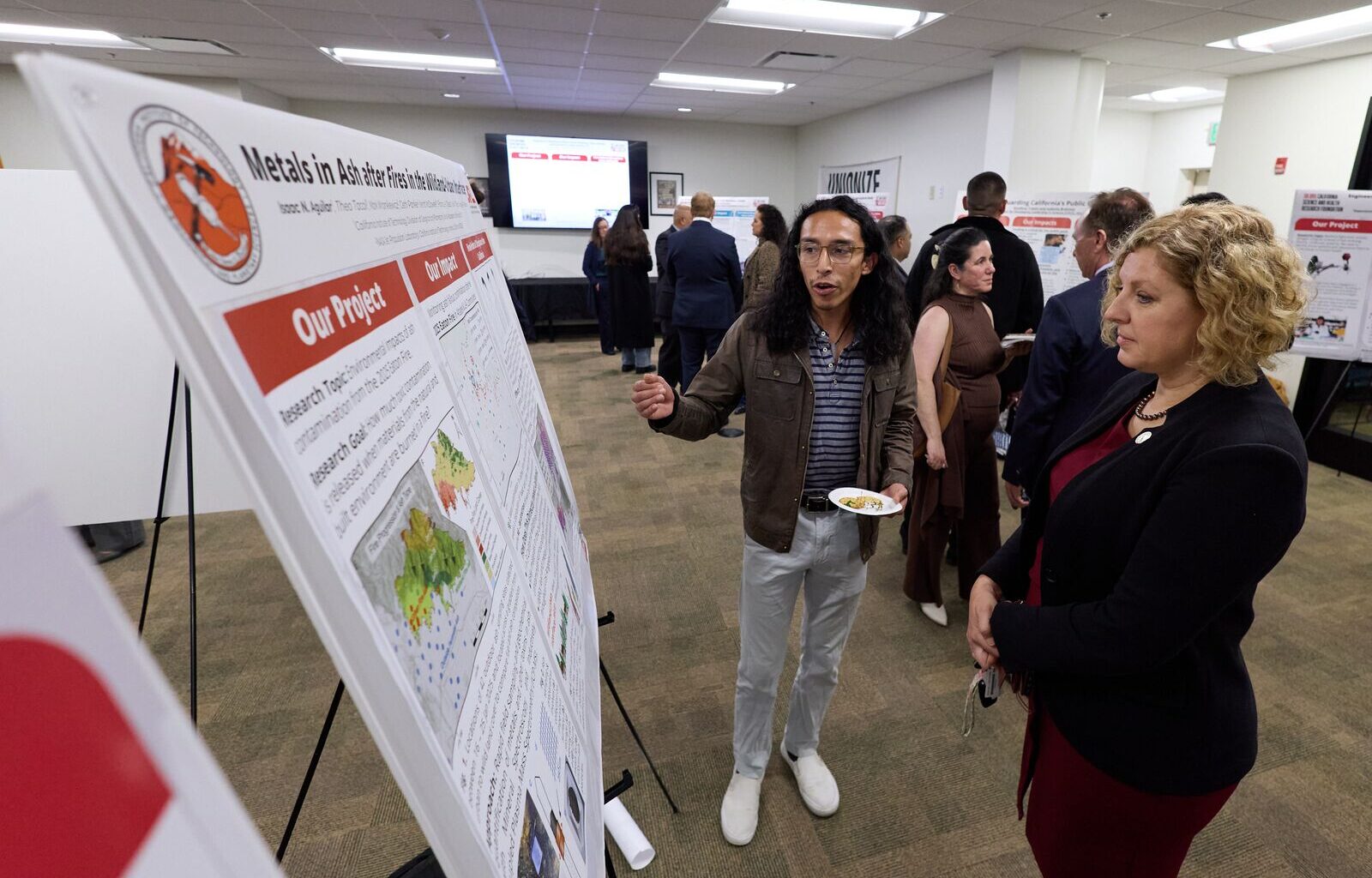
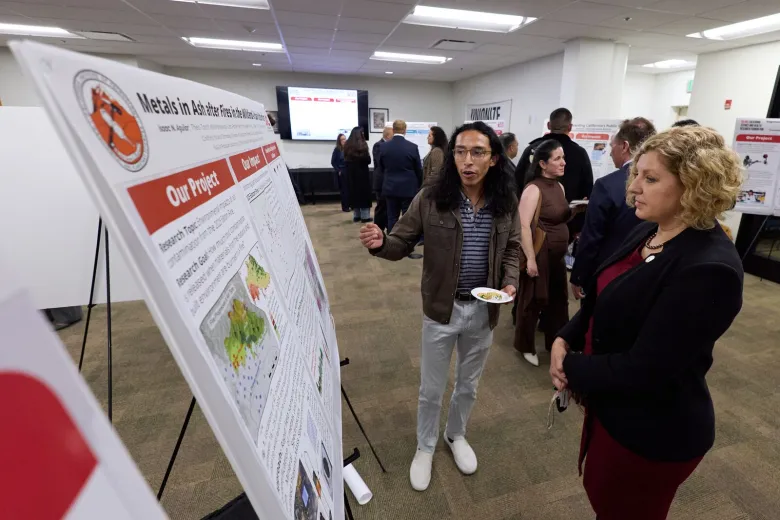
 California Assembly Member Pilar Schiavo listens to Caltech Ph.D. student Isaac Aguilar explain his research on metals found in the ash following the Los Angeles fires during a science fair for threatened and cancelled research held in Sacramento on Jan. 26. Credit: Fred Greaves for Berkeleyside
A proposed $12 billion bond measure to fund scientific research missed a deadline last week to qualify for the November ballot, dimming the hopes of scholars and University of California leaders who had aimed to use the funds to backfill losses in federal grants.
Are you a UC researcher whose work has been affected by federal grant cancellations?
Send me an email to reporter Felicia Mello at felicia@berkeleyside.org, or message her on Signal at Felicia.97.
State Sen. Scott Wiener urged state legislative leaders on Friday to extend the deadline and place the measure on the ballot in a joint statement with two other authors of the bill and a union leader, saying the Trump administration’s slashing of federal science funding “calls for real urgency.” (Any deal would likely need to happen before July 2, when the Legislature is set to adjourn for the summer.)
The bond proposal came as the administration has canceled thousands of grants to scientists nationwide that it said didn’t align with its priorities and is proposing rules that would further politicize federal grantmaking. UC Berkeley alone has lost tens of millions in funding from the National Science Foundation, National Institutes of Health and other federal agencies.
“The University of California is facing the most significant disruption to our research enterprise in our history,” UC President James Milliken said at a May rally in support of the bond.
The bill would have given Californians the opportunity to vote in November on whether to set up a state fund to support research in curing deadly diseases, preventing wildfires, tackling climate change and other scientific quests. In addition to raising $12 billion through a bond measure, the state would also have collected private donations, and would have received a portion of the revenue from inventions developed with money from the fund.
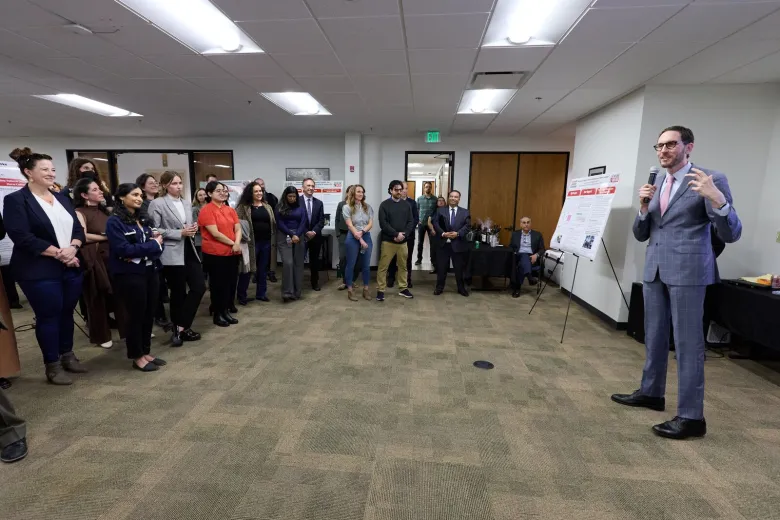 State Sen. Scott Wiener, who has proposed the multi-billion-dollar scientific research fund, talks at the science fair in January. Credit: Fred Greaves for Berkeleyside
Originally designed to raise $23 billion, the proposal was scaled down during the legislative process and passed the state Senate with bipartisan support. But it failed to make it to the Assembly floor before Thursday’s deadline for measures to qualify for the November ballot.
Nick Miller, a spokesperson for Assembly Speaker Robert Rivas, said legislative leaders — who typically come to an agreement with the governor before placing bonds on the ballot — faced painful choices as they tried to plan for Medicaid cuts and other federal policy changes that were likely to impact the state in the near future.
“Trump’s full-scale assault on California touches nearly every public service and program,” Miller wrote in an email. “California simply cannot backfill all these draconian cuts — and the economic chaos Trump has unleashed forces the state to prepare for even more uncertainty ahead, severely constraining bonding capacity.”
A spokesperson for the governor’s office did not respond to messages seeking comment.
As California’s leading public research university, UC Berkeley would have likely benefited significantly from the state fund, along with other UC campuses, private universities and labs.
“Scientific discoveries are absolutely critical to working families across California,” Mike Miller, president of United Auto Workers Region 6, a union that represents UC scientists, said in a joint statement Friday with Wiener and Assembly coauthor José Luis Solache. They urged the Assembly, Senate and Governor Gavin Newsom to place the bond on the ballot, saying it would “secure the future of science in California.”
Researchers say their jobs have become more unstable as Trump administration has pulled back on funding
The campaign for SB 895 marked a rare moment of collaboration between the leadership of the UC and unions representing the university’s scientists, both of which sponsored the bill. Early-career scientists in particular emerged from their labs to hold a mock science fair, gather signatures from the public, and otherwise try to convince legislators that their work is critical to the state’s future.
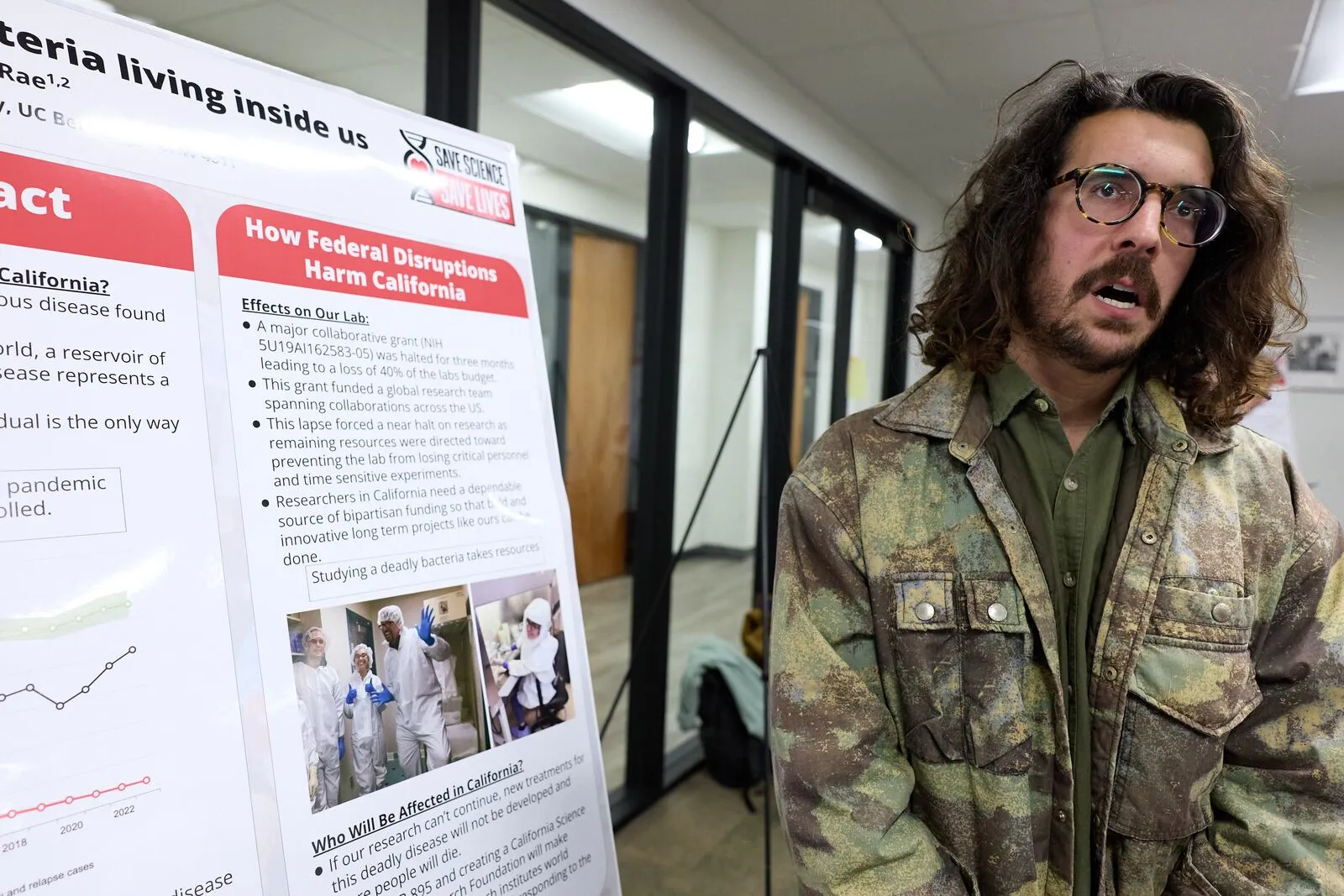 Christopher Rae, a UC Berkeley postdoctoral researcher who is investigating potential new treatments for tuberculosis, at the January science fair. Credit: Fred Greaves for Berkeleyside
Lara Schwarz, a UC Berkeley postdoc who studies how heat waves and wildfire affect human health, said job opportunities in her field were far more scarce than they had been just two years ago, as the National Institutes of Health pulled back on funding.
“California is experiencing more and more heat waves and wildfire smoke events and that’s not going away anytime soon,” she said. “The fact that we won’t have the funding to research this and understand how to respond is going to lead to drastic consequences on the health of Californians.”
The science bond, she hoped, could prevent researchers like her from needing to go abroad to pursue their work — or leaving the field altogether.
Housing bond may have crowded science bond off the ballot
Science bond supporters also faced competition from another pressing California challenge: the state’s housing crisis. Last week, Newsom struck an agreement with legislative leaders to place an $11 billion bond measure on the ballot that would fund the building and preservation of affordable housing.
Because bonds are essentially large loans the state takes out, with taxpayers paying the interest, their supporters often worry that having more than one such big-ticket measure on the ballot can weaken voter buy-in. State leaders, too, fear taking on too much debt. Voters are also set to decide in November on a more narrowly focused $8 billion bond measure, backed by billionaire philanthropist Gary Michelson and some patient advocacy groups, that would fund research into immunotherapy for serious diseases.
While court rulings have restored many of the grants to UC researchers that the Trump administration had sought to cancel, deep uncertainty remains about the future of federal science funding. Rules proposed by the White House’s Office of Management and Budget last month would require political appointees to review all new grants to ensure they serve the president’s priorities.
And in April, the National Science Foundation suspended another $21 million in research grants to UC Berkeley, saying the university failed to report foreign funding received by the projects’ principal investigators, a charge some of those researchers denied.
Related stories
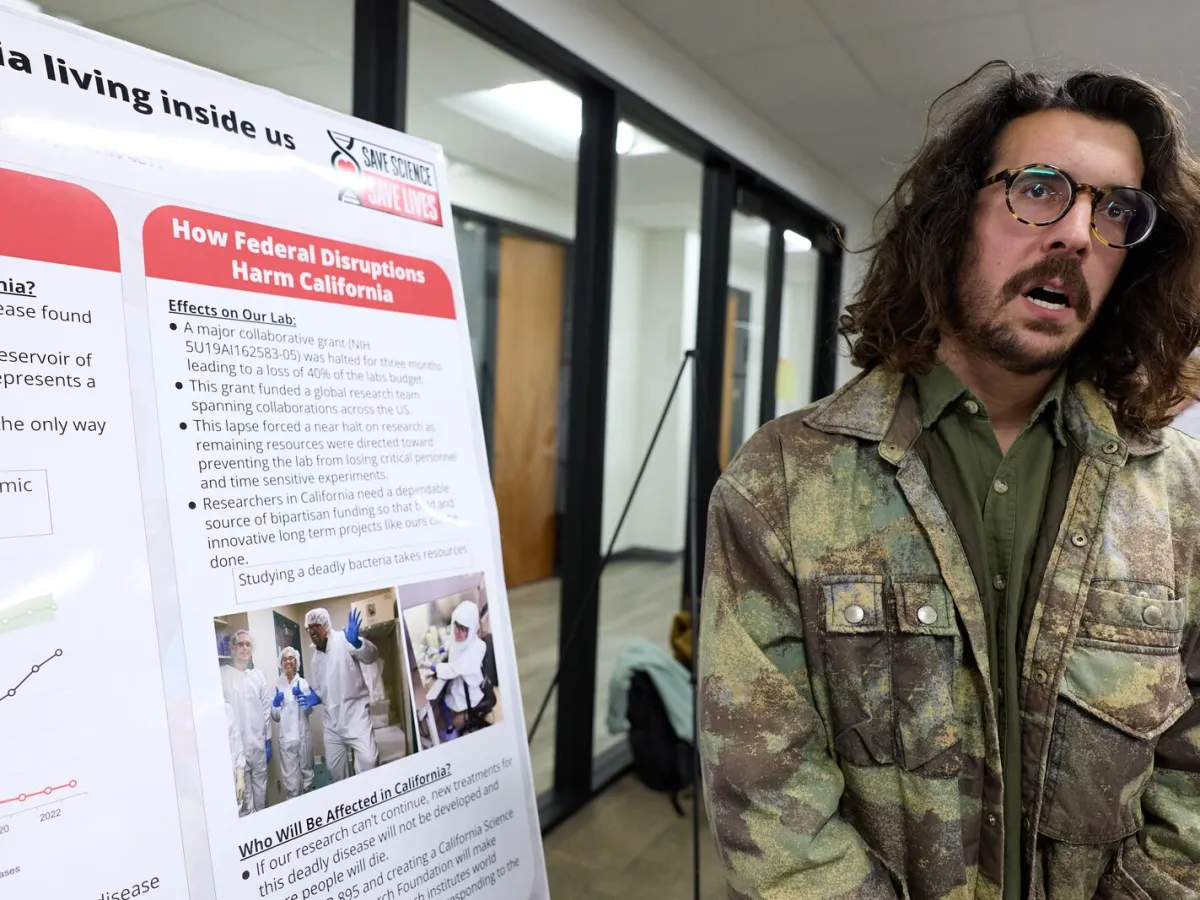
At science fair, UC Berkeley researchers lobby for $23B bond to offset Trump’s cuts
February 3, 2026June 29, 2026, 2:19 p.m.
The Indigenous exhibit that Trump failed to stop
May 19, 2026June 24, 2026, 3:45 p.m.
May 29, 2026June 1, 2026, 3:16 p.m.
“*” indicates required fields