
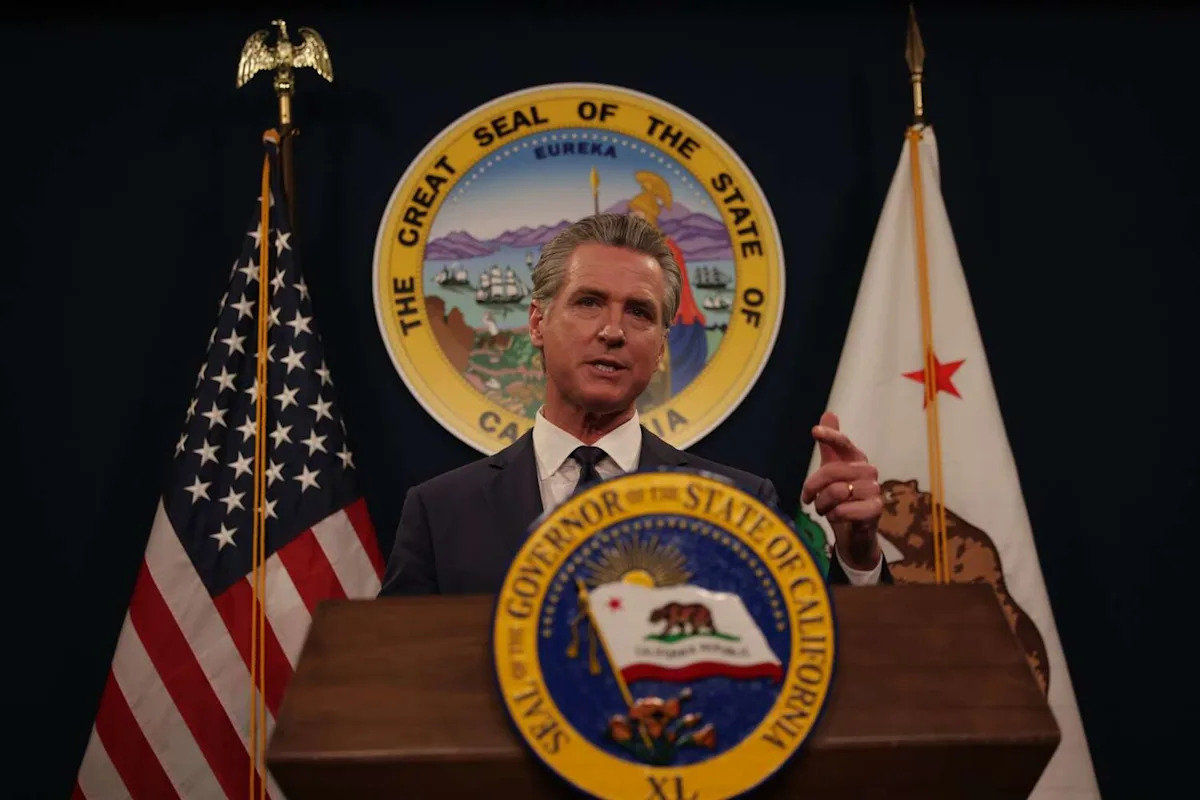
Gov. Gavin Newsom and California lawmakers approved a $351.7 billion state budget Monday – the last one Newsom will sign as governor – that increases some business and health care taxes and bolsters the state’s reserve funds.
The budget will also extend caps on corporate tax credits that would otherwise have expired in 2027. It also includes increased spending on housing and homeless aid, as well as money for county election offices to speed up vote counting.
The budget will bring the state’s reserve totals to nearly $29 billion. Newsom and lawmakers also agreed to place a measure on the November ballot that would expand the state’s so-called rainy day fund. If approved by California voters, the measure would make it easier for the state to save more in reserves to avoid painful cuts during budget deficit years.
The budget will delay some cuts to healthcare for low-income Californians that Newsom had proposed in May. Part of the way Newsom and lawmakers agreed to do that is to continue an existing tax on health providers to help fund Medi-Cal, the state’s health program for low-income people. It’s an unusual tax that providers for low-income residents actually support because it allows them to leverage federal matching funds.
But Newsom and lawmakers were forced to rework that tax because of new federal rules implemented through HR1, also known as the One Big Beautiful Bill Act, which requires states to tax public health plans at similar rates to private health plans.
To comply with federal law and keep the tax money flowing to Medi-Cal providers, the state must also increase taxes on private health plans. The California Association of Health Plans, which lobbies on behalf of health insurance companies, argues this will force them to increase private health insurance premiums.
Newsom acknowledged in May when he unveiled his final state budget proposal that the Trump administration “is not the easiest to work with” on California health care programs that require federal approval, including the tax revamp. If the Trump administration rejects California’s health plan tax proposals, it would create a multibillion-dollar hole in the state budget over several years that the governor and lawmakers would need to fill.
“It’s the Trump admin that was advocating HR1 in the first place, which is what necessitated this change,” said H.D. Palmer, a spokesperson for the California Department of Finance. “We hope and expect it will be approved.”
A White House spokesperson criticized the tax plan, but declined to say whether it would be approved.
“The Administration cannot prejudge an application until it’s thoroughly reviewed, but Gavin Newsom proudly pushing a plan that could jack up insurance premiums is on par for California Democrats,” White House spokesperson Kush Desai said.
Democrats framed the budget as a rebuke to President Donald Trump and an attempt to shore up the state’s safety net in response to federal cuts to health care and food aid. Many elements of the budget, particularly on healthcare, came in response to what Sen. Lola Smallwood Cuevas, D-Los Angeles, described as “Washington essentially turning its back on working people, particularly those working in low-wage sectors.”
“It’s really our responsibility to make sure that those working families are not standing alone,” she said during a Monday morning hearing on the budget. “I think this budget attempts to do that in a serious way for some, but certainly not for all.”
The state budget does not cover healthcare services for all Californians, she noted, and will still leave many immigrants without legal authorization to live in the United States without adequate care.
But Republicans pushed back on that framing, pointing out that Democrats have for years approved budgets that, in the long run, are projected to increase spending at a higher rate than the state brings in tax revenue. That’s not Trump’s fault, and is a big part of the reason Newsom first proposed scaling back care for undocumented immigrants.
Sen. Shannon Grove, R-Bakersfield, said state spending under the budget passed Monday is “unsustainable” and noted that the nonpartisan Legislative Analyst’s Office projects multibillion-dollar structural deficits moving forward.
A representative for the Legislative Analyst’s Office confirmed that Grove was correct, though he noted that the budget does reduce projected structural deficits from an estimated $20-$30 billion to closer to $8 billion.
Newsom touted the budget as a capstone achievement after nearly eight years as governor.
“This budget reflects years of disciplined decisions that built historic reserves, paid down debt, strengthened our economy, and made transformational investments in education, healthcare, housing, infrastructure, and opportunity,” Newsom said in a video announcing he had signed his final budget. “We’re leaving California stronger than we found it.”
Subscribe
There’s more to San Francisco with the Chronicle. Subscribe today for just 25¢.
This article originally published at Newsom signs $351.7B California budget deal. Here’s what it does.