
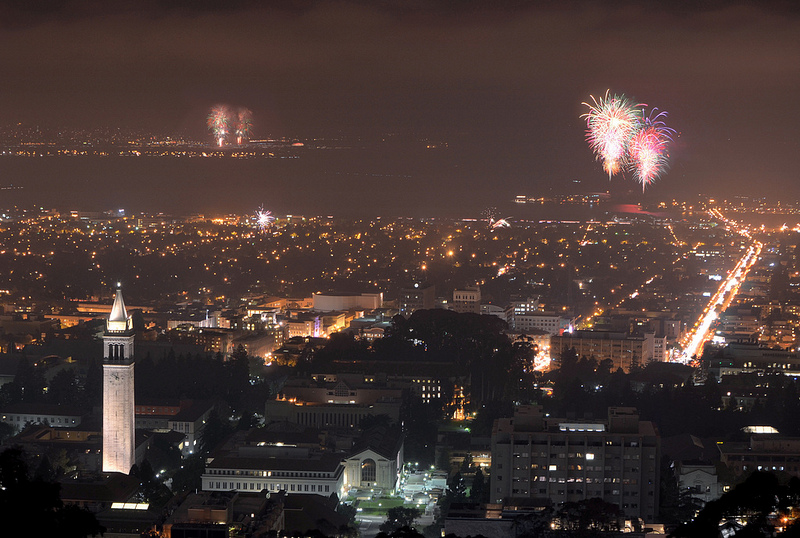
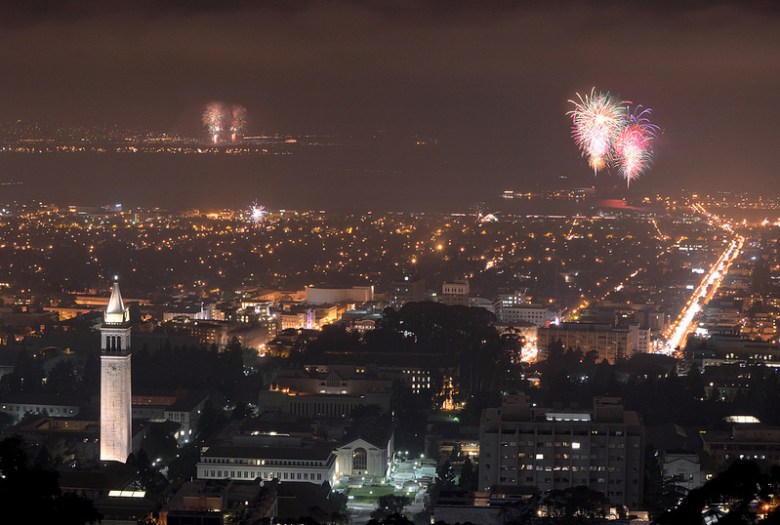
 Fireworks explode at the Berkeley Marina and over San Francisco in 2012. Credit: D.H. Parks
This Fourth of July marks 250 years since the signing of the Declaration of Independence. And the Bay Area will be taking its celebrations to a whole new level accordingly.
A major highlight will be San Francisco’s annual free fireworks show taking place not at its usual Fisherman’s Wharf location but on the Golden Gate Bridge itself — only the third time this has happened in almost a century.
The city of Berkeley has not put on its annual fireworks display at the Marina since 2019, citing budget restraints in past years. Some roads and amenities in the Berkeley Hills and Tilden are typically closed due to fire risk.
Along with fireworks galore, there will be a host of events throughout the Bay Area reflecting on America’s past and present — not just parades and parties, but crucial remembrances, exhibits and teach-ins.
So keep reading for what to know about fireworks (and drone) shows on the Fourth of July, 2026, from where you can safely view an official fireworks show, tips on comforting your pets, or navigating the holiday’s sights and sounds if you are living with post-traumatic stress disorder.
If you’re planning on buying your own fireworks, be careful. Since unofficial fireworks can cause truly dangerous situations — burning and seriously injuring people, sparking wildfires, and causing major property damage — fireworks are also banned in many parts of California. You can jump straight to our section on tips and regulations around fireworks to learn more.
Fourth of July fireworks and drone shows around the Bay Area
July 4 this year falls on a Saturday, and most fireworks and festivities will be happening that day, usually starting after dusk, around 9:30 p.m.
But not all of the celebrations will take place on that Saturday, so be sure to check the date and time of the event before you head out. Some events may require tickets in advance, so be sure to keep an eye out for that or possible cancellations due to interruptions like bad weather.
San Francisco
This year’s fireworks in San Francisco will be set off from the Golden Gate Bridge on Saturday, July 4, rather than the show’s usual spot at Fisherman’s Wharf.
The city has a thorough page on details about the Golden Gate Bridge fireworks, but the highlights are that the show is free and will start around 9:30 p.m. The best viewing locations are Crissy Field, Marina Green and Pier 39 and Northern Embarcadero. For those who don’t mind spending a bit of money, there will be private cruise options for the fireworks viewings, with tickets available on Eventbrite.
A heads-up: The city’s website recommends avoiding the Ferry Building and Embarcadero waterfront, since there will be no view of the fireworks there. Views of the Golden Gate Bridge fireworks will also be limited at Ocean Beach.
Also, a PSA for drivers in the area on July 4: The Golden Gate Bridge will be fully closed to cars “from shortly before” the 9:30 pm scheduled display start time until “shortly after” the end of the fireworks show, according to the city. “Closure duration may change based on operational needs,” the city’s website reads. “Expect delays before the bridge reopens.”
The bridge’s sidewalks will also be closed to pedestrians and cyclists at certain times on July 4, with the east sidewalk closed as early as the morning of July 3. Read the full list of closures on sf.gov.
East Bay
South Bay
North Bay
Fourth of July parades, festivals and parties around the Bay Area
East Bay
San Francisco
South Bay
North Bay
America 250 exhibits and longer-term events
Something else to bear in mind: Until July 6, California State Parks is also offering a downloadable free pass to celebrate America 250, which can be used for free entry to all state historic parks through Dec. 31.
Crucial reminders for fireworks safety in the Bay Area
How personal fireworks — and bonfires — can injure or kill you
Even before considering the huge risks of sparking a wildfire (more on this below), setting off your own fireworks — even when legally purchased in one of the areas that permits them — can be incredibly dangerous.
At a 2023 safety briefing, Dr. Clifford Sheckter, Director of the Regional Burn Center at the Santa Clara Valley Medical Center, gave graphic examples of the kinds of injuries — and even deaths — that attempting to set off your own fireworks can incur. On mortar-style fireworks, Sheckter warned that “if those go off in your hand, you are losing fingers, if not your whole hand. If this goes off by your face, you could end up blind.”
And while sparklers might strike many folks as a small, innocuous kind of personal firework on July 4, Sheckter noted that not only are they illegal in many areas, but sparklers can also pose massive threats to children. “Kids think it’s a popsicle: They put it in their mouths, they put it near their faces, they give themselves pretty severe burns and end up on the burn unit for one to two weeks,” he warned.
Fireworks remain prohibited in Berkeley, Oakland and in East Bay parks, as well as in California state parks and on National Park Service land. (and yes, sparklers are considered fireworks according to the state).
“Sparklers burn at 1,800 degrees, which is [hot] enough to burn gold,” Lt. Jonathan Baxter, a spokesperson for the San Francisco Fire Department, has said. “So if it can burn gold, you can imagine what it can do to your hand.”
Sheckter particularly stressed the importance of not mixing alcohol and drugs with fireworks or fire, noting that “one of the most common injuries” his burns unit sees around the Fourth of July is incurred by people “mixing alcohol and bonfires.”
“If you get wasted and fall into a bonfire, you’re either going to die, or you’re going to end up severely burned and on my burn unit for the next six months,” Sheckter said, warning of so-called sixth-degree burns that can extend down into a person’s bones. Injuries from these kinds of burns, Sheckter said, are very difficult to reconstruct and often necessitate tissue grafts or prostheses. Curious children wandering around campsites and grasping coals, embers or fire pit rings are also a common source of pediatric injuries.
How personal fireworks can spark wildfires at this time of year
In 2021, over 150 fire scientists were moved enough to join many fire officials across the West in urging residents to abandon their plans to launch personal fireworks on July Fourth because of the wildfire risks.
Mishandled fireworks, specifically around the Fourth of July in California, have caused real damage in the past. In 2014, a reveler set off fireworks in Yolo County near the Monticello Dam, igniting a 6,500-acre blaze that took days to put out, injured five firefighters and drove dozens of people from their homes.
The Bay Area Air Quality Management District also warned that “smoke from exploding fireworks results in elevated levels of particulate matter close to the ground, making it difficult for people to breathe, and may trigger asthma attacks, coughing, wheezing and eye irritation.”
“At the local level, personal fireworks can cause unhealthy buildup in particulate matter pollution over the July 4 holiday,” a 2023 statement reads. “‘Safe and sane’ fireworks, like those purchased at pop-up fireworks stands, contain metal salts used to produce colors and can also cause excessive smoke.”
Whether you’re planning to light up some fireworks or simply watch them from afar, here are a few safety tips compiled from experts around the state.
Check what kinds of fireworks are allowed
Although certain fireworks are legal in much of California, the state has a zero-tolerance policy for both the sale and use of illegal fireworks, and violators may face fines of up to $50,000 and jail time.
Illegal fireworks include firecrackers, Roman candles, skyrockets, bottle rockets, aerial shells and other fireworks that move on the ground or in the air uncontrollably.
Want to do a quick check? Look for the Safe and Sane label that indicates fire marshal approval. But sometimes even Safe and Sane fireworks are banned, like in Berkeley, Oakland and East Bay parks.
If you do set off fireworks, plan your location wisely
“We really are urging people to be extra cautious in wildland areas,” said Cal Fire’s Berlant, who notes that even in urban areas, fireworks can still spark a wildfire.
Berlant recommends you make “sure that Safe and Sane fireworks are used in areas that are cleared from vegetation” and are lit in “parking lots or in driveways that are surrounded by nothing that could catch on fire.”
Be ready to douse a fire
Never point fireworks at yourself or another person, and never attempt to relight or fix a firework that won’t light. Designate a sober, responsible adult to light up the fireworks. Light one firework at a time, far away from dry grass, and have a bucket of water or a hose handy in case something goes wrong. Also, this may sound obvious, but alcohol and fireworks do not mix well.
Properly dispose of fireworks
At the end of the celebration, all used and misfired fireworks should be submerged in water for 15 minutes and wrapped in a plastic bag to keep them from drying up. Then, toss them in the household trash. Any unused fireworks that have not expired should be kept in a cool, dry place away from children.
Berkeleyside is a media partner of KQED, a listener-supported public radio station serving Northern California. Berkeleyside occasionally republishes KQED stories we believe will be of interest to our readers.
We know that most readers don’t get to the end of the article. But you did! To support our in-depth, rock-solid reporting, please consider making a donation to our nonprofit newsroom today. We rely on our readers — particularly the ones who read the whole story!
“*” indicates required fields