
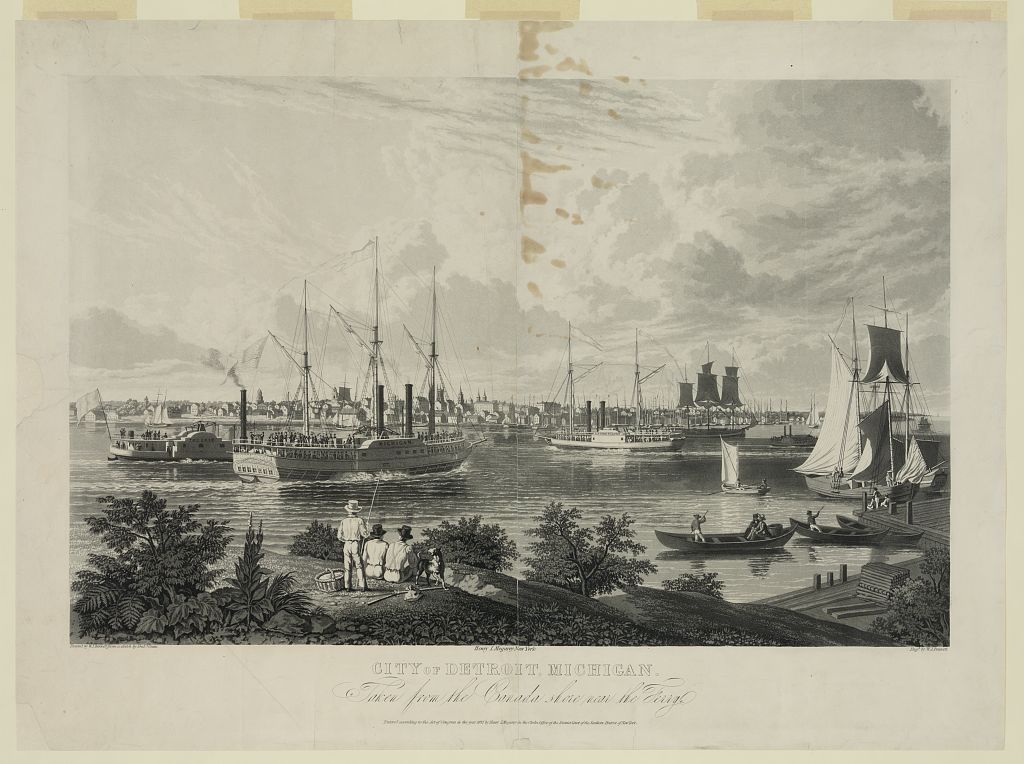
Michigan almost wasn’t a state.
Long before it became synonymous with automobiles, innovation and industry, Michigan’s future as part of the newly forming country was often iffy. A look back at Michigan’s impact on the country, now celebrating 250 years, shows that the almost missing piece — the state that finally joined the Union on Jan. 26, 1837 — made a big difference in the country’s future.
Nearly 190 years later, as the United States celebrates its 250th anniversary, few states have played such an outsized role in America’s development. Michigan helped fuel westward expansion, powered industrial growth, supplied the nation during wartime, advanced civil rights, and continually redefined innovation.
If America is a story of opportunity, historians say Michigan is one of its most vivid chapters.
“I think Michigan has been a land of opportunity for people from the beginning of America’s story,” said Amy Branfield, senior education advisor and America250MI state co-chair with the Historical Society of Michigan. “Whether it was settlers arriving through the Erie Canal, immigrants coming to work in mining and lumber, or African Americans arriving during the Great Migration, Michigan has served as a place where people could improve their lives.”
Nicholas DiPucchio, assistant professor of history at Oakland University, sees Michigan as a reflection of the nation’s founding ideals.
“Michigan embodies that ‘land of opportunity’ promise that the founders envisioned,” he said. “It was a place for ambitious fur traders, merchants, immigrants, runaway enslaved people seeking freedom, and later workers looking for economic opportunity.”
Before 1776: Indigenous nations shape the region
Long before Michigan became a state, the region played an important role in North America’s economic and cultural development. The Anishinaabe peoples, including the Ojibwe, Odawa and Potawatomi nations, established trade networks throughout the Great Lakes, making the area a center of commerce long before European settlement.
Branfield notes that Michigan’s abundant natural resources have always attracted people.
“It’s our natural resources — what we have around us — that have allowed people to come here and find opportunities,” she said.
1701: Detroit connects a continent
When French explorer Antoine de la Mothe Cadillac established Fort Pontchartrain du Détroit in 1701, he chose a strategic location that would become one of North America’s most important transportation and trading hubs.
Michigan’s position along the Great Lakes helped connect the interior of the continent to international markets.
“Michigan’s geography connects the interior of North America to the wider world,” DiPucchio said. “Whether we’re talking about Indigenous peoples, the French, the British or Americans, they’ve always viewed Michigan as an opportunity to connect the continent with global markets.”
1812-1815: A state nearly lost
One of the least-known chapters in Michigan history came during the War of 1812. American forces invaded Canada from Detroit, but soon retreated. Detroit surrendered without a major battle, creating fears that the United States could permanently lose the territory.
“There was talk about losing Michigan,” DiPucchio said. “Some policymakers were writing to President James Madison’s administration saying, ‘We should just abandon this place.’”
At one point, British leaders even considered turning the region into a Native American buffer state between Canada and the United States.
“There’s a good chance Michigan might not have been part of the United States,” DiPucchio said.
Instead, American forces regained control, preserving the territory that would later become vital to the nation’s economic growth and expansion.
1825: The Erie Canal opens the American frontier
The completion of New York’s Erie Canal transformed both Michigan and the United States.
By connecting the Great Lakes to the Atlantic Ocean, the canal accelerated westward expansion and made Michigan accessible to thousands of settlers seeking farmland, opportunity and a fresh start.
“You can still see that history today,” DiPucchio said. “Communities like Rochester and Utica share names with towns in New York because many settlers came from there.”
The canal helped turn Michigan from a distant frontier into a growing destination and future state.
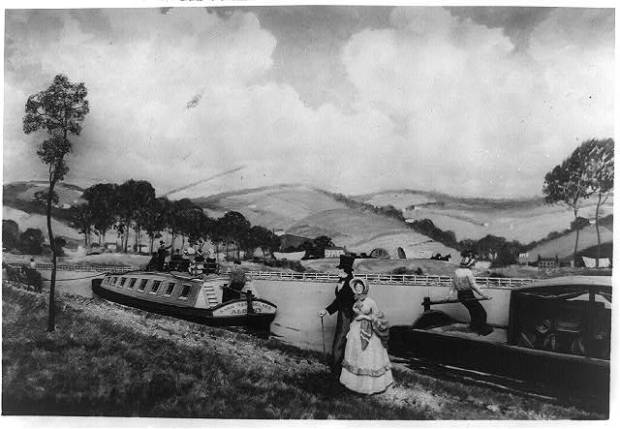 1825: The progress of the roads around the Erie Canal. (Photo courtesy Library of Congress)
1835-1837: The Toledo War and statehood
Michigan’s path to statehood encountered another obstacle when both Michigan Territory and Ohio claimed a strip of land near Toledo. Though the conflict involved more political maneuvering than actual fighting, Congress refused to admit Michigan until it relinquished its claim. The compromise granted Michigan most of the Upper Peninsula, a trade many residents initially viewed as unfair.
History would prove otherwise.
In the UP, Michigan gained access to enormous deposits of copper and iron ore that would help fuel America’s industrial growth for generations. Branfield points to Michigan’s first governor, Stevens T. Mason, as a key figure during this period.
“He fought hard for statehood,” she said. “He really wanted Michigan to have equal footing with the other states.”
And in 1837, Michigan officially joined the Union.
1840s-1890s: Fueling America’s industrial growth
As the nation industrialized, Michigan supplied many of the resources that made that growth possible. Copper from the Upper Peninsula helped electrify a growing nation. Iron ore fed America’s steel industry. Michigan’s vast forests supplied lumber for homes, railroads and expanding cities across the country. Branfield credits geologist Douglas Houghton with helping launch that growth.
“His report about the copper in the Keweenaw Peninsula really brought Michigan to people’s attention and attracted people looking for jobs and opportunity,” she said.
The state’s economy diversified rapidly. Furniture manufacturing in Grand Rapids, paper production in Kalamazoo, stove manufacturing in Dowagiac, cigar rolling in Detroit, and garment factories in the Upper Peninsula all contributed to America’s expanding economy.
“In Detroit, they had cigar rolling, something you don’t even think of and you don’t associate with Michigan, but they had a huge industry of cigar rolling, and many women were working in that industry early on, before women were really working out of the home,” Branfield said. “We’ve always had that industrious spirit.”
 1936: Giant wheels, 10 feet in diameter, once used for carrying logs to a Michigan sawmill. (Photo courtesy Library of Congress)
1850s-1860s: Michigan and the fight for freedom
Michigan’s contribution to America was not limited to economic growth. Its proximity to Canada made the state one of the last stops on the Underground Railroad, helping enslaved people reach freedom.
“Michigan was a hotbed for abolitionism,” DiPucchio said. “Many Michiganders played a role in helping enslaved people escape.”
The state also contributed soldiers to the Union cause during the Civil War and is often cited as one of the birthplaces of the Republican Party. An 1854 anti-slavery gathering, “Under the Oaks” in Jackson, helped launch the political movement that would eventually lead the nation through the Civil War.
Late 1800s-Early 1900s: Immigration, culture and community
As industry expanded, immigrants from Europe and elsewhere continued arriving in Michigan in search of opportunity. Branfield points to important but often overlooked figures such as Agatha Biddle and Jane Johnston Schoolcraft. Both women, whose mothers were Indigenous and fathers were European, helped preserve and share Native American culture and history.
Schoolcraft is often recognized as one of the first Native American literary writers published in the United States, while Biddle played an influential role in treaty negotiations that helped many Indigenous communities remain in Michigan during a period when Native Americans elsewhere were being forced from their lands.
Their stories reflect Michigan’s unique role as a meeting place of cultures and traditions.
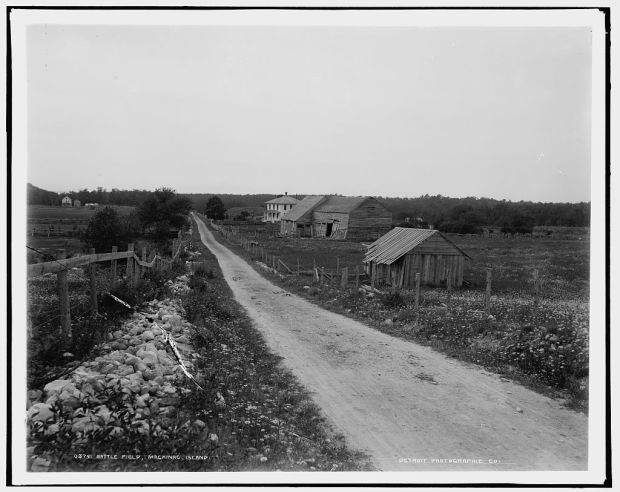 1899: A battlefield on Mackinac Island. (Photo courtesy Library of Congress)
1903-1945: The state that put America on wheels
No state contributed more to the transformation of everyday American life than Michigan.
Henry Ford and other automotive pioneers revolutionized manufacturing, making automobiles affordable for ordinary Americans and forever changing how people lived, worked and traveled. The automobile industry attracted workers from around the world and fueled the Great Migration, bringing thousands of African Americans north from the South in search of opportunity.
“Detroit became one of the largest cities in the United States,” DiPucchio said. “People believed they could make a great living there.”
The impact reached far beyond Michigan’s borders. New suburbs adjacent to Detroit emerged, and highways connected communities as American culture became increasingly mobile.
Then, during World War II, Michigan once again helped shape the nation’s future.
“When World War II came, and Michigan became the Arsenal of Democracy, what we were producing really helped make the United States a powerhouse,” Branfield said.
Detroit’s automobile factories converted to producing tanks, aircraft engines, and military equipment. Michigan factories produced approximately 25% to 30% of all American war material utilized during World War II. The rapid industrial mobilization helped pull the United States entirely out of the Great Depression and created an unprecedented workforce boom, drawing hundreds of thousands of women, “Rosie the Riveters”, and minorities into high-paying factory jobs.
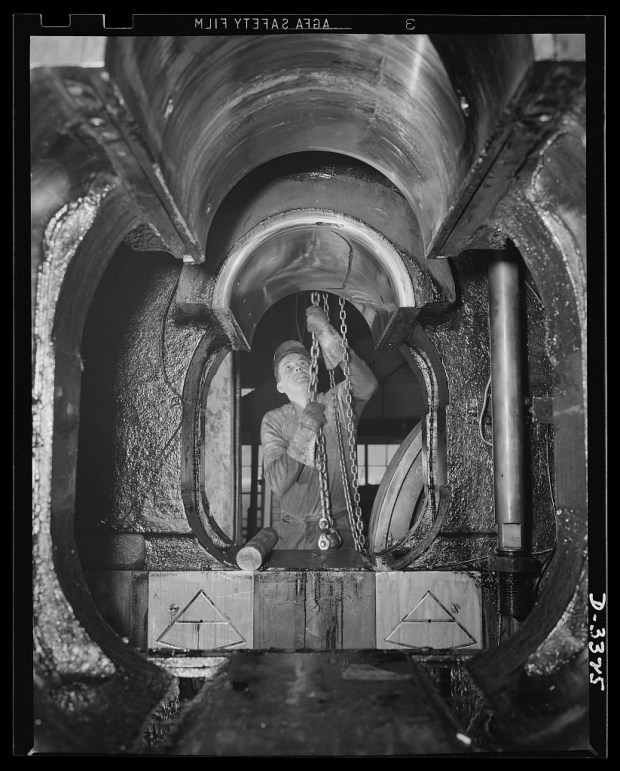 1942: A huge forge hammer in an automobile plant is converted to war work in Lansing, Michigan. The importance of the auto in American life is proving to be a tremendous advantage as the great automotive plants pool their resources in the mightiest war production effort the world has ever seen. (Photo courtesy Library of Congress)
1915–1970s: Crossroads of civil rights and opportunity
Michigan played a significant role in one of the most important social transformations in American history — the fight for civil rights and equal opportunity.
Beginning in the early 20th century, Detroit became a major destination during the Great Migration, the movement of millions of African Americans from the rural South to Northern cities. Yet economic opportunity did not eliminate discrimination. Housing restrictions, segregation and unequal treatment in employment persisted, prompting many Detroiters to become active in the growing civil rights movement:
Michigan emerged as an important center of activism. The Detroit branch of the NAACP became one of the largest and most influential in the nation. Labor leaders, clergy members and community organizers worked together to advance voting rights, fair housing, and equal employment opportunities.
One of the movement’s defining moments occurred on June 23, 1963, when more than 100,000 people gathered for the Walk to Freedom in Detroit. Led by the Rev. Martin Luther King Jr., the march remains one of the largest civil rights demonstrations in American history. During the event, King delivered an early version of the speech that would later become famous as “I Have a Dream” at the March on Washington.
Michigan also influenced the nation through culture. Detroit’s Motown Records broke racial barriers in popular music and introduced artists such as Diana Ross, Stevie Wonder, Smokey Robinson and The Temptations.
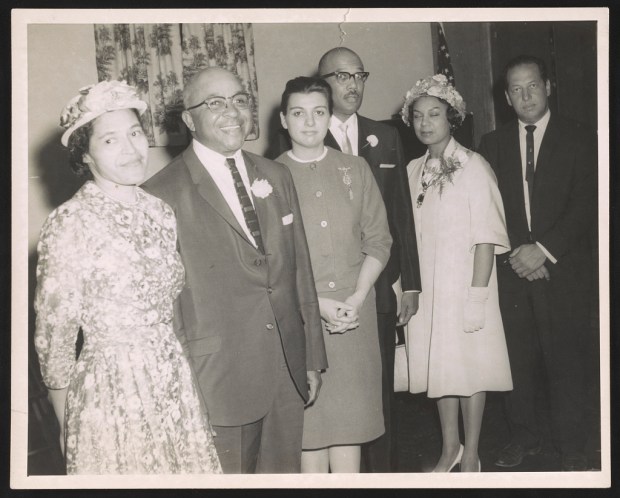 Undated: Group portrait with Rosa Parks and others, likely at an event, after the Montgomery Bus boycott. (Photo courtesy Library of Congress)
1930s–1970s: Building America’s middle class through labor
Michigan’s role in shaping America extends far beyond automobiles and manufacturing. The state became one of the most influential centers of organized labor in the nation, helping transform the relationship between workers and employers and laying the foundation for the modern American middle class.
A defining moment came in 1936 and 1937 with the Flint Sit-Down Strike. Rather than walking off the job, workers occupied General Motors plants, preventing production from continuing. The highly publicized strike ended with GM recognizing the United Auto Workers, marking a watershed moment for organized labor nationwide.
The victory resonated far beyond Michigan. Contracts negotiated by auto workers became models for industries across America, helping secure higher wages, health insurance, pensions, paid vacations, and workplace safety standards.
Michigan labor leaders also became influential voices on national issues. UAW President Walter Reuther emerged as one of the country’s most powerful advocates for workers’ rights, social justice, and civil rights, helping connect labor movements to broader efforts for equality and opportunity.
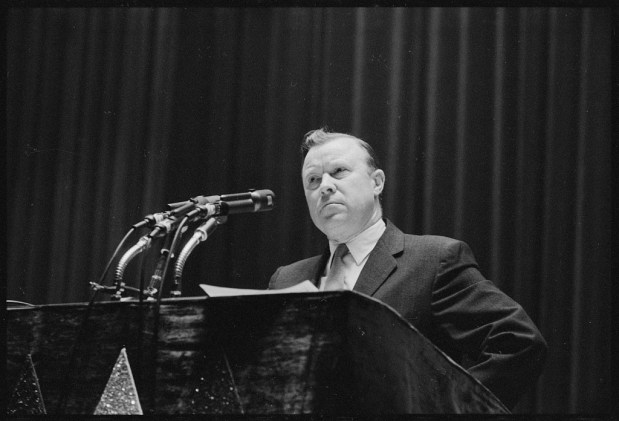 1958: United Auto Workers President Walter Reuther speaking at a UAW convention in Detroit. (Photo courtesy Library of Congress)
Today: Innovation continues
Michigan’s economy has evolved beyond automobiles while remaining rooted in innovation.
Advanced manufacturing, engineering, mobility technology, healthcare, research, and emerging technologies continue to shape the state’s future. DiPucchio sees a direct connection between Michigan’s industrial past and today’s technological landscape.
“Michigan has a long history of being a place of innovation and opportunity,” he said. “The foundations laid by the automotive industry continue to influence the economy today.”
He notes that while modern debates about data centers, artificial intelligence, and new technologies may seem unique, similar concerns accompanied every major period of industrial growth.
“Whether we’re talking about the 19th century or the 21st century, people are concerned about the impact of industrialization and new technologies on their communities and environment,” he said.
 1998: The former Packard Plant on E. Grand Boulevard in Detroit. (Photo courtesy Library of Congress)
Michigan’s enduring American legacy
For Branfield, the state’s greatest contribution may be its ability to bring people together around common goals.
“When people work together, they can achieve amazing results,” she said. “If we can find common goals, we can really solve whatever challenges we face.”
DiPucchio believes Michigan’s future should be built on the same principles that shaped its past.
“We should continue striving to make Michigan a place of innovation and belonging,” he said. “That’s one of the great successes of our past, and it’s something worth carrying into the future.”