
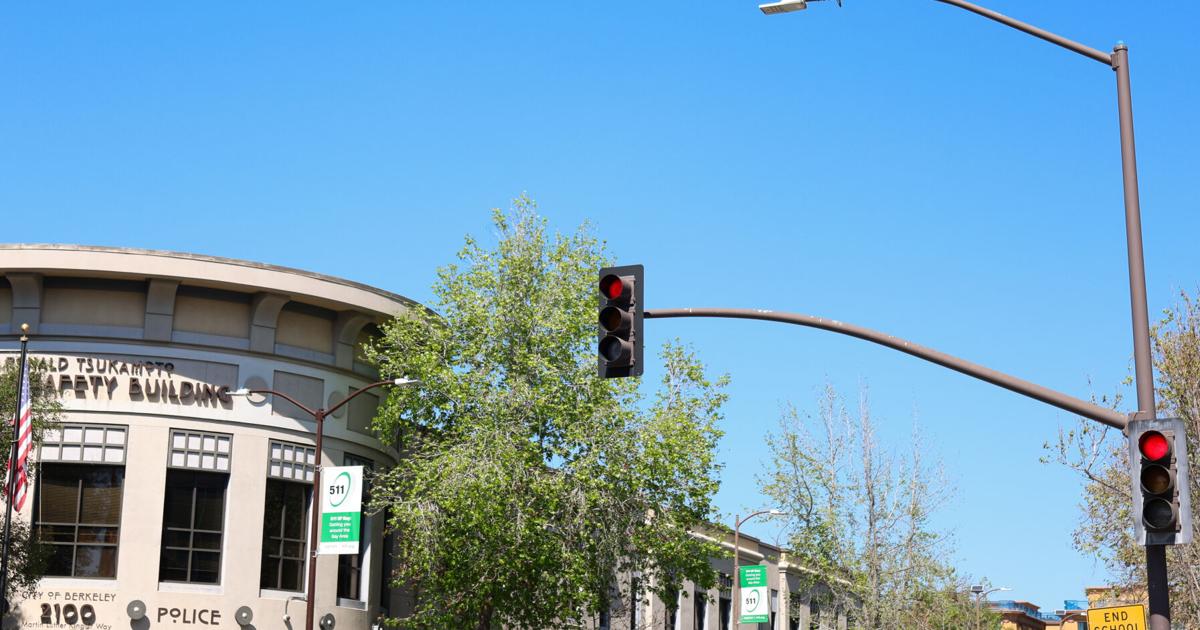
If you live in Berkeley, California — or in basically any American city — you are constantly under the watchful eye of a surveillance camera. Only now, Big Brother goes by a new name: Flock Safety.
Flock is a company that produces mounted surveillance cameras and automated license plate readers, or ALPRs, which have been adopted by municipalities across the country. Although these technologies are not new, they carry dangerous implications. Companies such as Flock covertly share the information they collect with federal agencies, including ICE.
Despite Berkeley’s sanctuary city status, external law enforcement agencies have searched ALPR data held by the Berkeley Police Department without the knowledge of the Berkeley City Council. Additionally, The Ellis Collective recently exposed the UC system for sharing ALPR data from its Flock cameras at its Merced and Riverside campuses with federal agencies.
Through ALPR data, ICE can find the registered owner of a vehicle whose plate was captured by the reader and, in turn, can learn where this individual lives, works and commutes, endangering both that individual and anyone they visit. These cameras act as ICE’s eyes, tracking the movements of our most vulnerable populations and violating Berkeley’s sanctuary city status.
A leaked memo from Berkeley’s City Attorney’s Office indicated that Flock refused to accept amendments proposed by the office that would have limited Flock’s ability to share data with federal agencies. However, when renewing the contract, Berkeley City Council did not engage in a competitive bidding process with other potential surveillance equipment providers, leaving it with very little leverage to pressure Flock to accept contract amendments.
Once the contract is signed, it is difficult for local governments and police departments to negotiate the terms of data sharing. Already, Flock has begun sharing information illegally through a “National Lookup” composed of ALPR data siphoned from the many cities with which it contracts, potentially even without the consent or knowledge of local governments.
As it stands, there are 52 Flock cameras in Berkeley alone. San Francisco and Oakland boast a staggering 2,173 cameras. Last month, Berkeley narrowly renewed its $200,000 contract with Flock for another year. So what are we to do now?
I will not pretend I have a perfect answer. What I can offer are some cautionary words.
The mass adoption of Flock’s surveillance systems is part of a greater political shift whereby the business interests of private tech companies supersede the authority of elected officials. Now that Berkeley’s deal with Flock is signed, there is no guarantee that Flock will continue to comply with California or Berkeley law surrounding data sharing. In fact, both precedent and the financial incentives offered by the federal government for data sharing indicate that Flock may do the opposite.
As more and more cities across the country adopt Flock, the federal government will have eyes, ears and license plate readers everywhere. Of course, this is not the only. Far from a top-down approach, the federal government has used Flock as a convenient tool to surveil American cities without the expensive and unpopular approaches of sending the National Guard or trying to directly influence state and local policies.
Of course, Flock is not the only company that hands over this type of information to the federal government. Companies such as Ring doorbell, which normally market themselves to private buyers, have previously come under fire for wanting to share data between customers, making sharing with the federal government seem imminent. We all know that our online presence is not safe either — both private data brokers and the government are able to purchase it to gain insight into our shopping habits, personal identities and political convictions. However, Flock is special as its entire business model revolves around contracting with local law enforcement agencies, which necessitates police surveillance. And with more than 5,000 cities across the country making these contracts, it is one of the fastest-growing surveillance companies in the country.
This is how mass surveillance happens. It is not as though you wake up one day with your phone tapped and the Thought Police at every corner. Rather, surveillance creeps up slowly; the more we get used to it, the worse it will become. Knowing you are being watched creates an environment where you police yourself. So although no laws have officially changed in Berkeley surrounding immigration or protesting, the adoption of Flock creates an environment in which you must assume that everything you do is under the watchful gaze of a federal agent.
My best practical advice is to learn where the cameras are positioned around the city, so you can know when and where you are being watched. This is doubly important if you are a non-citizen and/or engaged in protest.
Moreover, we must hold the city council members who voted to renew this contract accountable. Councilmembers Brent Blackaby, Mark Humbert, Rashi Kesarwani, Shoshana O’Keefe and Terry Taplin voted in favor of renewing the $200,000 contract. Out of these five, only Kesarwani has said she will not run for re-election — the others are likely hoping to be reelected this November. This means that now we have the most power we ever will as voting residents of Berkeley. We must show them that this decision is intolerable and vote for strong, opposing candidates where possible. We must make it clear that such a violation of our privacy and safety will not be tolerated.
In the end, there is no amount of surveillance that will preemptively stop crimes of passion or desperation. All surveillance will, however, decrease the privacy and freedoms of those whom it surveils. Just as I wrote after President Donald Trump’s election that we must not preemptively give up our rights in anticipation of them being taken away, I will caution readers not to retire their demands for freedom and privacy because they are being encroached on.
So while I encourage readers to be cautious and to know where cameras are, it is also important not to become dogs that refuse to cross the perimeter of the lawn long after our shock collars have been removed. We are the first people to bear witness to our own actions, and we must not turn the carceral gaze in toward ourselves.