
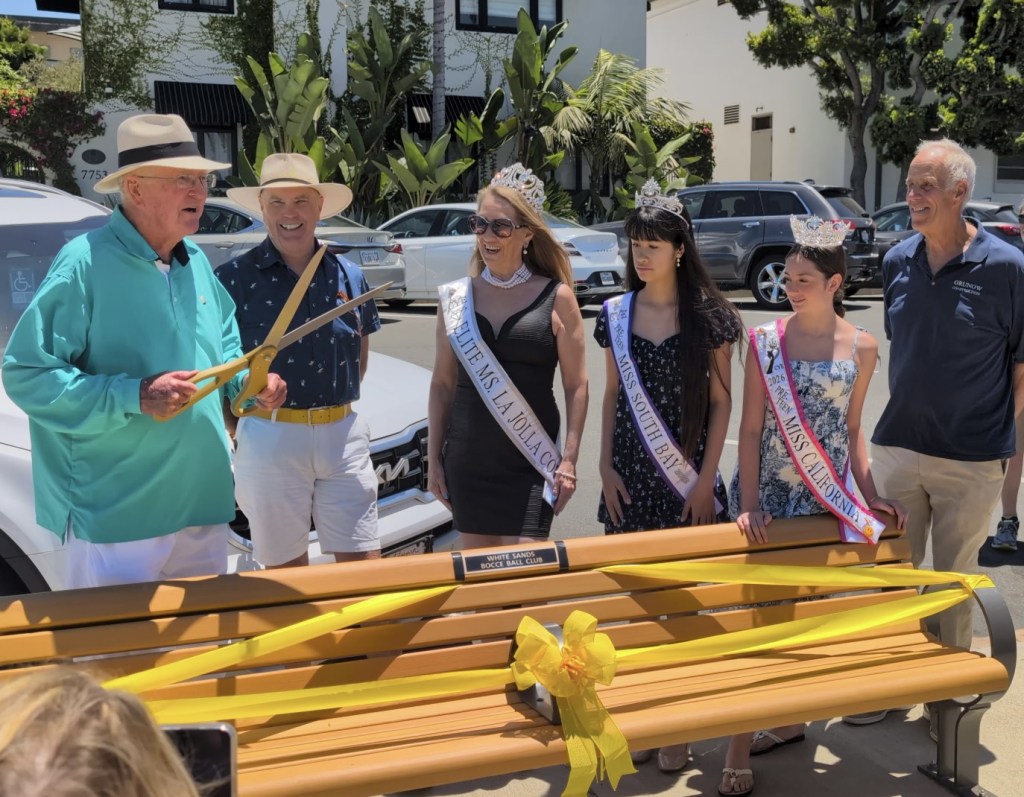
Community celebrates new bocce benches at Rec Center
About 50 bocce players, benefactors and community members gathered at the La Jolla Recreation Center on June 22 to celebrate new benches next to the bocce court.
The four 8-foot-long benches were installed May 29 beside the regulation-size bocce court along the Draper Avenue side of the Rec Center grounds.
The project took nearly two years.
Several people were recognized at the June 22 ribbon-cutting for their roles in making the benches happen: Vito Formica, who championed the bocce court’s creation in 2020; Brian Early, Ed Witt and Laurel Coito of Enhance La Jolla, who managed the project and placed the group’s name on permits; Tom Grunow and Jim Neri, who shepherded the San Diego Development Services Department design plan; and J.C. Thomas, assistant director of the department, who took the project under his wing.
Institutions that pitched in also were thanked, including the San Diego Parks Foundation (Ann Dynes), La Jolla Recreation Center (Nick Volpe), Kiwanis Club of La Jolla (Glen Rasmussen) and White Sands La Jolla (Clyde Crockett).
Children’s Pool gate removed and replaced
A rusted metal gate fronting the seawall walkway at La Jolla’s Children’s Pool recently was removed and replaced. The gate is closed when weather conditions make walking on the seawall unsafe.
The “severely rusted” and worn gate was removed in early June, according to city of San Diego spokeswoman Ombretta Di Dio, and caution tape and a sign were put in its place.
A new gate was installed later in June, she said.
San Diego hearing officer supports Whale View Point stairs repair
A plan to rebuild beach access stairs at La Jolla’s Whale View Point got the support of a city of San Diego hearing officer last week, clearing a key hurdle.
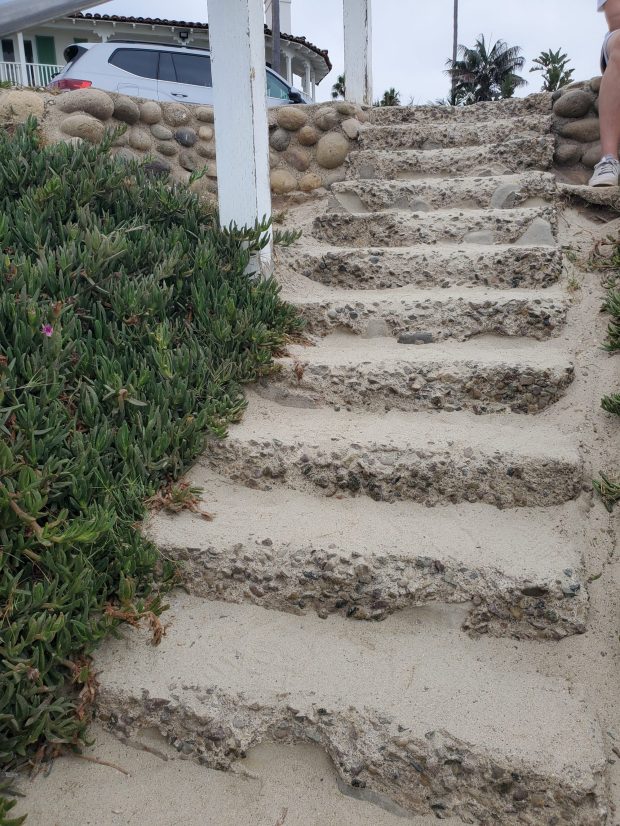 The beach stairs at Whale View Point in La Jolla are slated for repair. (Ashley Mackin-Solomon)
The hearing officer approved the project June 24 on the consent agenda, with no presentation or discussion and no speakers in opposition.
The plan is to repair, clean and install precast concrete pavers on the approximately 100-year-old beach access stairs in the 400 block of Coast Boulevard. The stairs are in the La Jolla Park Coastal Historic District, which also encompasses places such as La Jolla Cove, the Children’s Pool, the Casa de Mañana retirement community and the Red Roost and Red Rest cottages.
The district was listed on the National Register of Historic Places in spring 2024. At a celebration ceremony in November that year, volunteers said they were raising funds to repair the beach access stairs at Whale View Point.
In August last year, city representatives met with the volunteers to review the site’s condition and options for repair.
The city determined earlier this year that a costly and time-consuming coastal development permit would be required to complete the work because the stairs are within 50 feet of a coastal bluff.
The hearing officer’s decision approves the coastal development permit. The decision is final unless appealed to the city Planning Commission.
State bill to create ‘surfing reserves’ appears dead in the water
A state legislative proposal that would help create “surfing reserves” up and down California — with La Jolla being considered — appears to have suffered a wipeout.
Assembly Bill 1938, authored by Assemblywoman Jacqui Irwin (D-Thousand Oaks), would create an option for local governments to designate surf breaks as state surfing reserves if they meet certain criteria.
However, as part of the review process, the bill in May was held in the Assembly Appropriations Committee in what is known as the “suspense file.” That happens when bills above $150,000 cost to the state are considered at once and either are allowed to continue in the legislative process or are held. AB 1938 was held, and there currently is no schedule for it to be revisited.
“We know big ideas like this take a few attempts before they become law,” Irwin said. “To use a surfing metaphor, we missed the first wave, and if at first you don’t succeed, paddle harder. There are still many ocean lovers that are dedicated to seeing this through.”
La Jolla Light wins two awards in journalism competition
La Jolla Light staff writer Noah Lyons won a pair of honors last week at the Society of Professional Journalists’ San Diego awards ceremony.
Lyons took first place in the health category of non-daily reporting and writing for his October article “La Jollan blazes own path in fight to prevent blindness from rare illness.”
He finished second in the light-subject feature story category for “Sail-setting partners settle in La Jolla after decades on the water,” published in May 2025.
SPJ’s San Diego chapter recognizes print and broadcast journalists throughout the county. First-place winners receive a commemorative plaque, while second- and third-place recipients receive a certificate.
St. Germaine gives $160K at Star Bright Awards dinner
The La Jolla-based St. Germaine Children’s Charity gave $160,000 to eight youth-related agencies at its recent Star Bright Awards dinner. The groups help children who live in foster care or have experienced violence or exploitation.
The agencies are Big Brothers Big Sisters, Bithiah’s Family Services, Casa de Amparo, Friends of the Children, Olive Crest, Rady Children’s Hospital’s Chadwick Center, San Diego Police Foundation and Walden Family Services.
St. Germaine, founded in 1984 by La Jolla resident Barbara Christensen, raises funds through memberships, donations and three annual events to give money to 10 to 15 organizations each year to support efforts that align with its mission to aid abused and neglected children in San Diego County.
Mutt Strut raises $11K, with most going to dog rescue
The 2026 La Jolla Mutt Strut on June 20 brought in $11,000, of which $7,500 will go directly to the nonprofit animal rescue organization A Way Home for Dogs, run by East County “pet detective” Babs Fry.
 Dogs and their owners mingle on the Pacific Sotheby’s courtyard in La Jolla at the 2026 Mutt Strut. (Ashley Mackin-Solomon)
The event — part fundraiser, part scavenger hunt — invited dog owners to gather and socialize on the patio of Pacific Sotheby’s on Prospect Street before going on a walk with a map of certain Village businesses, each of which gave walkers a letter of the alphabet they could use to complete a word puzzle. After visiting all the businesses and getting all the letters, participants could turn in their completed puzzle for prizes.
Salk researchers revisit existing drug for pancreatic cancer treatment
Pancreatic cancer is the third-leading cause of cancer-related death in the United States. While scientists continue searching for new therapies, important advances also can come from understanding how existing drugs work.
By uncovering the underlying biology, researchers can identify new ways to use drugs, improve their effectiveness and overcome barriers that have limited their clinical impact.
Such was the case at the La Jolla-based Salk Institute for Biological Studies.
Salk researchers examined the effects of entinostat, an investigational cancer drug that inhibits enzymes called histone deacetylases, or HDACs. Their insights led them to design new ways to use entinostat against pancreatic cancer, including combining it with therapies that induce DNA damage and developing a nanoparticle-based delivery method that reduces side effects.
 Salk Institute scientists Gaoyang Liang and Ronald Evans led a pancreatic tumor study that developed new therapeutic strategies. (Salk Institute)
Working with collaborators at the Massachusetts Institute of Technology, the researchers developed a version of entinostat loaded into bottlebrush-shaped nanoparticles that preferentially accumulate in tumors and gradually release entinostat over time.
In preclinical models, the nanoparticle-based therapy produced strong anti-tumor activity while reducing toxicity, researchers said, suggesting it has a promising future for clinical translation.
Salk scientists also are exploring a more personalized approach to understanding chronic pancreatitis.
The inflammatory disease, which affects about 3 million people worldwide, has no cure because of how it varies from person to person.
The scientists’ new approach, published June 30, involves “disease in a dish” organoids that replicate a pancreas. For their study, researchers created 37 organoids personalized to match a patient’s original tissue and retain key molecular proteins and inflammatory factors.
Unexpectedly, there was dysfunction of a protein associated with cystic fibrosis in half of the organoids. As a result, cystic fibrosis is now seen as a possible therapeutic target for patients with pancreatitis, the researchers said.
Salk Institute explores iron’s role in neurodegeneration
A recent discovery by scientists at the Salk Institute for Biological Studies in La Jolla sheds light on the role of iron accumulation on the brain and neurodegeneration.
The findings center on chronoferroptosis, a chronic stress pathway in cells. Through this process, iron dysregulation in neurons can make them less resilient and more vulnerable to degeneration.
Iron accumulation thus appears to be a key target in predicting, preventing and eventually treating neurodegenerative disease, according to the study, published June 18 in Cell Death Discovery. ♦