
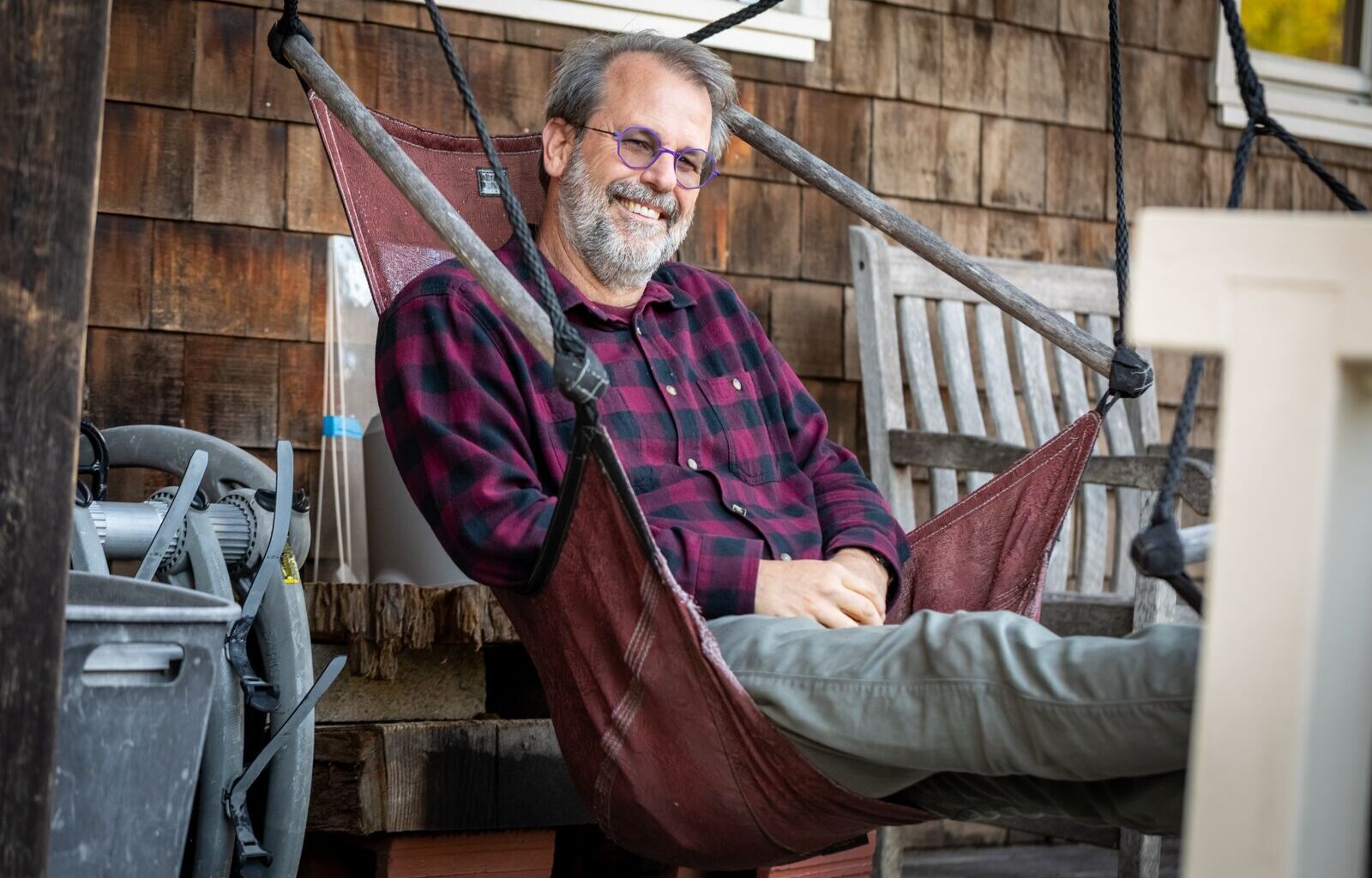
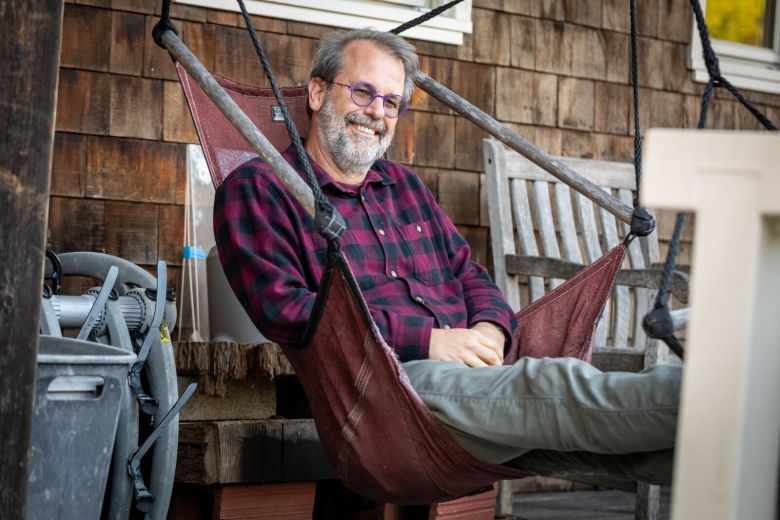
 Jeff Hobson sits in his favorite chair on the porch of his home in the Berkeley Cohousing community on April 28. In 2001, he and his wife, Kim Seashore, bought a two-bedroom for $270,000. In 2004, they bought a slightly larger home for $350,000. Credit: Kelly Sullivan for Berkeleyside
As the sun shot long shadows across the lush central garden, the scent of long-stewed brisket wafted out of the kitchen, permeating the air. The Craftsman-style sofas in the wood-panelled living room were empty now, but shelves of framed photos of members remained crowded on a nearby shelf. The cook went outside and rang a bell. Dinner time.
The idyllic scene is a family gathering of sorts — a chosen family. The 20 or so who dined together that Tuesday night are members of Berkeley Cohousing on Sacramento Street in West Berkeley, the city’s oldest cohousing community, where residents join together for a communal meal they cook themselves three times a week and everyone — young, old and in between — has a seat at the table.
Since its founding in 1994, Berkeley Cohousing has been a haven for old-time Berkeley values that emphasize cooperation and community with an underlying counter-culture vibe. It’s also a model for other cohousing and cooperative living arrangements, which are on the rise as the cost of housing spirals upward. In the fall, Berkeley Moshav will open on San Pablo Avenue, across the street from what might be a Frolic Community, now in the feasibility stage. Smaller, more experimental developments are also in the works. In addition to affordability, proponents of cohousing boast of the social benefits of multigenerational living and, for seniors, the ability to age in place.
“I love that I know my neighbors and I know who I can borrow a cup of milk from and who would join me on a bike trip,” said Raines Cohen, 59, a longtime cohousing advocate who has lived in the complex since 2003.
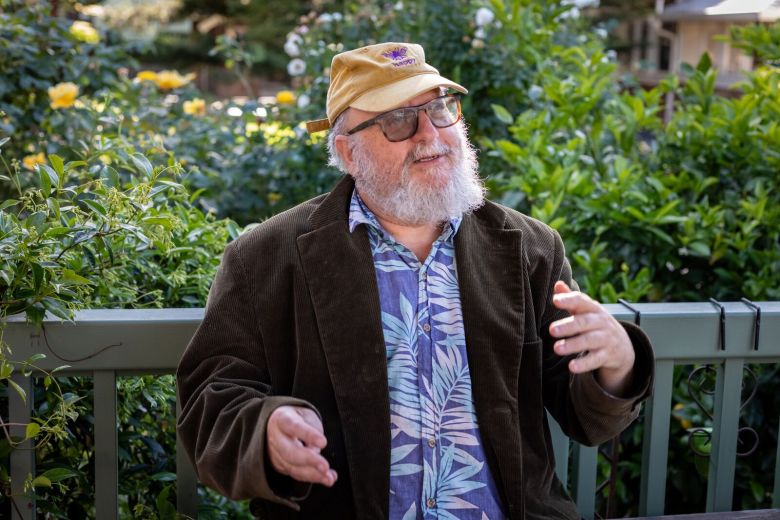 Raines Cohen sits on his deck. Credit: Kelly Sullivan for Berkeleyside
Berkeley Cohousing “has sort of replaced my church and family — although you can never replace family,” said Ashley LeBlanc, a physical therapist who, at 33, is one of the group’s younger members. “Every Friday night, I don’t go out with my friends. I hang out with my neighbors.”
“I love living in a community that spans all ages because that’s a natural way of living,” said Alice Green, 84.
But the sun may be setting on some of the community’s unofficial founding principles.
People may want to give their homes to their heirs. Their heirs may not care at all.” — Alice Green, 84
Thanks to a 30-year arrangement with the city, Berkeley Cohousing has been providing affordable housing to working people of moderate means. When the deed-restricted price and income caps expire next year, the value of the 14 condominium units will rise to market value. Some longtime residents worry that the counter-culture vibe and socially conscious values of thrift, sharing, caring and “coming together in community” will be sidelined for a more market-based view.
“I have mixed opinions,” said Jeff Hobson, 56, a member of the cohousing’s finance committee, who has lived in the community for 26 years and raised two children there. “I share the concern about the long-term impact on the makeup of the community. I also understand that the price cap makes it harder for people to sell their unit and turn that into another down payment or retirement money.”
The price cap, in effect, has prevented unit owners from climbing the usual real estate ladder, which encourages moving up to a more expensive house after a “starter home.” Not having the financial incentive to move out and up can also have the effect of encouraging owners to stay.
“The price cap has encouraged stability,” Hobson said.
Green is one of 10 founding members, five of whom remain. With older members dying off, and the median age of residents around 60, the question of succession looms large.
“People may want to give their homes to their heirs,” Green said. “Their heirs may not care at all.”
In 1990s, 10 Berkeley residents turned a plot of land in ‘bad shape’ into their communal home
Berkeley Cohousing is the unofficial name for the condominium homeowners association legally known as Strawberry Commons because it’s not far from Strawberry Creek. “But nobody uses that name,” Cohen said.
Cohousing is defined as much by what it isn’t as what it is. It’s not a commune, a remnant of hippie culture, though cohousing does have a communal aspect. Nor is cohousing a cooperative, where boards approve new owners. Most cohousing is a condominium with communal living spaces. As a condominium, Berkeley Cohousing is made up of individually owned units and also has a Common House, which contains a kitchen, two dining rooms, a living room, a guest room, a kids room and a laundry room.
Green and the nine other original owners came upon the property in 1993. Green described the group as being socially progressive.
A former teacher, Green was immersed in progressive causes, like the Northern California War Tax Resistance Group, of which she still is a board member. She has also been an avid recycler, who was on the board and was a member of the Northern California Recycling Association, and a trailblazing sea vegetable harvester who foraged greens from the San Francisco Bay and taught weekend workshops in Point Reyes on how to gather and cook them.
Green and her nine peers had been looking for a piece of land “on either side of the Bay” when they discovered the three-quarters of an acre off Sacramento Street. “It was in pretty bad shape,” she said.
The property contained a 1920s stucco duplex, a dilapidated shack dubbed “Possum Hollow” for its many vermin tenants, four cottages from the 1910s that had been moved from what is now the Target property on University Avenue in 1952, a 19th century house that would become the Common House, where Green said “a small family was living in squalor,” and two small houses near Sacramento Street.
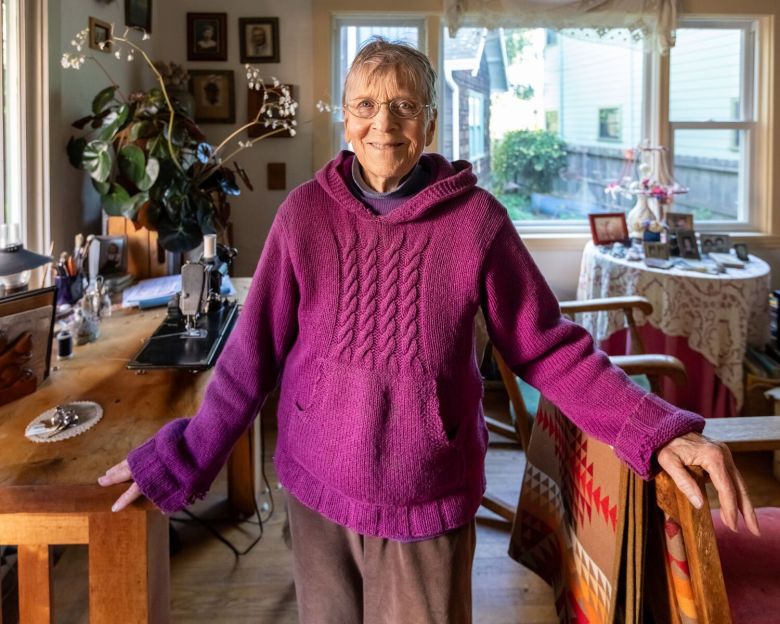 Alice Green, 84, in her Berkeley Cohousing cottage. She’s one of 10 founding members, five of whom remain. Credit: Kelly Sullivan
Four cohousing groups initially bid against each other for the property in late ’80s and early ’90s, Green said. “They weren’t organized enough and I think they did not have the money when it came to actually buying it.”
According to the website East Bay Cohousing, a virtual bulletin board that acts as a regional network for those interested in cohousing and run by Cohen and his wife, Betsy Morris, the city quashed a subsequent plan to build more than 75 units on the site after neighborhood opposition.
The group of 10 acquired the site in 1994, when there were 10 units. They lived on the property and made improvements during the three-year condo conversion process.
“As a condominium, it is easy to get bank approval,” Cohen said. “Coops are harder to finance.”
Some of the changes intended to make the buildings more connected. A driveway that once cut through the lot became a central courtyard, while a parking lot acted as a buffer from Sacramento Street. Four new units were built and a fifth renovated. By the time they were done, in 1997, the new residents had added four units and expanded a fifth, and were able to buy their own units.
“Mine was the smallest and cheapest,” Green said. A shingled, one-bedroom cottage, her home is about “700-something” square feet and cost $116,000 in 1997.
The most recent sale of a unit was in 2021, when a 576-square foot one-bedroom went for $384,000 — still below market-rate.
City has long capped sale price and buyers’ income, but that ends next year
To avoid Berkeley’s condo conversion fees, Berkeley Cohousing became a “limited equity” condominium, according to Cohen, following 1993 amendments to the city’s Condominium Conversion Ordinance, designed to allow the formation of cohousing communities. Under a 1997 agreement negotiated between Berkeley Cohousing and the city, both price and income are capped at the time of purchase.
The program promotes affordable homeownership through below market rate units for first-time buyers with incomes at or below 120% of the Area Median Income (AMI) — these days, about $192,000 per year per household. The maximum sales price is determined by a formula that incorporates any capital improvements that were made. According to East Bay Cohousing’s website, sale prices are around 50% below market.
“That has kept sale prices lower than in other places in the city,” said Hobson. “That helped us to be able to afford a place we wouldn’t have been able to afford without it.”
Hobson now runs finance and operations for All Home in San Francisco, a nonprofit that “disrupts cycles of poverty and homelessness” in the Bay Area. His wife, Kim Seashore, is a professor at San Francisco State. He and his family have lived in several units, first as renters. In 2001 they bought an 800-square-foot, two-bedroom for $270,000.
The price cap has encouraged stability.” — Jeff Hobson, 56
After their second child was born, the couple bought a 1,000-square-foot, more centrally located unit with two bedrooms for $350,000 in 2004, “still below what houses were going for at that time,” Hobson said.
Other residents include a retired couple who had been business owners, a tech writer, an accountant, teacher, nonprofit worker and a physical therapist.
“We have had tech people, but not lots,” Hobson added.
When the caps expire, the allowed selling price will likely rise, bringing new and wealthier owners. The community now includes 14 units in nine buildings: three three-bedrooms, eight two bedrooms and three one-bedrooms. Common charges are several hundred dollars a month.
“It’s people’s choice,” Cohen said. “Some people might need the additional money for elder care. Or they could need funds to buy another home, to be able to move.”
While owning a unit is a money-saving option, renting can be more in line with the market rate, so renters have to want in on the communal benefit. LeBlanc, for example, lives in a three-bedroom with her husband and a roommate, paying $4,300. According to Zillow, the average price for a similarly sized Berkeley apartment costs $4,000-$6,000.
Green herself doesn’t even know the exact value of her unit and doesn’t seem to care. She has seen online estimates range from $400,000 to $900,000 on Zillow. “Zillow doesn’t take into account community. They just look at individual houses.”
To keep their units affordable, Cohen, Morris and Green are looking to partner with a community land trust or other organization.
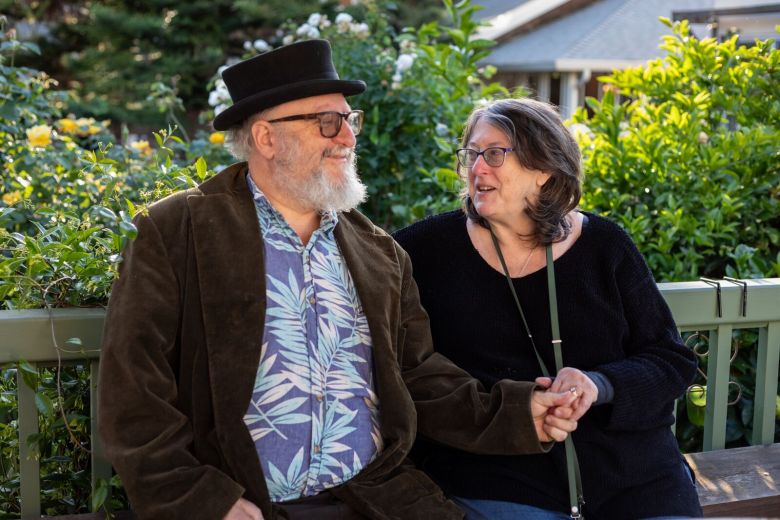 Raines Cohen and Betsy Morris sit on the deck at their Central Berkeley cottage on Apr. 28, 2026. Credit: Kelly Sullivan
In terms of her own unit, Green hopes her successor is someone “just like me, who holds my values. I live simply. It is an important value.”
“Living simply” in this instance usually means within a relatively compact space. Cohen and Morris share a unit in a 1920s stucco duplex, one of the original buildings on the site when Green and her friends encountered the property. It was around 675 square feet and had a Murphy bed closet in the living room when they bought their one bedroom. They added about 20 more square feet when they squared off a corner in the bedroom.
Along with small spaces, however, come big benefits, proponents say. Intergenerational families have been on the rise, especially since the pandemic, and cohousing advocates cite plenty of reasons for generations to come together. Families with young children can get extra sets of hands and eyes and additional attention. Residents without children get to play with those who do. Younger members, like LeBlanc, can seek counsel from the more “mature.” And the elderly get the benefit of connection, which the CDC has now cited as an important component of longevity.
Cohousing is about tearing down fences and sharing gardens
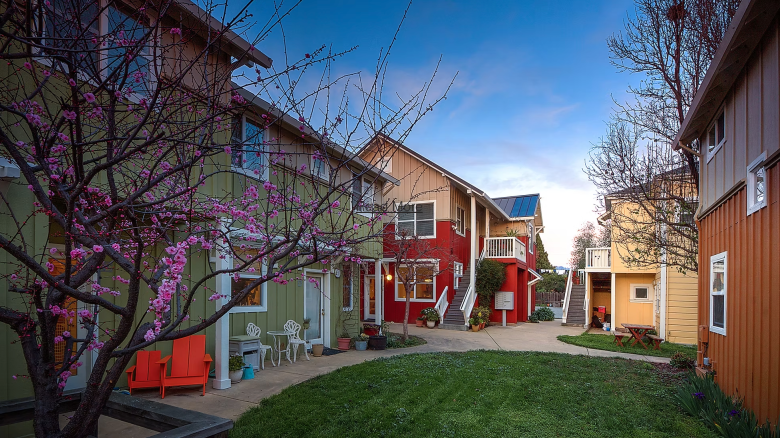 Temescal Commons opened in Oakland in 1999. Credit: John Cary
In the U.S., one of the first and most influential retrofit cohousing communities was created in Davis in 1986 when two homeowners tore down a fence between their 1950s tract houses. The community grew to include more than 20 homes with shared gardens and a common house with a kitchen.
Hobson had lived in the N Street community in the early ’90s and the experience made him a lifelong cohousing enthusiast.
Cohousing took off in the U.S. after a seminal book on the subject, “Cohousing: A Contemporary Approach to Housing Ourselves” by architects Kathryn McCamant and Charles Durrett, was published in English in 1989. Often referred to as the “cohousing bible,” the book detailed the Danish model of collaborative housing and provided a framework for recreating it in the U.S. The couple were considered the founders of the cohousing movement in the U.S.
[Berkeley Cohousing] has sort of replaced my church and family — although you can never replace family.” Ashley LeBlanc, 33
Muir Commons, also in Davis, was the first new-construction cohousing community in the country when it was established in 1991. A year later, McCamant and Durrett’s 12-unit Doyle Street cohousing in Emeryville became the second.
Other cohousing followed in Oakland: Temescal Commons (1999), Swan’s Market (2000),
Temescal Creek (2000), Mariposa Grove (2008), created with a community land trust, making it “even more affordable than Berkeley Cohousing,” Cohen said. Golden Gate Cohousing, a nonprofit rental model, began forming in 2011.
The Cohousing Association of the United States estimates that there are 165 occupied cohousing communities and 140 that are underway in the U.S. In California, there are now more than three dozen established cohousing communities, according to the website Cohousing California, which Cohen also runs. More than a dozen of those communities are in the Bay Area, with Oakland boasting six, making it the largest cohousing city in the country.
As dinnertime came to a close on April 28, Berkeley Cohousing residents continued to linger. The topic of the pandemic came up, which tested the community because its very definition requires coming together.
“The pandemic also stressed the benefit of staying connected and knowing your neighbors,” Cohen said.
He boasted that there was no community transmission during that time because of all the precautions they had taken. Community dinners were put on hold and shared activities moved outdoors.
I love that I know my neighbors and I know who I can borrow a cup of milk from and who would join me on a bike trip.” — Raines Cohen, 59
During that time, LeBlanc, who also has a dance background, talked about how she led exercise, cardio dance classes and created what she called “a senior parcourse” outdoors.
“Excuse me,” Morris interrupted. “We called it ‘the wisdom parcourse.’” There was laughter all around.
As to the community’s future, there will likely be disagreements, and laughter too, as long as the conversations continue.
“We all want the people who live here to want community,” Green said. “The issue is, how do you maintain the values of the original group? I think we need to talk about that more. But that’s the question.”
“*” indicates required fields