
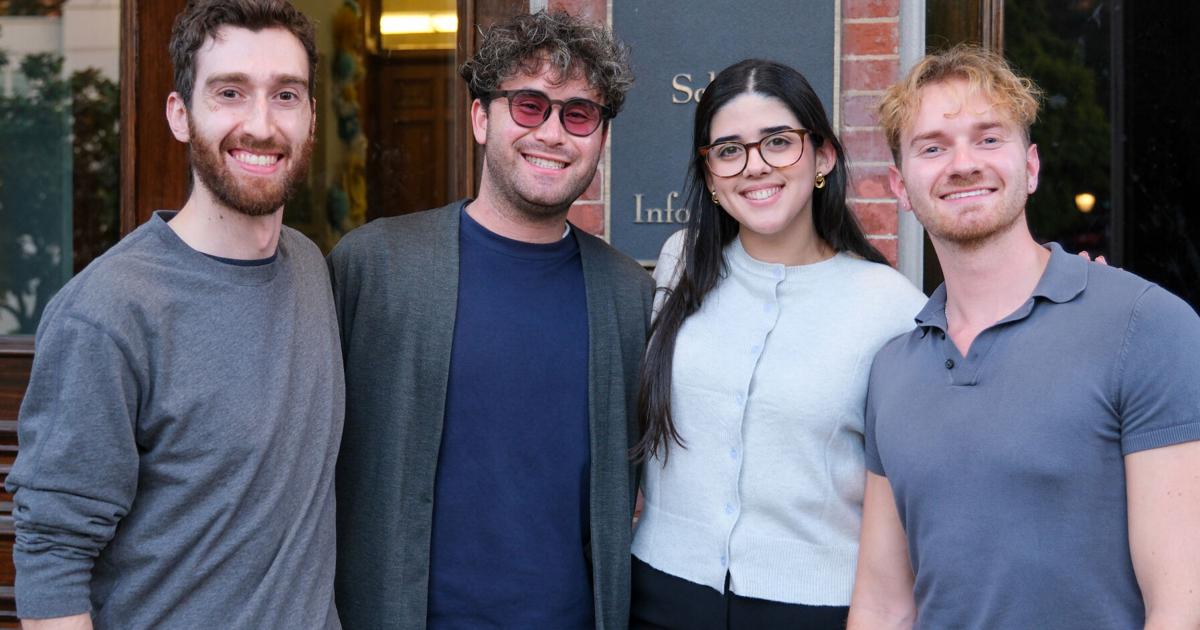
A team of UC Berkeley graduates developed an incident-reporting platform for autonomous vehicles, or AVs, after noticing a need for such a channel.
AV Watch was built by four former Master of Information Management and Systems students as their capstone project. It won the Dr. James R. Chen Award by the UC Berkeley School of Information, which recognizes outstanding and innovative projects.
The first dedicated AV reporting platform, AV Watch, allows both riders and bystanders to report AV incidents from reckless driving to accessibility issues, with the ability to add information such as locations, photos and timestamps. Past incident reports are displayed on a public dashboard along with reports compiled from external sources such as Reddit.
In recent years, self-driving cars have become ubiquitous in parts of the Bay Area, operating within a 260-plus-square-mile zone spanning from San Francisco to San Jose. By May, Waymo had expanded across 11 cities and had been approved for testing in Berkeley. Amid a rising tide of AV expansion, the creators of AV Watch noticed a glaring lack of safety regulation.
According to a survey conducted by AV Watch, more than half of respondents underwent a negative experience with an AV, such as the vehicle blocking traffic or driving unpredictably. Of those, 86% never reported the incident, and none of the respondents used a government reporting channel.
Incidents are tracked only by AV operators — such as Waymo and Zoox — and, at the federal level, are only reported in cases of serious incidents such as crashes or deaths. Currently, San Francisco is the only city with an AV incident reporting channel embedded in 311, a non-emergency reporting website.
“No one really has a complete picture of what is happening to autonomous vehicles on the road,” said UC Berkeley Master of Information Management and Systems graduate Evan Haas, who led user research and policy for AV Watch, in an email. “If a host of riders, drivers, pedestrians, bicyclists, emergency responders, and public transit operators don’t have an easy way to share what’s happening, how will AV companies react?”
While AVs claim to be safer than human drivers — a 2025 Waymo report found that its self-driving cars experienced 92% fewer pedestrian crashes than human drivers — Waymo has faced backlash after an AV ran over a beloved San Francisco bodega cat and others illegally passed stopped school buses in Texas.
“The technology could be perfectly safe, but if the public is wary, they won’t want to adopt it,” Haas said.
By filling current gaps in data reporting, the team hopes AV Watch can give the public a voice — better informing both AV companies and policymakers about users’ lived experiences.
“People report what they witness, those reports inform policy, and that policy governs the vehicles. It’s a win-win, because the more data we all have, the better every part of that loop works,” said Noah Baier, backend engineer and data lead for AV Watch, in an email. “Ultimately we want to make sure decisions aren’t only being made by the big players, but are informed by real stories from the people sharing the road.”