
College football is in the midst of a six-week “dead period” in which no official or unofficial visits are allowed with recruits.
Coaches also aren’t allowed to make in-person evaluations, though they can contact recruits through email, texts and phone calls.
The dead period ends Aug. 1, four days before San Diego State begins practice for the 2026 season.
All this is to explain why SDSU coaches and staff worked so furiously the first three weeks of June to bring Class of 2027 recruits to campus for official visits and secure commitments.
For the second straight year, SDSU coach Sean Lewis has “buttoned up” the Aztecs’ high school recruiting class nearly six months before the NCAA’s December early signing period.
SDSU has received 26 commitments — 13 on offense and 13 on defense — for the Class of 2027. That’s four more than the record 22 commitments the Aztecs secured a year ago. Most of SDSU’s focus was at wide receiver and defensive line (five players each), followed by offensive line and safety (four players each).
San Diego State Class of 2027 football tracker: Aztecs’ class nearly complete with 26 commits
How has recruiting accelerated in recent years? In 2023, SDSU had only six commitments by the end of June.
“From a college standpoint, everyone wants to hit the dead period and be able to focus on their team,” Lewis said last week. “Being able to put most of their time and effort and energy preparing their team for the upcoming season, that’s what your current team has earned.
“Also, I think the high school coaches and kids and agents and handlers have all understood this is the time when this happens.”
SDSU’s 2027 recruiting class includes four local players — La Costa Canyon High School tight end Diego Botron, Cathedral Catholic High School wide receiver Isaac Cook, San Diego High School safety Kye Cooper and Madison High School defensive lineman Logan Nelson.
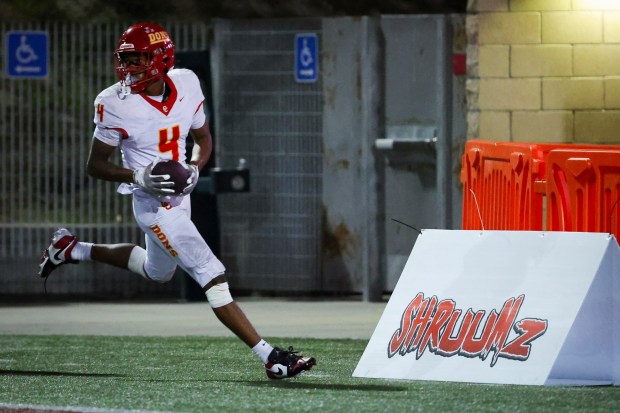 Cathedral Catholic’s Isaac Cook scores a touchdown against Carlsbad during the CIF San Diego Section Open Division finals at Southwestern College on Tuesday, Nov. 25, 2025 in San Diego, California. (Meg McLaughlin / The San Diego Union-Tribune)
Cook (49 receptions, 1,242 yards, 12 TDs) and Cooper (70 tackles) were both second-team all-CIF selections last season. Cooper (64 catches, 897 yards, 7 TDs) also was a standout wide receiver and kick returner.
Class of 2027 commitments began rolling in back in February, when Austin (Texas) Regents High School quarterback Jack Devine was among three players who declared for SDSU. Devine passed for 3,491 yards last season with 55 touchdowns and only three interceptions. He also rushed for 725 yards and 12 touchdowns while leading the Knights to a 12-1 record.
For decades, the majority of commitments came during the fall after colleges got a glimpse of game film during a player’s senior season. That’s all been sped up, set in motion a decade ago when the early signing period was created (making the traditional February signing period all but obsolete).
“It’s great for the high school kids,” Lewis said. “I think most high school seniors going into their senior year know where they’re going to college. It allows you to enjoy your senior year, know where your future is and map out what that plan is.”
Another trend is toward high school recruits graduating midyear, giving them the opportunity to enroll in college for the spring semester. SDSU had seven players from the Class of 2026 arrive this spring. Lewis said he expects that number to be double digits for the Class of 2027.
“That’s becoming common practice,” he said.
Getting on campus in January rather than July makes a significant difference for a player, enabling him to participate in winter conditioning, spring practice and summer conditioning and potentially contribute as a true freshman.
“If you’re going to invest all of the amount of monies that we’re investing in these rosters, in essence they’re our employees,” Lewis said, “get them onboarded, get them here and let’s get them rolling.”