

The Anaheim Ducks are signing forward A.J. Greer to a four-year contract with a $4.25 million cap hit, according to league sources, granted anonymity to speak about a deal that isn’t public.
The deal includes a 10-team no-trade clause in all years.
The Ducks acquired the rights to Greer from the Florida Panthers for the rights to defenseman Radko Gudas.
Greer recorded 17 goals and 32 points in 78 games last season.
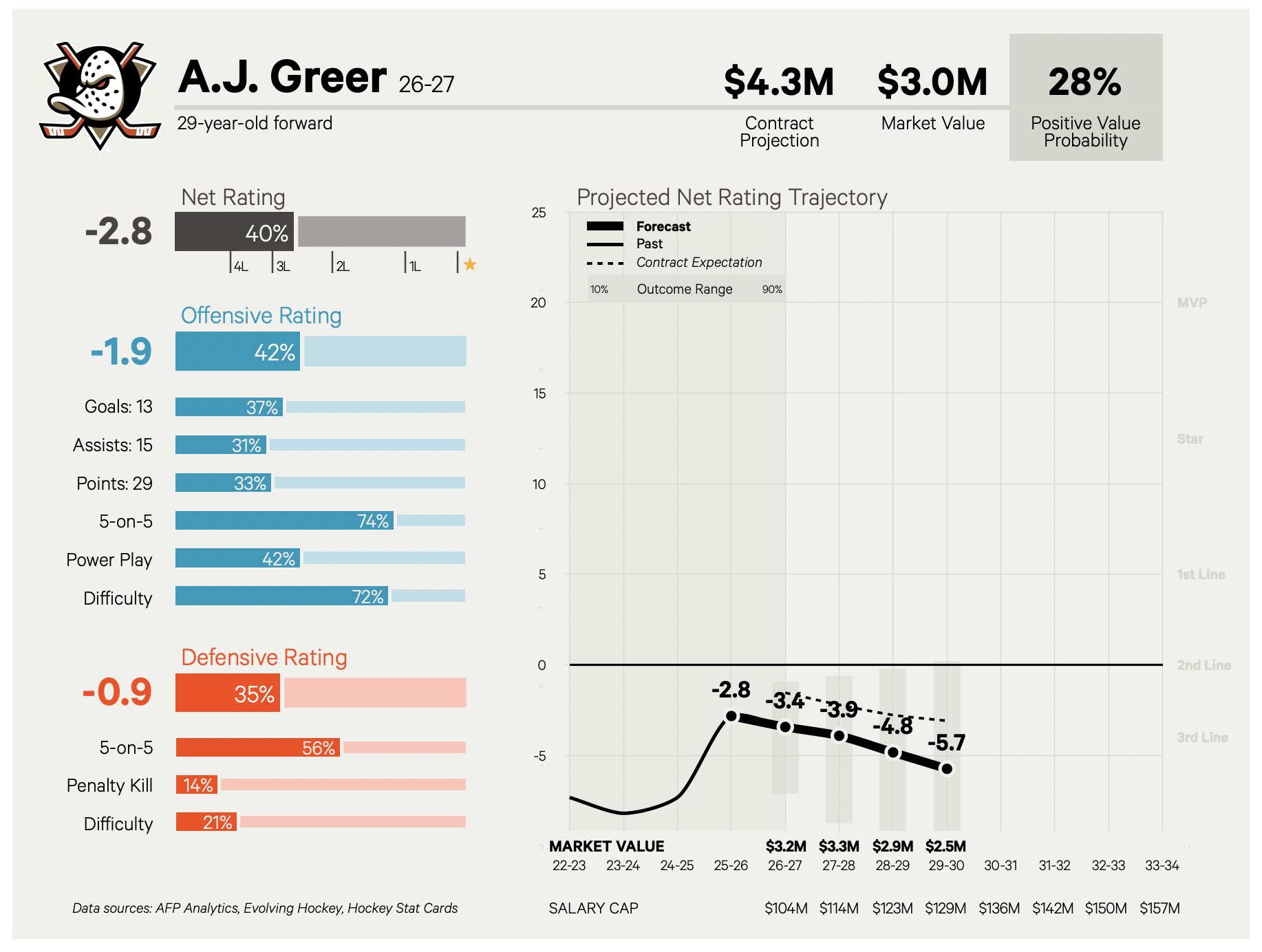
Why it’s an overpayment
A four-year, $17 million contract for Greer isn’t back-breaking for a team that still has about $41 million in cap space this summer. But it’s still an avoidable overpayment.
To Greer’s credit, he can be effective in his role, between his forechecking, defensive puck touches and overall ability to limit offense against. Add in the fact that he stepped up in Florida last season and boosted his scoring, and it makes sense why Anaheim would be interested — especially after a postseason where the Ducks’ fourth line made a real impact. But that production lines up with his shooting percentage jumping to 16 percent, when his career average is only 10 percent. The sustainability factor is a real question mark when his track record is closer to being a fourth-line value. Another question mark is whether he can deliver at a $4.25 million value over the next four years; he doesn’t project to be worth it even when accounting for salary cap growth.
The timing hurts, too. It would be one thing to sign this contract with a ton of entry-level talent. Instead, this lines up with Leo Carlsson and Cutter Gauthier’s salaries more than likely exploding. If both sign long-term deals, AFP Analytics projects a collective $20 million cap hit between them. That leaves the team with $21 million to sign three or four defensemen, plus another few forwards.
And then there’s the later years to consider. How many general managers can’t afford to go after star talent because their bottom-six contracts aren’t cost-effective or flexible? The Trent Frederic situation is obviously more extreme in Edmonton, but the same line of thinking should apply here, too. Teams, especially in the early stages of their playoff windows, should not be committing this much money or term to role players — or handing out any sort of trade protection. So while it’s easy to blame the growing cap and market trends for this, the real problem is that so many general managers can’t help but overpay sandpaper types with playoff experience — and in Greer’s case, a Stanley Cup ring. — Shayna Goldman
Where does Greer fit in the Ducks’ lineup?
For a playoff team last season, the Ducks will have a fair amount of change in their lineup next season. Most of the attention is on the defense with unsigned UFAs John Carlson and Gudas both traded and Jacob Trouba likely also headed to market Wednesday, but they’ll also have changes up front.
The most notable hole to fill is Mason McTavish after he was dealt to St. Louis, but it seems apparent that the Ducks won’t retain UFA wingers Jeffrey Viel and Ross Johnston. Greer could be an upgrade as long as he’s filling the right hole. The veteran took advantage of injuries in Florida’s lineup last season to post career highs across the board. And in 2024-25, he proved he could be an everyday regular while also scoring a couple goals in the Panthers’ successful Stanley Cup defense. It wouldn’t be surprising if the Ducks look at Mats Zuccarello or Ilya Mikheyev to help replace some of the offense McTavish provided.
Greer’s 17-goal, 32-point season is likely the outlier as he may never shoot 16.2 percent again or average 12 and a half minutes — nearly three minutes more than his career average. But the forechecking winger should bring some ferocity to their fourth line, though his physical nature can get him into hot water with the NHL. Think of it as a bigger Viel who can skate with the ability to chip in a little more offense.
As far as the contract is concerned, this is the league’s new frontier when it comes to more money being in the marketplace. This price for a fourth-line grinder would have once been laughed at. Maybe it still is. But the flat-cap era is over. Energy guys will want to get paid, too. — Eric Stephens