
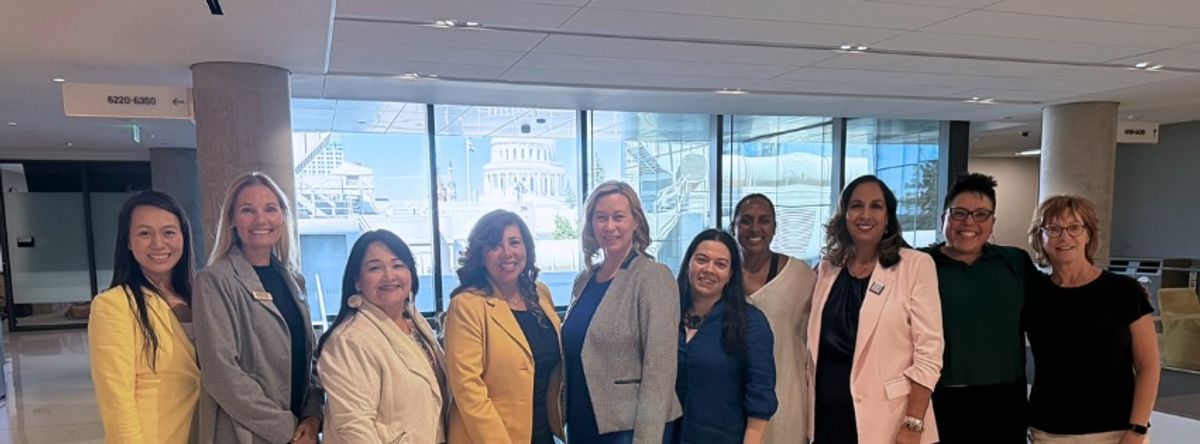
From championing the needs of women veterans to advancing a minimum marriage age and strengthening workplace rights during menopause, the California Commission on the Status of Women and Girls is uniquely positioned to advocate for policies that directly impact women and girls.
“The Commission is proud to advocate for women and girls statewide. We sponsor legislation, offer expert testimony, and collaborate with partners across the state to advance policies that improve safety, expand access to health care, strengthen economic stability, and open pathways to opportunity for women and girls throughout California,” said Dr. Rita Gallardo Good, chair of the California Commission of the Status of Women and Girls.
“The work is critical because the policies debated today will determine whether women and girls have the resources, protections and support systems needed to thrive, especially at a time when persistent inequities continue to shape their daily lives,” said Darcy Totten, executive director.
“We are building an environment in California that is equitable for women and girls,” she says.
The commission focuses on educational needs, workplace health and safety, military women and veterans, the effect of social attitudes and pressures and the economic considerations assumed by women in society., including women in the media and the impact of emerging technologies on gender equity.”
Currently, the commission is supporting a wide array of proposed legislation.
Assembly Bill 1940, introduced by commissioner and Assemblymember Lisa Calderon, would prohibit discrimination against employees experiencing perimenopause, menopause, post-menopause, and related medical conditions under the California Fair Employment and Housing Act (FEHA). The bill would require the Civil Rights Department to update information posted in places of employment to notify employees of their rights and protections and require the commission to raise awareness of these rights.
Alex Zucco, director of policy and legislation, says the commission is also a co-sponsor of AB 1267, a bill introduced by commissioner and Assemblymember Gail Pellerin that would set a minimum marriage age of 18. California is one of only four U.S. states with no minimum marriage age.
“If you are 16 in this state, you are not allowed to buy cigarettes, you can’t vote, you can’t enlist in the military,” she says. “If you are 16 and marry a 21-year-old man, the balance of power is clearly inequitable. It’s a loophole that can lead to exploitation,” says Zucco
“We are building an environment in California that is equitable for women and girls.”
Alex Zucco
Director of Policy and Legislation, California Commission on the Status of Women and Girls
Other legislation the commission supports aims to improve women’s safety by strengthening laws governing restraining orders against abusers. SB 1395 by commissioner and Sen. Suzette Martinez Valladares, would extend the time that a restraining order is in effect from five-to-seven years to 15-20 years for those victimized as minors and whose perpetrator has been tried, convicted, and released from incarceration.
“Other states allow for permanent protective orders,” Zucco says. “Forcing a survivor of this type of crime to return to court every five years and face their perpetrator is retraumatizing.”
Another bill supported by the commission, SB 99 by commissioner and Sen. Catherine Blakespear, would further protect a military member who has a military protective order (PO). Because military POs do not extend off base, this legislation would allow a civilian judge to consider a person’s military PO when deciding whether to grant a civilian PO.
Female military veterans are a top priority for the commission. In September, the commission will hold an informational hearing in Blakespear’s district near Camp Pendleton on a recently completed survey of female veterans in California. Zucco says she expects several area legislators to attend the hearing to learn how they can better serve this population.
Zucco encourages California residents who wish to support bills related to women and girls to contact their senate and assembly representatives by submitting a letter online. Expressing support on social media can also be effective. As the commission continues to advance a robust policy agenda, its work extends into building the statewide advocacy infrastructure and support for legislation needed to sustain long term progress.
In March of 2027, the commission will mark a truly historic milestone: the first time that women- and girl-serving organizations throughout California will gather in one place for the first-ever Women and Girls’ Advocacy Day. By bringing so many dedicated partners together in a common purpose, this convening will help build a powerful statewide network committed to elevating the voices, needs, and leadership of women and girls. Participants will meet with legislators and staff to advocate on legislation selected by the commission that has a deep impact on the well-being of women and girls in California.
As the commission prepares for this landmark Advocacy Day, it continues to build toward a future where every woman and girl in California can thrive. By strengthening partnerships, amplifying community voices, and championing policies that reflect the lived experiences of women and girls, the commission is laying the groundwork for a more equitable and resilient California.
For more information on the California Commission on the Status of Women and Girls visit https://women.ca.gov/