
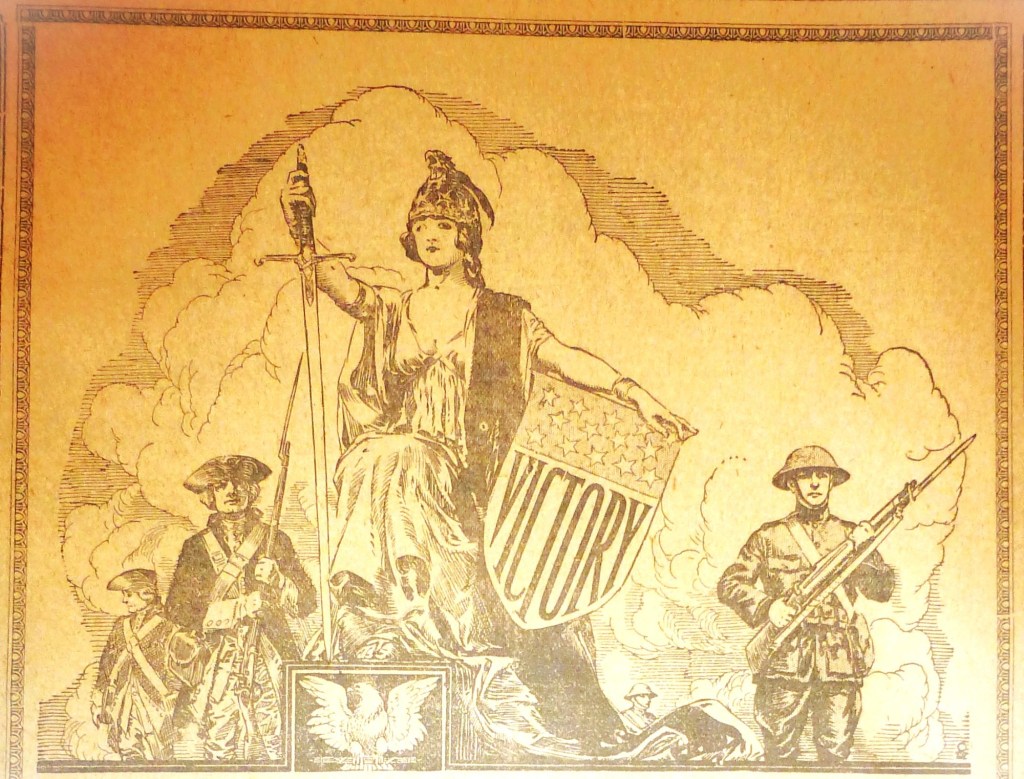
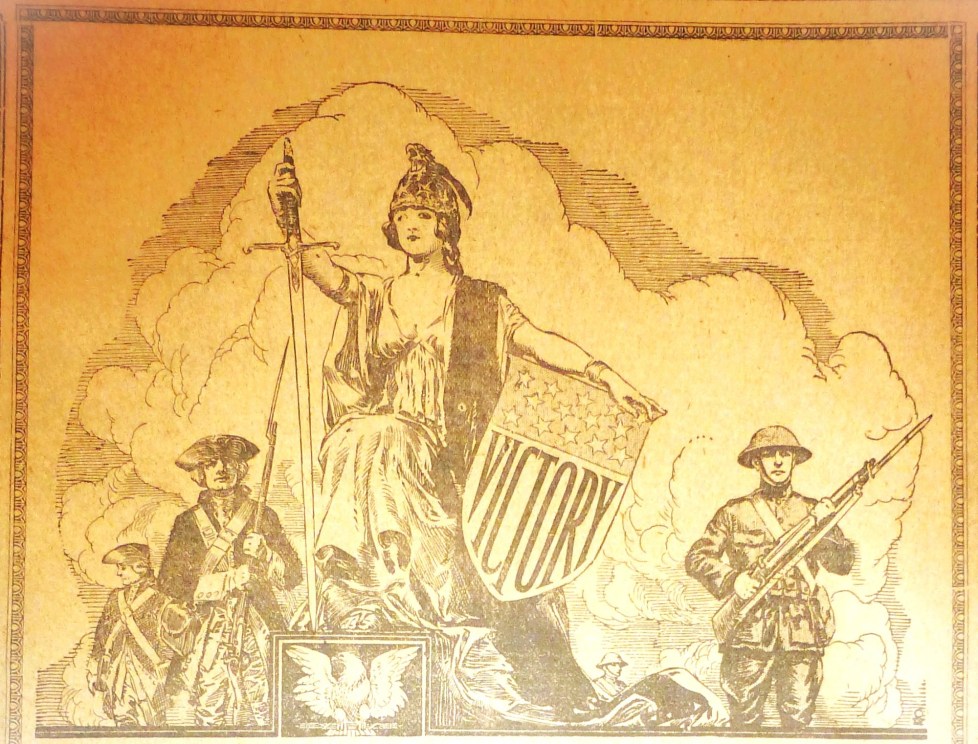
A full-page ad for July Fourth weekend specials from Berkeley businesses ran in the Berkeley Daily Gazette a century ago with this illustration of the goddess Columbia flanked by American Revolutionary and World War I-era soldiers. (photo courtesy of the Berkeley Historical Society and Museum)
A century ago on July 4, 1926, the city of Berkeley held “an old-fashioned picnic amid picturesque surroundings, patriotic exercises … musical numbers, addresses and tableaus depicting the history of the country and games and contests for the children” at Live Oak Park.
The contests included pie eating, father-and-son and mother-and-daughter races, a sack race and “a tilting contest in which one man will stand on another’s shoulders and attack a similar team with a padded pole … . There will also be a pillow fight and a cracker battle,” the Berkeley Daily Gazette reported (I have no idea what a cracker battle involved).
Hundreds of people attended and heard a speech by Judge J. Allen of Oakland, an “Independence Day orator” who “cited the history of the republic as symbolic of the spirit of the people. ‘There is no fear for its future,’ he declared.”
Downtown Berkeley stores closed Monday, July 4, that year, and several local churches held Independence Day services. Along the West Coast that holiday, 28 “persons met death by tragic means,” the paper reported. Among them, 13 died in traffic collisions, two from fireworks mishaps and “four persons were drowned and three killed in gasoline explosions.”
Fireworks injuries seem as old as the July Fourth holiday itself. On July 1, 1926, the Gazette carried a story that began, “Fourteen-year-old Richard Otis McMann is in the Berkeley General Hospital today minus his right hand as a result of the explosion of fireworks which he manufactured at his home, 754 Arlington Avenue, yesterday. The boy’s arm was amputated two inches above the wrist … .”
He and a teenage friend, were building a “toy cannon” out of “a piece of iron water pipe.” After “entertaining boys in the neighborhood with the pyrotechnic display … a terrific explosion ensued.”
Ferry approved: Berkeley got its desired car ferry to San Francisco by decision of the State Railroad Board, on July 7, 1926. “Work on the construction of a thee-mile pier at the foot of University Avenue will be started just as soon as contracts can be awarded, President O.A. Stewart of the Golden Gate Ferry Company announced.”
Art exhibit: Berkeley’s third summer annual exhibition of paintings at the Berkeley League of Fine Arts opened July 2, 1926. Sixty-one paintings and seven sculptures done by local artists were on display, and local women were prominent among the artists. The exhibit was at 2419 Haste St., the old McKinley School Annex which still amazingly survives on the grounds of Berkeley’s First Presbyterian Church.
Prominent Bay Area artist Alice Best died July 6, 1926, “following a long illness.” She and her , Arthur, had a studio in the same building where the art exhibit was held. They had previously run an art school in San Francisco.
Train injury: A Key Route interurban train struck Miss Emma Jarvis, 76, at Alcatraz Avenue and Adeline Street on June 30, 1926. She was taken to the hospital with “a possible fractured skull.”
Police news: Berkeley police Chief August Vollmer said July 7, 1926, that criminals were taking advantage of “two factors — the automobile and the pistol. … Most holdup men are between the ages of 17 and 27,” and many were “auto bandits, auto burglars and auto thieves.”
Also, Berkeley police uniforms were changing a century ago. Old “choker-style” collars were out, and new “low collars with long lapels” were in. “White shirts and black ties are worn with the new collars,” the Gazette reported. Since Berkeley police had to pay for their own uniforms, the changes would be phased in over time, as the older uniforms wore out.
Bay Area native and Berkeley community historian Steven Finacom holds this column’s copyright.