
Published Jul. 1, 2026at6:54am
Its bright-green scooters are on virtually every street corner in San Francisco. Now, Lime is on Wall Street.
The San Francisco company behind the electric shared scooters made its public market debut Wednesday, nearly a decade after it was founded in 2017.
Uber-backed Lime was part of the first batch of companies to bring shared two-wheeled transportation to San Francisco streets. It changed the way many working San Franciscans and tourists alike get around and has brought attention to “micromobility” — shared transit options like bikes and scooters for distances too long to walk but not right for a bus, train, or car.
Though Lime’s workforce is remote, with many employees outside the city, the company is doubling its footprint here, moving into a 29,000-square-foot space at 444 Townsend St. in SoMa, just down the road from the Caltrain station. Lime says the space has a hardware lab where it will design its vehicles, as well as a meditation room.
The company has 1,148 employees worldwide, including more than 100 full-time Bay Area workers who will likely see their own net worth take a jump as they join San Francisco’s latest IPO era.
The company, which is officially known as Neutron Holdings, priced shares at $25 each, raising $174 million. Its market value is $1.6 billion.
The dockless scooter craze hit the city in 2018, when three competing companies — Bird, Lime, and Spin — launched nearly simultaneously.
It hasn’t always been a smooth ride. First, there was tension with the local government, which had yet to figure out regulations for the new technology. The companies dropped their scooters on streets without permits, were briefly banned, and eventually reached a collaborative peace with the city, if not always with its residents.
A selling point was that the scooters were dockless, meaning they could be left on any random sidewalk — but this led to complaints of clutter and tripping hazards. Riders were frequently spotted using the scooters on sidewalks, where their speeds — up to 15 mph — alarmed pedestrians.
Have thoughts on this story?Start the conversation
Many San Franciscans still chafe at the electric scooters, and complaints about them to 311 more than doubled in 2025 from the year before, according to an analysis by KQED (opens in new tab).
The companies have responded with designated parking areas, geofencing, improved fleet management, and stronger enforcement, according to Susan Shaheen, a professor at UC Berkeley and codirector of the Transportation Sustainability Research Center.
Lime also recently launched a program called “Parking Wardens,” under which it sends patrols into busy areas to “encourage proper parking and safe riding behavior.” In another push to keep sidewalks clear, it’s trying a social media safety campaign with the hashtag #DontRollWhereYouStroll.
“When shared scooters first arrived, they were viewed largely as a disruptive technology. Today, they are increasingly integrated into the city’s mobility ecosystem,” said Shaheen. “They may offer an alternative to driving for local trips, particularly in neighborhoods where parking is limited and congestion is an issue.”
The San Francisco Municipal Transportation Agency doles out permits for shared scooter companies. Lime’s current permit — which was just extended to another year — allows it to operate a maximum of 3,250 scooters in the city.
“We’ve always believed in San Francisco and could not be happier to play even a small role in its ongoing success,” said Monica DiLullo a senior regional government relations lead at Lime.
Lime, which is active in about 230 cities and 29 countries, is experimenting with seated scooters, tandem rides, and longer-distance rides. It already offers bikes and mopeds in some other metro areas.
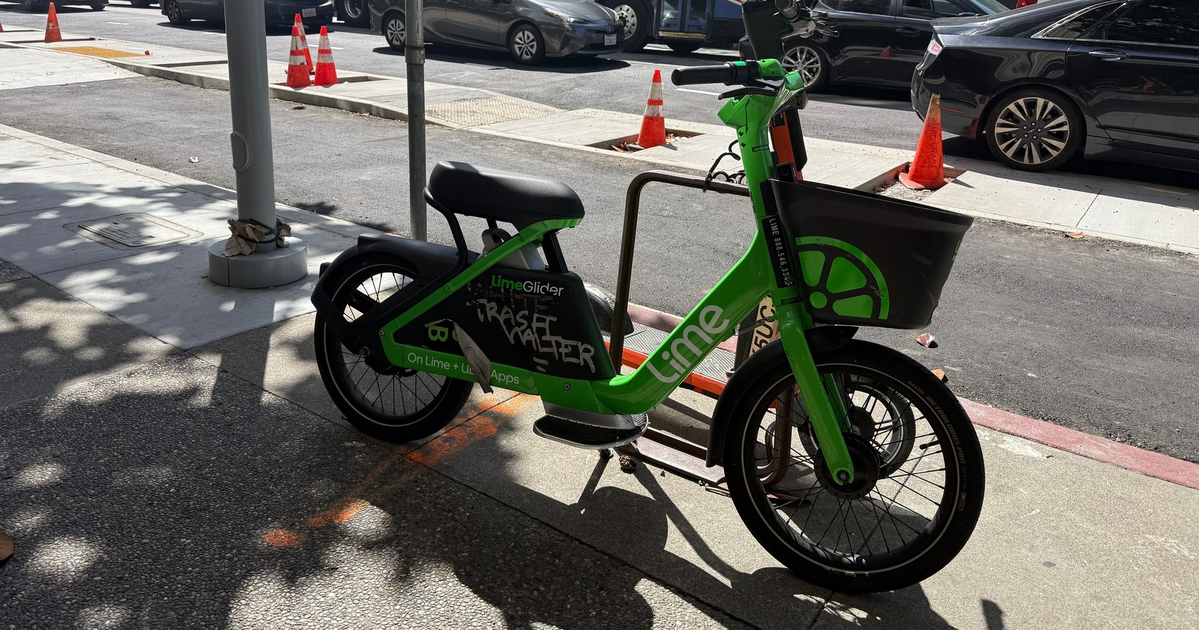
 A Lime scooter parked on a sidewalk in San Francisco. | Source: Heather Kelly/The Standard
Shaheen said the business model for these companies is “operationally intensive.” They need to continue investing in maintaining the fleet, charging, and redistributing scooters. Separate from its full-time staff, Lime has an operations team of workers who drive around in vans to pick up and redistribute scooters, fix batteries, perform maintenance, and make sure the company is complying with city requirements.
“Many companies have exited markets or consolidated over the past several years,” said Shaheen. “Long-term financial sustainability has been just as important as overcoming regulatory or operational challenges.”
Another financial speed bump is fines.
So far this year, Lime has racked up about $445,000 in fines — far more than Spin’s $98,000, according to SFMTA data. The fine for an improperly parked scooter, which can impede the sidewalk for pedestrians, is $150 per citation.
Fines and regulations caused Bird to leave the city in 2023, the company said at the time. Bird filed for Chapter 11 bankruptcy that year, and its assets were acquired in 2024.
That leaves Lime and Spin to operate e-scooters in San Francisco, alongside shared bikes like Lyft’s Bay Wheels.
Lyft’s longtime rival Uber is a major backer of Lime and holds about 14 million shares, or 24%, of Lime’s common stock, according to filings with the SEC. Riders can find and book Lime scooters through the Uber app. The partnership accounted for approximately 14% of Lime’s revenue in 2025.
In 2025, the company reported revenue of $886.7 million, up 29% from the previous year, according to filings. Lime recorded a net loss of $59.3 million last year.
The company says its rides in San Francisco doubled from 2024 to 2025.