
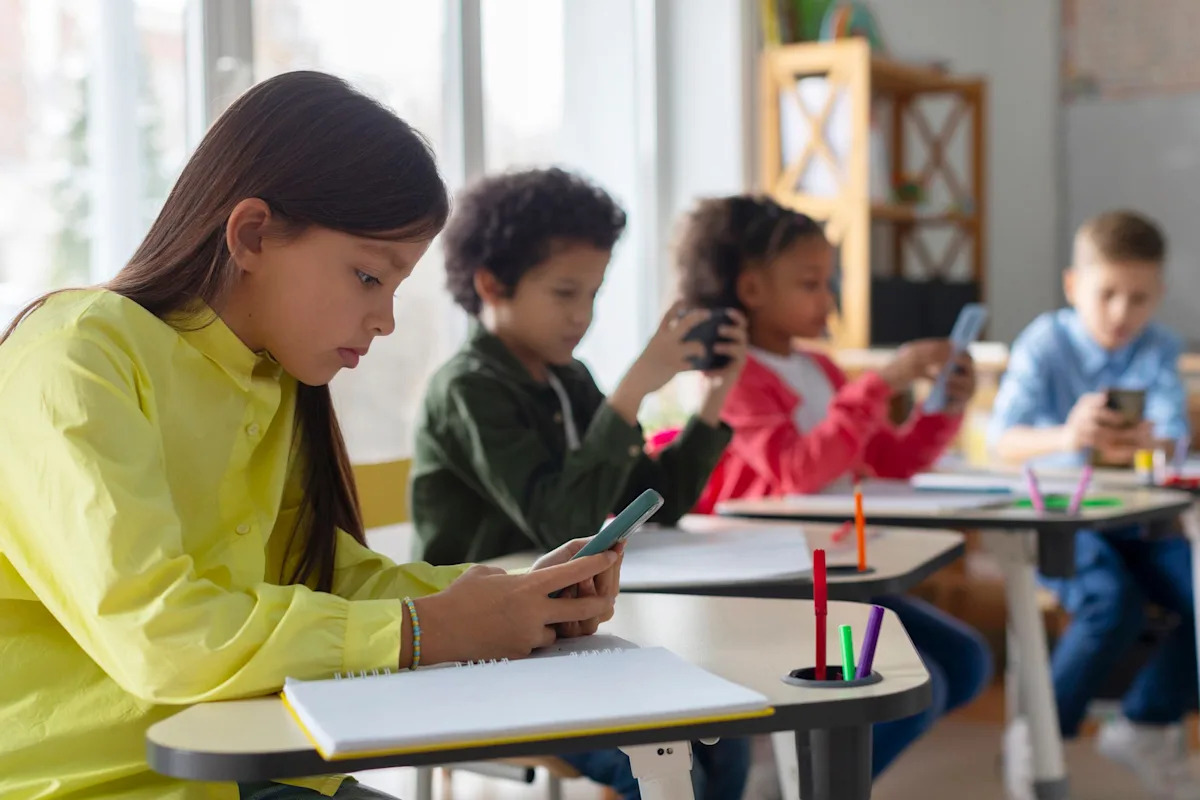
California tasked leaders of its schools with adopting policies limiting or banning students’ smartphone use. Now, that deadline is here — and right as lawmakers pursue a stricter smartphone policy that would impact students statewide.
The Phone-Free Schools Act requires that every school district, charter school and county office of education create a policy limiting or prohibiting students from using their smartphones at school or while they’re being supervised by an employee of that school district, charter school or county office of education.
It gave school officials a deadline: Develop and adopt such a policy by July 1, 2026.
At the time of its passing, state officials had expressed concerns about how students’ wellbeing could be harmed because of excessive phone use or cause distractions in their learning.
School districts in California such as Los Angeles Unified and San Diego Unified already have policies restricting students’ phone usage. LAUSD, one of the largest school districts in the nation, was in pursuit of such an effort even before Gov. Gavin Newsom signed the Phone-Free Schools Act in September 2024.
We asked middle schoolers to design a US flag. Here are the finalists
1 of 11
Ming-Yu C., a seventh grader from Saline, Michigan is named a finalist. “On my flag, I’ve painted four key figures in American history: George Washington, who helped start our nation; Susan B. Anthony, who fought for women’s voting rights; Abraham Lincoln, who ended slavery; and Martin Luther King Jr., a leader in the civil rights movement,” she wrote in her entry. “Each one of these leaders had their own goals, but together they represent the freedom and fairness in the United States. They all worked hard to make America a better place for everyone. The eleven stars on my flag represent the eleven nations in the U.S., showing the many different traditions we have and how much we value them. This part of the flag was important to me because it celebrates the backgrounds that each nation brings to our country. In the center of my flag, there’s a big tree. This tree stands for the various cultures that are part of our history. Everyone’s identities and experiences are unique, just like no two leaves on a tree are the same, which makes us who we are as Americans. This tree also reminds us that we need to take care of our roots, sticking together even when things get tough. The blue and red in the background symbolize the sacrifices that many people have made to create a better America and the wisdom behind those actions.”
(Ming-Yu C.)
California isn’t alone in its efforts. Public school boards in Wisconsin were tasked with developing policies barring students from using cell phones during the school day thanks to a law in 2025, according to the Milwaukee Journal Sentinel, which is part of the USA TODAY Network. Ohio, Iowa, Arizona and Florida are among the states with laws in place related to limiting or banning student phone use in schools.
California’s Phone-Free Schools Act deadline comes the same day as state lawmakers were presented with Assembly Bill 1644, which could force school officials to enact stricter smartphone policies for younger students by July 2028.
The bill would require officials of schools serving students in transitional kindergarten, kindergarten or grades first through eight to develop and adopt a policy prohibiting students from using smartphones at school or while they are under the supervision of an employee of that local education agency. That’s compared to the Phone-Free Schools Act that calls for a policy either limiting or prohibiting smartphone use.
The Senate Education Committee is expected to vote on this measure July 1.
The bans and limits on phones come as school districts in California and nationwide evaluate the extent to which technology plays a role in the classroom and in learning, like LAUSD’s adoption of a policy limiting students’ screen time that will go into effect in the 2026-2027 school year.
The Phone-Free Schools Act does have some exceptions. For example, a student can’t be prohibited from using a smartphone in the event of an emergency or if using a smartphone is required in a student’s individualized education program, also known as an IEP.
Paris Barraza is a reporter covering Los Angeles and Southern California for the USA TODAY Network. Reach her at pbarraza@usatodayco.com.
This article originally appeared on USA TODAY: California schools must limit or ban smartphones under new law