
Left with a mess, the owner of the shuttered Horton Plaza property in downtown is looking to repair contractual breaches with the city of San Diego with a new commitment to reopen the high-profile, public park attached to its unfinished office project next year.
On May 18, in a letter addressed to the property owner, Horton Plaza Propco LLC, the city agreed to give the entity 360 days to cure the defaults of its lease agreement with the city for Horton Plaza Park, according to documents obtained by the Union-Tribune through a public records request.
The city’s letter makes explicit the time frame required for the lender-turned-developer to complete $5 million in park improvements, as required by the lease, said Christina Bibler, the director of San Diego’s Economic Development Department.
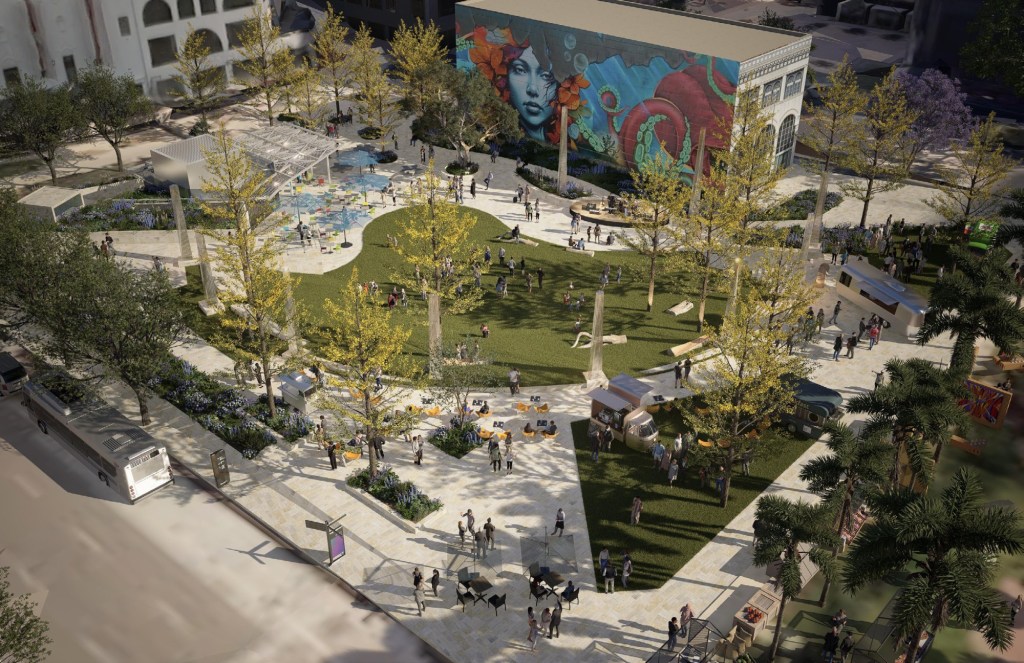
It also makes official a new park development plan that centers around repurposing the existing sunken outdoor amphitheater as a sloped lawn area with artificial turf, according to architectural renderings obtained by the Union-Tribune.
In addition, Horton Plaza’s owner has agreed, albeit more informally, to prioritize completing the work required to reopen the substantially renovated Lyceum Theatre, Bibler said.
The Lyceum, in the basement of the former mall, is owned by Propco but is leased to the city. The city recently spent $13.5 million on major interior improvements, but is waiting on Horton Plaza’s owner to reconstruct the entrance to the underground facility.
“Horton Plaza Propco LLC assumed ownership of Horton Plaza through foreclosure. Since that time, our focus has been on working through the property’s complexities and establishing a practical, achievable path forward for returning the property to productive use for the benefit of downtown San Diego,” a spokesperson for the entity said in a statement sent to the Union-Tribune. “Our near-term priorities include advancing plans for an activated Horton Plaza Park, completing work associated with the Lyceum Theatre, and pursuing a Temporary Certificate of Occupancy so the property can begin contributing again to the vitality of downtown San Diego.”
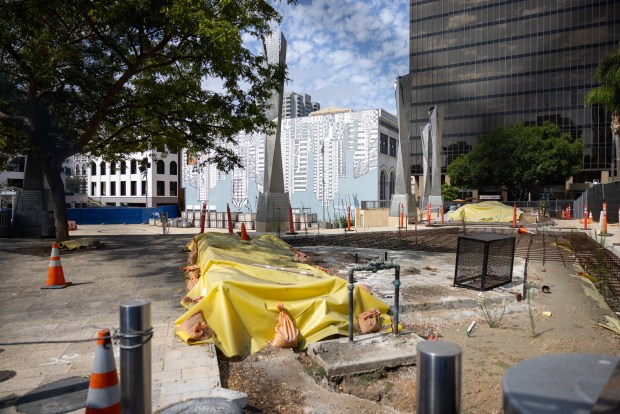 Horton Plaza Park, as seen on Aug. 26, 2025. (Ana Ramirez / The San Diego Union-Tribune)
Horton Plaza Park is the 37,000-square-foot, city-owned urban park property at 900 Fourth Ave. The park, closed since March 2020, was leased to developer Stockdale Capital Partners in December 2022, and was intended to be the front door of the firm’s adjacent Horton Plaza redevelopment project. The conversion project, called the Campus at Horton, sought to remake the 1980s-era, post-modern mall — spanning around seven blocks in the heart of downtown — into a mixed-use office campus, initially geared for tech workers but later refashioned for scientists.
Stockdale purchased the retail center in August 2018 and spent the next seven years on the conversion effort, with progress initially thwarted by a lawsuit and later complicated by a pandemic-driven shift in office dynamics. The developer eventually defaulted on its construction loan with lender AllianceBernstein before finishing the project or starting on the park work.
In August, the lender foreclosed on the campus project and the park leasehold. Horton Plaza Propco is the corporate vehicle created by the lender to own the asset and control the park leasehold.
In documents submitted to the city earlier this year, Propco stated that the campus project is 90% to 95% done, but said that all of the major project permits have expired, including the permit covering work on the Lyceum entrance. As such, Propco must reapply for permits before resuming construction, which delays the project’s completion until the middle of 2027, according to the documents.
The ownership transfer also put the lender in default of the Horton Plaza Park lease, as the leaseholder was required to complete $5 million in improvements and reopen the park by Dec. 27, 2025. The prior owner had not secured a permit for the park work, the documents state. The foreclosure itself also triggered a default under the park lease’s insolvency section.
The city waited until April 1 to formally issue a notice of default to correct the park lease breaches.
In the interim, Horton Plaza’s owner expressed a genuine interest in making good on its inherited obligations, Bibler said, adding that the city also pressed AllianceBernstein on the significance of reopening the park and the Lyceum in a timely fashion.
“I think it’s beneficial for the city and the community to have allowed the lender to get familiar with the nuances of this property and the value to the community,” she said.
Horton Plaza Park, as now planned, is a somewhat scaled-back version of what the previous developer had promised.
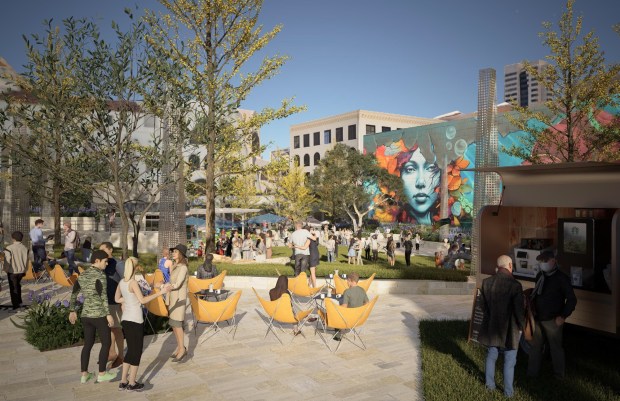 A rendering of Horton Plaza Park, as seen looking toward the Bradley Building and Horton Plaza. (City of San Diego)
Renderings submitted to the city show that Propco intends to fill in most of the sunken amphitheater with artificial turf to create a central lawn area that retains some of the existing steps. The sites of two former kiosk buildings at the north end of the urban park site will also be turned into small, grassy areas.
In addition, the plans depict a raised-deck area that doubles as a stage in front of the Bradley Building. The park will also retain its last-standing retail pavilion, where Burgerim previously operated. And there are two additional spaces for food trucks or other mobile vendors, the plans show.
The Bradley Building, which is just outside of the leasehold area, was envisioned by the previous owner as a food hall that would open up to the park space. However, Propco’s renderings show the building as remaining untouched with the exception of a new mural.
The lender characterized the recalibrated plan as a realistic way to get the park project done.
“We have worked closely with the city to refine the park plan so it is practical, financially responsible and capable of being implemented. We appreciate the city’s partnership and will continue working constructively toward outcomes that are both achievable and beneficial to the public and the downtown community,” the Propco spokesperson said. “For more than 40 years, Horton Plaza has been an important part of the San Diego community. We recognize its significance to residents, city leadership, and local businesses, and we intend to be a thoughtful, collaborative and responsible owner as we continue working with the city and other stakeholders on its future.”
With the new timeline, the city and the lender have formally defined the cure period allowed for the breached redevelopment obligation in the park lease, as administratively granted by staff, Bibler said. The redevelopment period is meant to be immediately followed by the park’s opening. If the lender can’t deliver as promised or if the project changes substantially during the permitting process, then any related lease changes would require City Council action, she said.
The rest of the terms of the park agreement also remain in effect, meaning Propco will be charged rent — or 50% of net revenue after expenses and credits — once Horton Plaza Park opens. The agreement, however, was structured in favor of the previous developer, meaning it won’t be a money-maker for the city. When the lease was approved, the city estimated that it would collect $4 million from rent payments over the course of the 25-year term.