
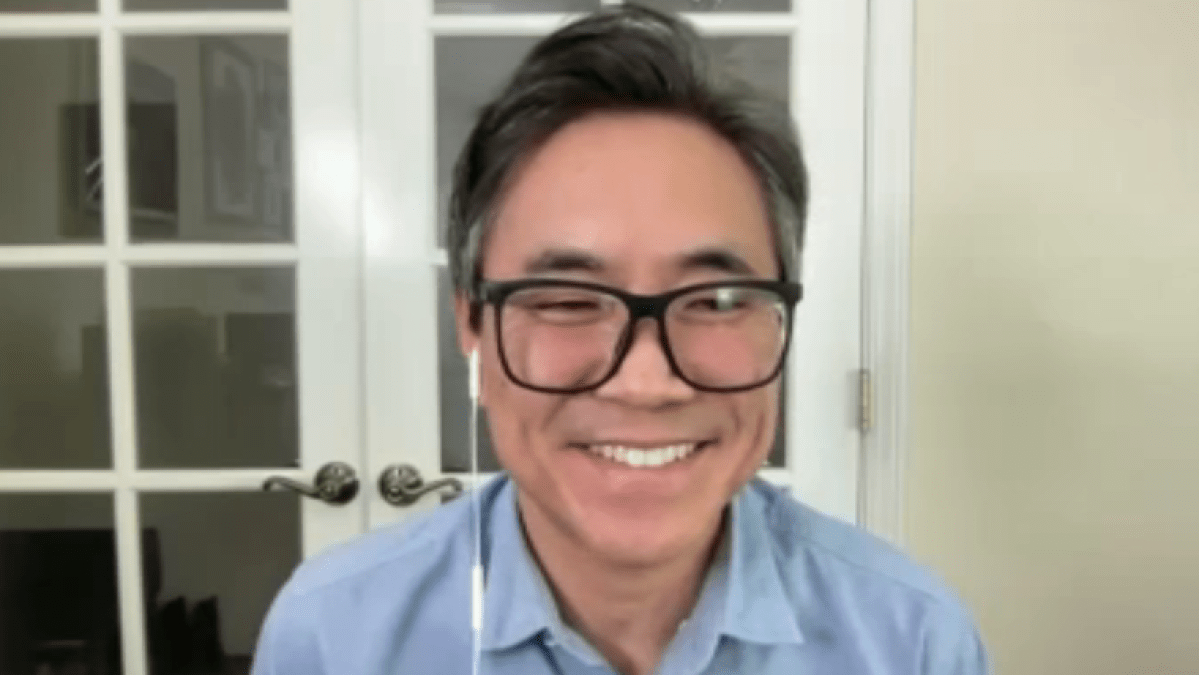
Words have long had the power to survive for centuries.
Now, Californians in 250 years will be able to enjoy the words of California Poet Laureate Lee Herrick.
Herrick’s poem, titled “My California,” was selected by Gov. Gavin Newsom’s office as part of the state’s contribution to the official America250 time capsule.
The capsule, which features contributions from all 50 states, is scheduled to be opened in 250 years — in the year 2276.
“I’m happy and deeply honored to be part of it,” Herrick said. “Never could have imagined it, but happy to be part of it.”
America250, the nationwide initiative organized to commemorate the 250th anniversary of the Declaration of Independence, asked all 50 states to contribute to the time capsule.
Among California’s contributions to the capsule is Herrick’s poem, which captures the state’s present and promise, a state where immigrants are intertwined and where people enjoy the cities and the coasts, the central valley and wine country.
“In my California, it’s a place of immigrants, parents, refugees, hard-working families,” Herrick said. “We’re almost 40 million people. And one out of every four is born outside of the United States. I happen to be one of them.”
Herrick’s perspective is deeply rooted in his upbringing in Fresno.
Adopted at 10 months old from South Korea by a white American family, Herrick said he often felt like an outsider growing up.
He wrote the poem when he was 37.
“When I wrote the poem, it was a turning point for me,” Herrick said. “I started to think, this is my state, too. You know, I’ve lived here all my life since I was adopted, and I have a lot of love for it. And I also have a lot of hope for it.”
By its final stanzas, the poem transitions into a map of what the state could become — a vision of California led by freedom for all people.
“It’s probably nearly impossible to guess what the country will be like in 2276 when they open this thing, the time capsule,” he said. “But I love that the arts and poetry are part of it.”
Ultimately, Herrick hopes his inclusion in the historical project will inspire others to find their own voices.
“Poetry is there for you,” Herrick explained, “and I like to think that there are a lot more poets out there, or that there is really poetry in everyone.”
“My California” by Lee Herrick
Here, an olive votive keeps the sunset lit,
the Korean twenty-somethings talk about hyphens,
graduate school and good pot. A group of four at a window
table in Carpinteria discuss the quality of wines in Napa Valley versus Lodi.
Here, in my California, the streets remember the Chicano
poet whose songs still bank off Fresno’s beer soaked gutters
and almond trees in partial blossom. Here, in my California
we fish out long noodles from the pho with such accuracy
you’d know we’d done this before. In Fresno, the bullets
tire of themselves and begin to pray five times a day.
In Fresno, we hope for less of the police state and more of a state of grace.
In my California, you can watch the sun go down
like in your California, on the ledge of the pregnant
twenty-second century, the one with a bounty of peaches and grapes,
red onions and the good salsa, wine and chapchae.
Here, in my California, paperbacks are free,
farmer’s markets are twenty four hours a day and
always packed, the trees and water have no nails in them,
the priests eat well, the homeless eat well.
Here, in my California, everywhere is Chinatown,
everywhere is K-Town, everywhere is Armeniatown,
everywhere a Little Italy. Less confederacy.
No internment in the Valley.
Better history texts for the juniors.
In my California, free sounds and free touch.
Free questions, free answers.
Free songs from parents and poets, those hopeful bodies of light.