
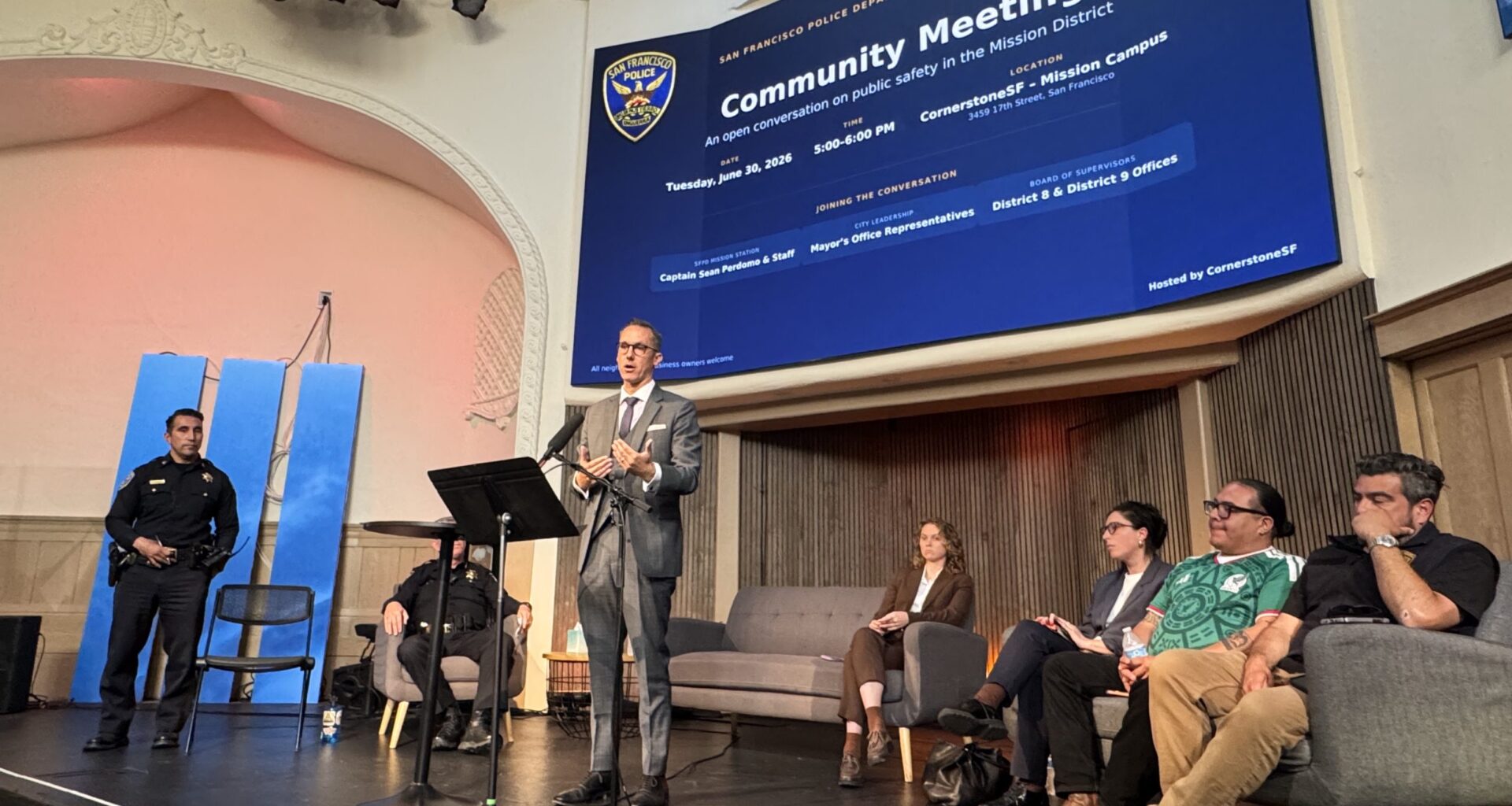
At Tuesday’s community meeting for neighborhoods covered by the Mission police station, the conversation, as it so often does, zoomed in on what is and isn’t possible to do about the persistent littering, public drug use, fencing of stolen goods, and general human misery in the streets and alleys around 16th and Mission.
Much of the discussion felt familiar. Then a representative of the mayor’s office also floated a new idea— a potential expansion of the city’s RESET center pilot across different neighborhoods.
“The absolute hope is that we will expand,” said Steven Betz, Mayor Daniel Lurie’s chief of public safety on Tuesday evening in front of nearly 80 attendees at the Cornerstone Church at 3459 17th St., near Albion Street. “There’s a lot more conversations that go into it, but my dream vision of this is that an officer could use RESET anywhere in the city.”

Want the latest on the Mission and San Francisco? Sign up for our free daily newsletter below.
RESET, also known as the “Rapid Enforcement, Support, Evaluation and Triage” center, opened on May 4 at 444 Sixth St., close to the Hall of Justice. RESET, said Betz, is a place where officers can take people who are publicly using drugs and don’t want to accept help. “The person is supposed to stay there until they are sober,” Betz told the crowd. “If they leave before they are sober, they can be subject to being rearrested and actually taken to jail.” The average person taken to a RESET center stays there for eight hours, said Betz, which gives time for clinicians and peer counselors to talk to them about getting into substance abuse treatment.
City officials are pleased with the Center so far, said Betz. “We have taken — arrested — about 650 people,” he told the group. About 27 percent, he continued, have agreed to go on to what we’re defining as that next level of care,” which is whether agreeing to go to a shelter, or to go into a residential treatment program.
The 27 percent, Betz said, is a higher number than the city had anticipated.
The center raised concerns from some in the city government that RESET’s model is not legal (a leaked memo from the city attorney’s office warned that holding people at the center against their will could open the city to lawsuits).
Residents who came to the meeting asked for many things. Some asked for more police. Others asked for less. Some asked for more trashcans, bathrooms, and mobile shower facilities in the blocks surrounding 16th and Mission.
Sasha Gaona, chief of staff for District 9 Supervisor Jackie Fielder, said that adding new infrastructure will depend on the city’s budget. Gaona added that Fielder’s office advocated to save a pit stop near 14th and Stevenson streets when the city tried to remove it.
As for more bathrooms, Gaona said, supervisor Fielder’s office is currently looking at legislation in New York City that mandates a certain number of public toilets across the city.
Another resident wanted to know why the police department’s budget was increasing.
“What I would like to know is why is it that the police budget, which is $840.7 million [$849 million, according to a recent document from the mayor’s office], continues to grow? Why all of our social services, all of our additional coverage, all of our shelter services continue to get cut,” said the resident.
Sophie Marie, chief of staff for District 8 Supervisor Rafael Mandelman, jumped in.
“It is the mayor’s top priority to my understanding is to fully staff our police department,” said Marie. “That has been a commitment that he made throughout his campaign, and his budget is a value statement and speaks to that. My boss [Mandelman] is in alignment with that idea as well.”
Other neighbors asked officials what their current plan was to address drug use, drug dealing, public intoxication, littering, loitering and selling of stolen goods given that the worst of it kept moving.
“We don’t experience drug markets, encampments, exploitation, unsafe transit hubs and struggling businesses as separate issues,” said John Bove, a Mission resident. “We experienced them as one street environment, and when one spot gets cleaned up, the activity often just shifts from transit hubs into parks, parks into residential blocks, corridors into school routes.”
Mission Station Captain Sean Perdomo said the police department and other city agencies are working on a new 90-day initiative to improve street conditions in the neighborhood. So far, Perdomo added, eight probationary officers from Mission Station have been stationed at the BART plazas and a new unit has been created to address street conditions.
Santiago Lerma, the city’s lead for Mission District “street teams”, spoke about the work the Mission street team and the Homelessness Outreach Team (the Mission has two, he said) do in the neighborhood. He also said the Mission would see an increase from 20 to 50 members of shared priority, a program with the Department of Public Health, that works with the area’s toughest cases.
“I’ve seen that program be very successful,” said Lerma, of shared priority. Four men who had routinely drank, spread garbage, and passed out on Capp Street between 16th and 17th for years had recently gotten into housing.
“We got all of these folks housed and there’s tremendous improvement on that block,” said Lerma. “It does take time and it’s not always right as you need it and as you want it. But we are out there.”
We won’t ignore your neighborhood
When a San Francisco neighborhood has a Mission Local reporter, it means someone is there. We’re following new housing projects proposed on your block, keeping tabs on what your district supervisor is up to at City Hall, and letting you know when longtime businesses close (and new ones open). When big news breaks, we already know the context.
Most neighborhoods don’t have that. Yours could.
That’s what Mission Local is building. Our reporters don’t parachute in — they write consistently on San Francisco, so you’re never reading about your neighborhood from someone who just looked it up.
So far we are in five of San Francisco’s neighborhoods. But we know all San Franciscans deserve our kind of coverage. Will you join us?