
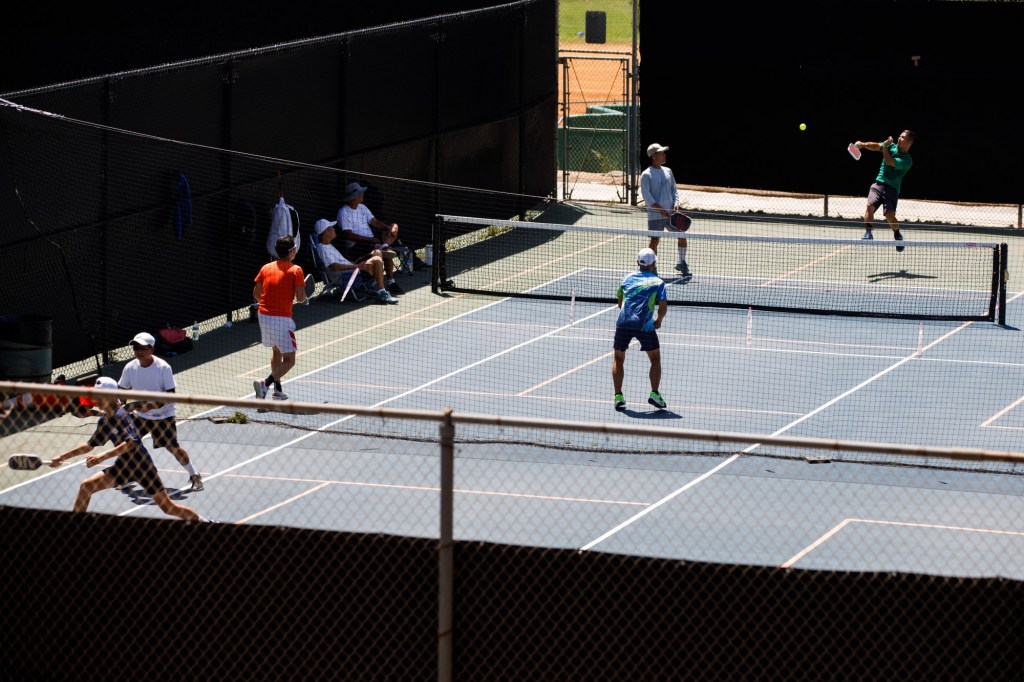
For years, San Diego pickleball players have been told to wait.
Wait for studies. Wait for planning. Wait for funding. Wait for future projects. Wait for Kearny Mesa. Wait for Robb Field. Today, that promise appears more uncertain than ever.
When the city unveiled plans for Robb Field, many players were encouraged to see pickleball included. But as details emerged, it became clear the proposed courts were never funded. Timelines slipped, with reports suggesting the project could be pushed into the 2030s. More recently, budget concerns have prompted discussions of delaying projects and reducing recreation services.
The question San Diego pickleball players should be asking is simple:
How long are we expected to wait?
Despite being one of the fastest-growing sports in America, pickleball still has no dedicated public facility in the city of San Diego operated with pickleball as its primary mission.
The Pickleball Association of San Diego has long argued that practical solutions exist today and that San Diego should not have to wait decades for additional pickleball access.
Years ago, we proposed converting six lightly utilized tennis courts at Robb Field into a dedicated pickleball facility. The conversion could have created 18 pickleball courts in weeks rather than decades, without requiring city funding. The Pickleball Association of San Diego even proposed a “zero-city funding” approach, offering to fund the entire conversion rather than asking taxpayers to bear the cost.
The proposal was not to eliminate tennis. It was to share public recreational space more equitably based on demonstrated demand.
The response was predictable.
We were repeatedly told pickleball and tennis were not compatible. We heard concerns about noise, co-existence and impacts on tennis. Yet directly across the street, a very different story has unfolded.
Over the past few years, Barnes Tennis Center has transformed from a facility with only a handful of pickleball courts into one of the largest pickleball venues in Southern California.
Today, Barnes operates approximately 25 tennis courts (including two clay courts), 19 dedicated pickleball courts and seven padel courts.
Barnes has demonstrated that these sports can co-exist.
More importantly, it has confirmed what the Pickleball Association of San Diego has argued for years:
The demand for pickleball is undeniable.
Ladders fill. Open play fills. Clinics fill. Tournaments fill. Barnes has shown that San Diego can support a large-scale pickleball facility. The question is no longer whether demand exists. The question is why San Diego still lacks a dedicated public facility designed around that demand.
But Barnes also highlights another issue. Pickleball players still do not control the facility. Decisions regarding pricing, scheduling, programming, tournaments and long-term priorities remain with a tennis organization.
Consider tournaments. Outside companies are often brought in to run major pickleball events. Players spend at least $315 to enter a single division, with additional fees for each division played.
The issue is not whether those fees are right or wrong. The issue is who gets to decide.
A facility operated by the pickleball community might place greater emphasis on serving the local community. Programming could be designed not only around tournaments and peak-hour play, but also around expanding access throughout the day for older adults, youth, beginners, adaptive athletes and players seeking a more social experience. The goal would be to maximize participation, community engagement and public benefit — not simply revenue and court utilization during peak hours.
Reasonable people can disagree on those priorities. But pickleball players should at least have a voice in those decisions.
That brings us to the bigger issue. Tennis has 13 dedicated public facilities. Tennis controls programming. Tennis controls expansion. Tennis controls its future. Pickleball does not.
Think about that. Barnes has demonstrated that large-scale pickleball facilities are viable, popular and heavily used. Yet the fastest-growing sport in America still has no dedicated public home in the city of San Diego.
Barnes proved the demand. Robb Field exposed the delay. Together, they reveal the same problem: San Diego pickleball players still do not control their own destiny.
The Pickleball Association of San Diego believes there is a better path. Not through decade-long promises. Not through unfunded plans. Not through endless studies. But through practical solutions, fair allocation of public recreational space, facilities designed around the needs of pickleball players and giving pickleball the same opportunity other sports have enjoyed for decades:
A place of its own — and a voice shaping its future.
Boyland is the founder of the Pickleball Association of San Diego.