
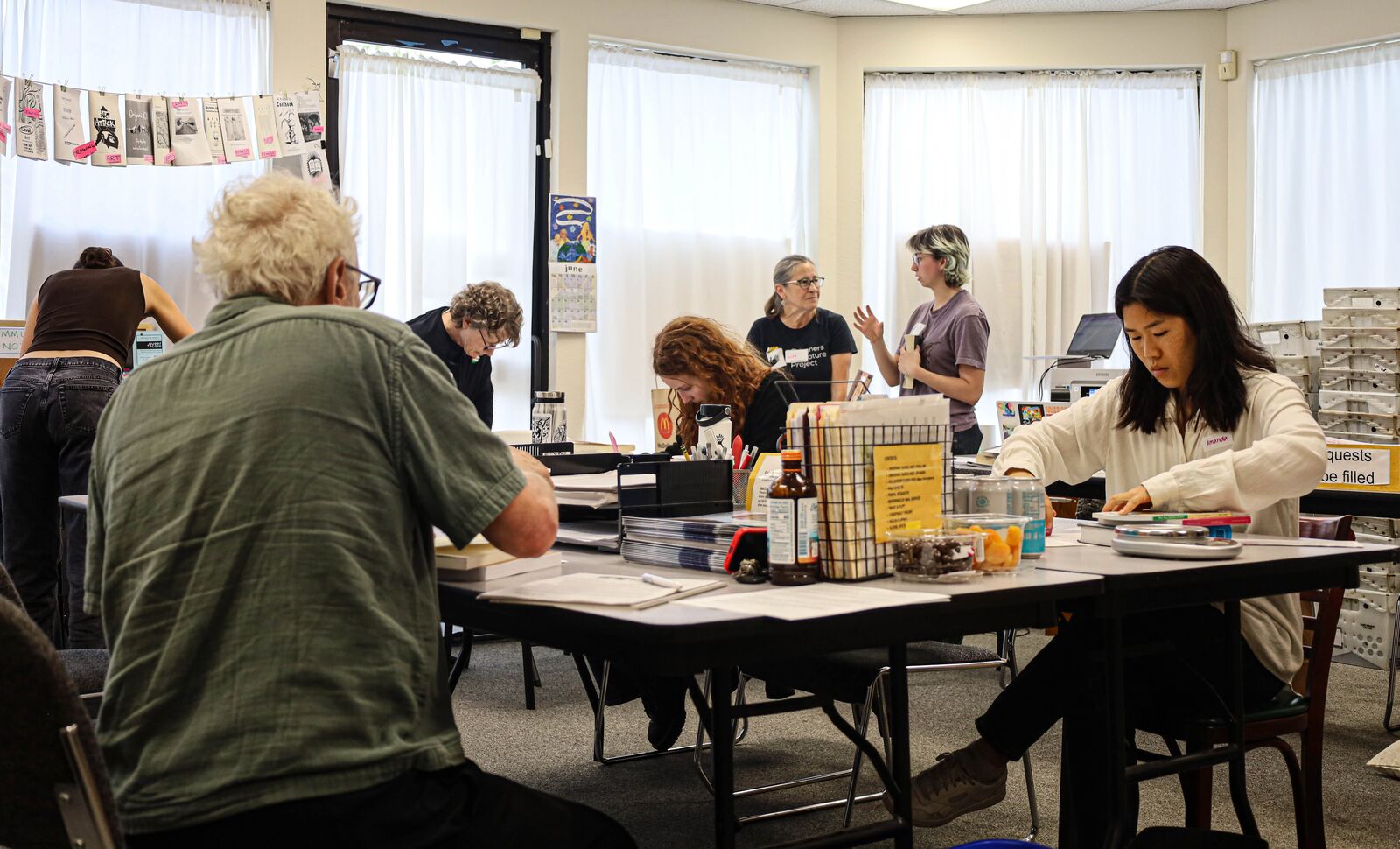
 Volunteers at the Prisoners Literature Project nonprofit’s Berkeley headquarters, at Martin Luther King Jr. Way and Dwight Way, reply to letters and package books for inmates last month. Credit: Daniel Ekonde/Berkeleyside
Most nights in Berkeley, volunteers with the Prisoners Literature Project, the largest nonprofit of its kind in the Bay Area, will sit around a table in an office next to a chiropractic clinic, picking letters from a box that are addressed to them by people incarcerated in facilities across the country.
Each letter comes from an inmate hoping for something to read. Many ask for sci-fi thrillers, true crime stories and something that can teach them a trade. Comic books are in high demand. The most common request is for a dictionary.
The letters come with requests for specific titles or genres, but also with messages of gratitude and encouragement. “For many of us, [books] are our escape, a figurative (and sometimes literal) doorway to freedom.” “I am a lifer with no parole. Have no family alive anymore. Y’all are the only communication I’ve had.” “My facility banned books for a few months but now the ban is lifted! Yay!”
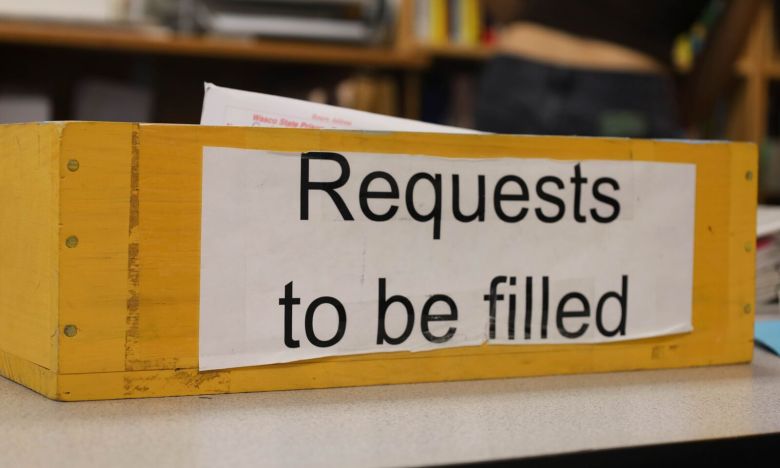 The box where volunteers retrieve letters. Credit: Daniel Ekonde/Berkeleyside
Inmates have a First Amendment right to read while in confinement, but correctional facilities restrict tens of thousands of titles, based on concerns about content or contraband, with bans varying widely between prisons. Everything from James Joyce’s “Ulysses” to Barack Obama’s “The Audacity of Hope” to Strunk & White’s “The Elements of Style” has been caught in the dragnet at one facility or another.
The letters from inmates frequently instruct volunteers on what it takes to make it past the prison censor. “Three books maximum, and they must be new,” one letter reads. “No stains, ink, or stickers.”
The Prisoners Literature Project’s Berkeley headquarters, at the corner of Martin Luther King Jr. Way and Dwight Way on the edge of downtown, resembles a small library or bookshop, with bookshelves stretching from floor to ceiling. After reading a letter, a volunteer will peruse the stacks. They’ll pick out three to five books, wrap them in a tidy package and hand-write a note in response.
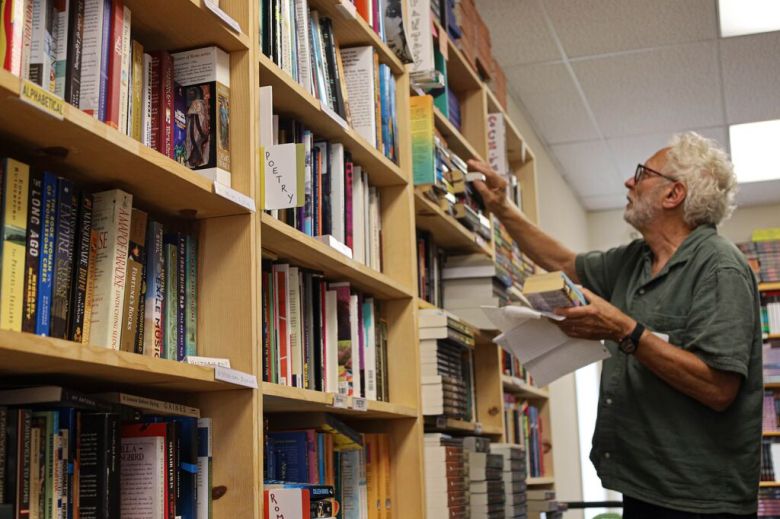 A volunteer browses the shelf and selects books. Credit: Daniel Ekonde/Berkeleyside
“Thank you for your letter,” Leslie, a volunteer who asked her last name not be used, wrote in one note the Wednesday evening Berkeleyside visited. “I have enclosed [the books] you requested.”
She was fulfilling a request from a person incarcerated in Kern Valley State Prison in Delano, California, who asked for phrasebooks in Mandarin, Cantonese and Mexican Spanish. The closest match for the Mexican Spanish book Leslie found was a Latin American dictionary.
She weighed the three books on a digital scale (under two pounds, not too heavy for Kern Valley State’s rules), wrapped them with a Prison Activist Resource Center (PARC) resource guide, attached the letter to the top of the package and bound them together with an elastic cord. Then she placed the bundle beside a group of others, ready to be sealed and mailed.
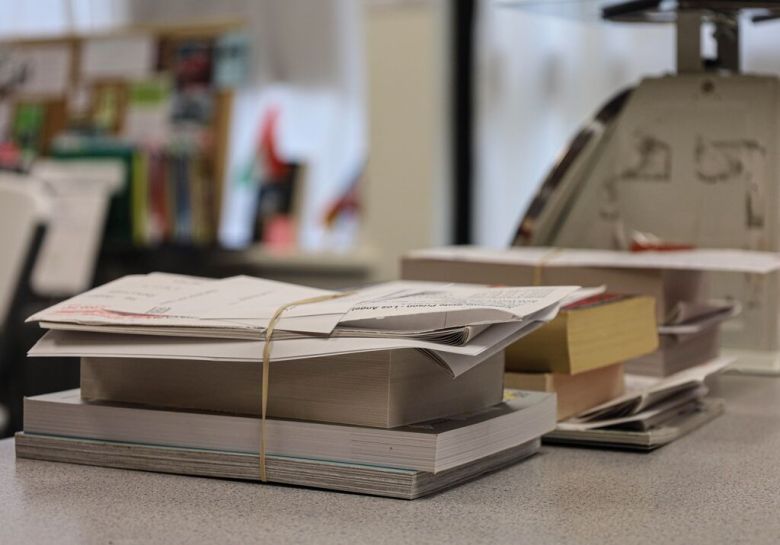 Bound books ready to be sealed and mailed. Credit: Daniel Ekonde/Berkeleyside
Across the room, another volunteer packaged up two books: “The Parable of the Sower” by Octavia E. Butler and “The Magicians” by Lev Grossman.
Between the time they arrived, at 6 p.m., and when they left, at 9 p.m., the 11 volunteers working that evening aimed to fulfill about 50 requests.
Prisoners Literature Project was born out of the need to help an incarcerated friend
Prisoners Literature Project was founded by activists in 1980 or 1981, at first operating out of the back room of Bound Together Books, a volunteer-run anarchist bookstore in San Francisco. “It was designed initially just to get books to a friend [in jail] of the people who set it up,” said Karen Franklin, a longtime volunteer at the nonprofit, one of the oldest books-to-prisoners organizations in the nation.
Getting just five to 10 requests a month in the early days, word spread among inmates and demand exploded. It moved to the East Bay in the 1990s, and today there are 300 volunteers who rotate through the Berkeley office, sending 30,000 books to inmates in more than 1,000 prisons, jails, and federal and juvenile facilities across the U.S. every year. They work in three-hour shifts, about 20 evenings per month.
The nonprofit has an annual budget of around $250,000, according to tax filings, which covers about $90,000 per year in postage fees, plus rent and the purchase of books at a discount on remainder websites. More than a dozen bookstores around the Bay, including the Pegasus store in downtown Berkeley, donate books to the nonprofit. Pegasus asks customers at checkout if they also want to buy a book for an inmate.
Prisoners Literature Project operates as an anarchist organization, with no hierarchical structure and collective decision-making. “Everyone contributes how they can in order to accomplish all the necessary tasks,” Franklin said.
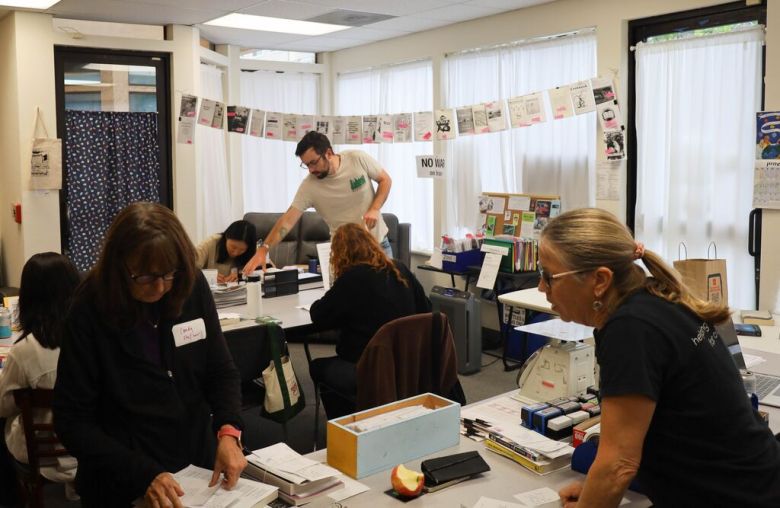 Volunteers work in three-hour shifts, about 20 evenings per month. Credit: Daniel Ekonde/Berkeleyside
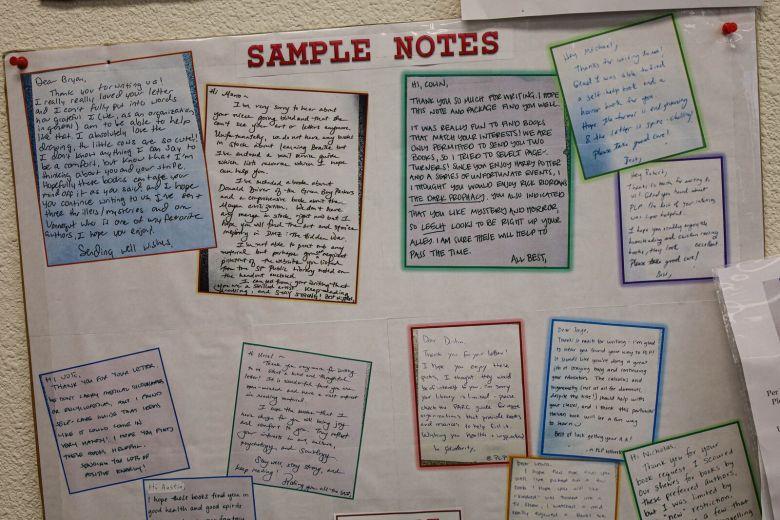 A poster with sample notes for volunteers to consult while writing responses to inmates’ letters. Credit: Daniel Ekonde/Berkeleyside
Leslie started volunteering at the Prisoners Literature Project last September, when a bookstore she volunteered for supplied books to the project. “When I heard about it, I thought that’s really fascinating and interesting,” Leslie said. A freelance book editor, she had an incarcerated friend 13 years ago, whose prison library didn’t have his desired books.
“If he had known about [the Prisoners Literature Project] back then, I think it would have been better for him,” Leslie said. “But at that point it was me who was getting him books every so often, whenever I could.” She volunteers three times a month, aiming to come at least weekly.
Susana, another volunteer, who also declined to give her last name, said she is a project lead at a tech company and she learned about the project two years ago when she found their bookmark in a book she read. She is an avid reader who loves thrillers, which she said provide her an escape. Whenever inmates request similar titles, she genuinely hopes they lend relief from confinement.
“I can recommend specific books that I enjoy and write them in a little note like, ‘This is one of my favorites by this author. I hope you like it.’ That’s enjoyable for me.”
The nonprofit is also involved in advocating against book bans
With many corrections institutions restricting the type of books accepted, the Prisoners Literature Project has become involved in anti-censorship advocacy.
In 2019, it joined sister organizations in writing to the Supreme Court, pushing for a reversal of a ban by the Florida correction department on the magazine Prison Legal News.
Recently, the California Department of Corrections and Rehabilitation barred a book on “computer programming for inmates,” which had been published by the Prisoners Literature Project, one of the few books the nonprofit publishes itself. The grounds were that learning Python could enable inmates to hack the department’s computer systems. The nonprofit fought the ban and the corrections department reversed it in May. “They claimed it was a mistake,” Franklin said.
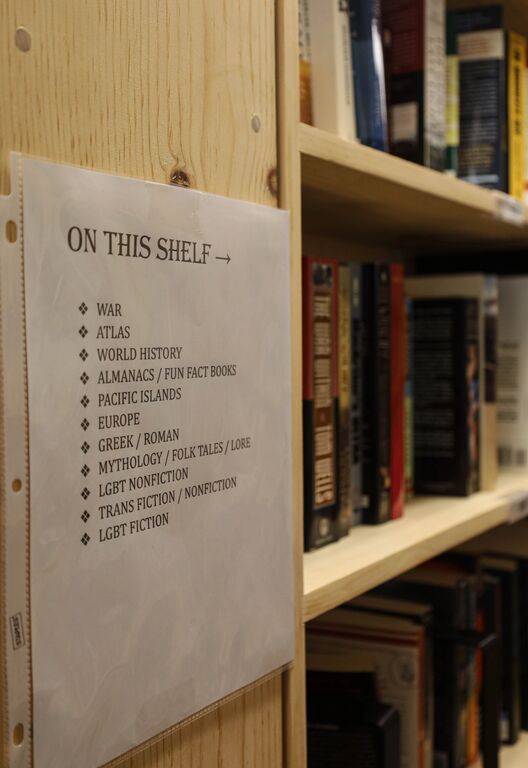 Sci-fi, thrillers and dictionaries are the most popular titles requested by inmates. Credit: Daniel Ekonde/Berkeleyside
Texas, the state with the largest prison population, banned all inmates from receiving hardcover or used books in April, and the Prisoners Literature Project has stopped sending books to Texas altogether.
Franklin said the way to combat book bans is by talking about them. “If there’s enough media attention and public pressure, they’ll walk it back,” Franklin said, noting how several prison systems, including those in Washington state, Pennsylvania and New York, have rescinded overbroad statewide restrictions of books after public backlash.
Just as books helped Nelson Mandela endure 27 years in prison during the Apartheid era in South Africa, Franklin and the Prisoners Literature Project believe the same impact is being achieved in correctional facilities across the country.
“Prisoners in solitary confinement will write to us and say that our books saved their life and kept them sane, because [it’s] the only way they had of escaping their reality,” Franklin said.
You can sign up to volunteer with the Prisoners Literature Project or support the nonprofit with a donation.
We know that most readers don’t get to the end of the article. But you did! To support our in-depth, rock-solid reporting, please consider making a donation to our nonprofit newsroom today. We rely on our readers — particularly the ones who read the whole story!
“*” indicates required fields