
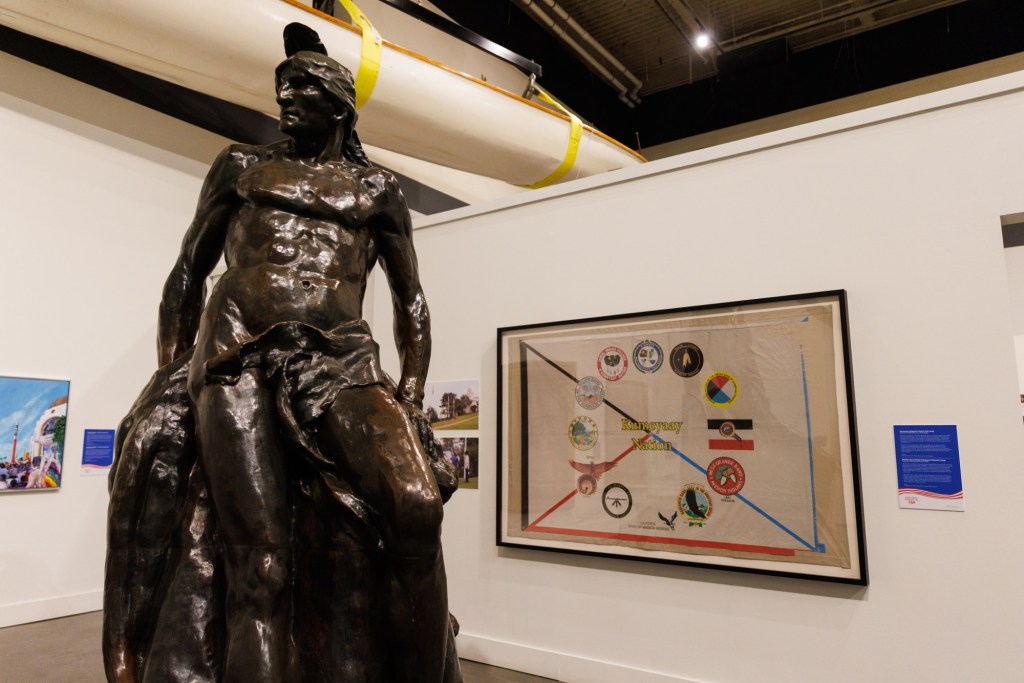
As the United States marks its 250th anniversary, the “America at 250: San Diego 1776–2026” exhibition at the San Diego History Center in Balboa Park explores how San Diego has helped shape the nation’s history. Through 100 objects, including paintings, photographs, documents and maps, it traces the city’s role in historical events and social change.
The exhibition spans three of the History Center’s nine galleries, with a few objects displayed throughout other spaces. Most of the featured pieces come from the San Diego History Center’s permanent collection.
“The goal of this exhibit was to showcase those moments of intersection with the larger U.S. history, where San Diego overlaps, where it intersects, but also to show those points of divergence,” said Tina Zarpour, vice president of community engagement, education and collections at San Diego History Center.
The project was curated with the help of seven history student interns from UC San Diego and San Diego State University. The interns conducted research over six months, each selecting and featuring six to eight objects and writing the placards that accompany each display.
“We’re not hearing from the staff and the historians at the history center. You’re hearing from the next generation of people working in history,” said Zarpour.
The curatorial process began with placing some of its largest objects, including a 1920s Model T Ford Touring Car and an 1880s printing press, in the gallery space. Paintings were arranged chronologically from oldest to most recent, while large murals once displayed in San Diego schools stretched across the walls and clusters of photographs filled the surrounding spaces. Smaller artifacts were then interspersed throughout the galleries.
The oldest pieces come from the 18th century, including a wardrobe of George Marston, founder of the San Diego Historical Society. Another notable work from this period is “La Madre Santísima de la Luz,” an 18th-century painting of the Virgin Mary, which was collected after surviving a fire at the original Mission San Diego de Alcalá, and was later overpainted in 1930 to add Indigenous representation, including two chiefs.
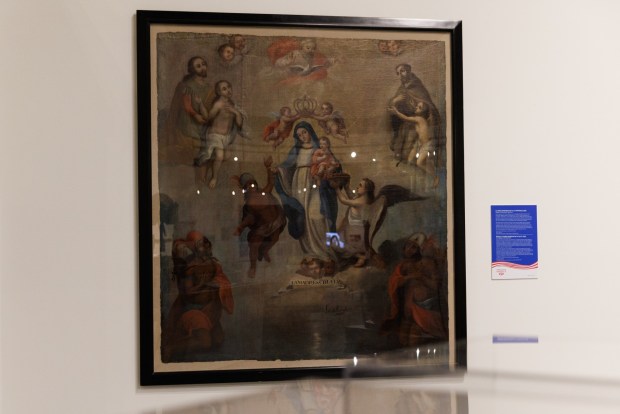 A painting that survived a the Mission San Diego de Alcalá fire on display at the San Diego History Center in Balboa Park on Tuesday, June 30, 2026. (Kristian Carreon / The San Diego Union-Tribune)
“We want to not just talk about the things that were positive and good, but we want to talk about the things that were challenging,” said Zarpour.
As the exhibition moves forward in time, it explores the experiences of immigrant communities through artifacts such as the “Ah Quin Diaries.”
“What we have in his diaries is a very singular voice and perspective of a Chinese man living in California after the time of the Chinese Exclusion Act. He’s writing in both Chinese and English,” said Zarpour.
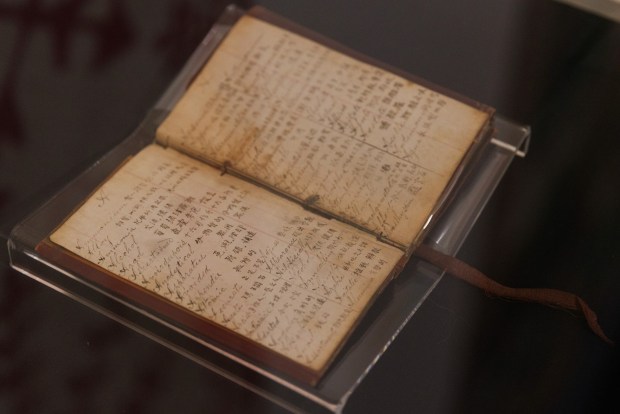 A diary of Ah Quin, an immigrant from Guangdong, China, on display at the San Diego History Center in Balboa Park on Tuesday, June 30, 2026. Quin’s diaries show a unique perspective of San Diego from 1876-1902. (Kristian Carreon / The San Diego Union-Tribune)
The exhibition also confronts darker chapters of the city’s past. A Ku Klux Klan taillight cover from the 1930s, which the history center says was donated by the son of a former Klan member along with pins and medals, preserving evidence of the Klan’s presence in the region.
The galleries then turn to World War II, featuring objects from a San Diego Japanese family who were separated during their time in incarceration camps. Letters exchanged between family members, alongside photographs and a child’s coat are on display.
“There are painful parts of our history that contribute to the national history too,” said Zarpour.
More recent objects include a pair of pink boxing gloves, acquired from the Women’s Museum of California before it merged with the San Diego History Center, commemorating the 2017 Women’s March. The exhibition also features a “Peace, Love, Hope” banner from San Diego’s first COVID-19 vaccination clinic at the Del Mar Fairgrounds in 2020.
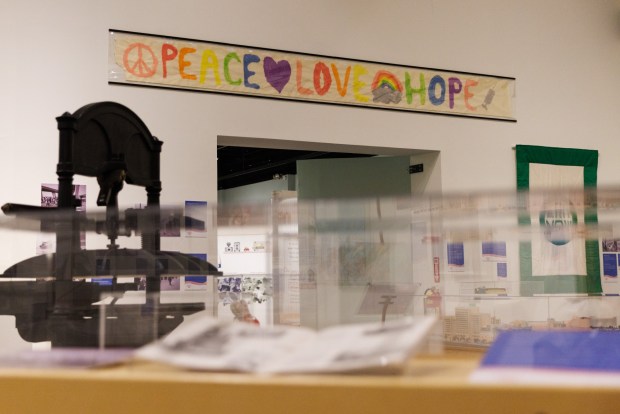 A banner that was on display at a vaccination site at the Del Mar Fairgrounds during the coronavirus pandemic hangs in the “America at 250” exhibition at the San Diego History Center in Balboa Park on Tuesday, June 30, 2026. (Kristian Carreon / The San Diego Union-Tribune)
Other ephemera include Padres memorabilia dating back to 1945, posters from San Diego’s first Comic-Con, a doll from the 1996 Republican National Convention and an interactive display where visitors can write their own wishes for San Diego.
“America at 250: San Diego 1776–2026” is on view at the San Diego History Center through spring 2027. Tickets are available 10 a.m. to 5 p.m. Wednesday through Sunday, with donation-based admission.