

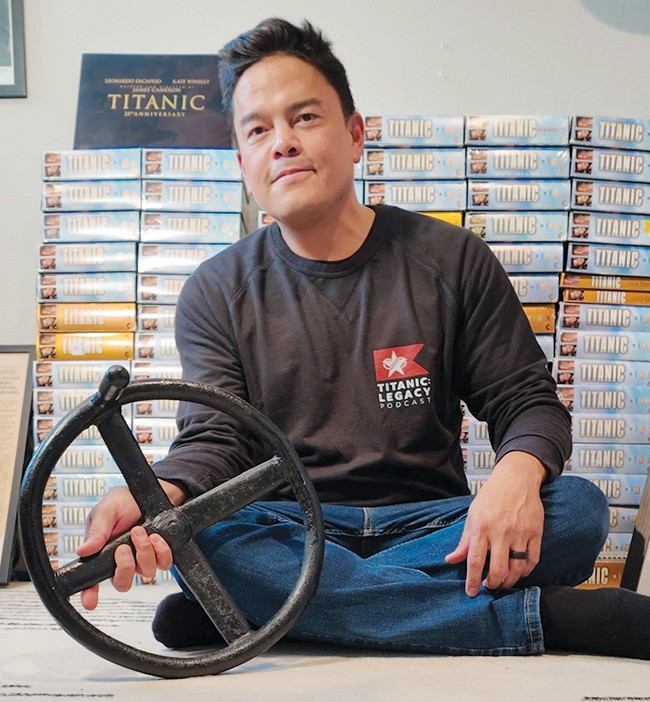
UNSINKABLE—Paul Carganilla, left, with the capstan-wheel prop Kate Winslet’s character Rose grasps in the movie “Titanic” before her fateful jump, runs the Titanic Anniversary Weekend fan gathering on the Queen Mary in Long Beach. Courtesy Paul Carganilla
In a home recording studio in Moorpark, VHS copies of the movie “Titanic” piled waist-high against a wall might, to the untrained eye, look like the remnants of a video store gone under.
To Paul Carganilla, they are evidence of a global community.
Carganilla, 44, hosts a podcast called “Titanic Legacy,” where he explores the 1912 tragedy and the 1997 James Cameron movie that sprang from it. It’s a passion that owes its start to a boyhood visit to his grandparents’ home, but one that has developed through the adult lens of research.
He is quick to deflect the title of expert, despite having amassed a collection of rare props, survivor autographs, and firsthand historical accounts that would rival a small museum exhibit. For Carganilla, the Titanic is not just a tragedy from 1912; it is a living narrative. The story of the magnificent vessel that famously sank on its maiden voyage from Southampton, England, to New York remains a source of inspiration, serving as the foundation for a vibrant international community.
SCOTT STEEPLETON/Acorn Newspapers
Carganilla’s journey began not in a theater but on his grandparents’ couch, flipping through a copy of National Geographic shortly after Dr. Robert Ballard discovered the wreck in the mid-’80s.
“I was 5 years old,” he recalled. “Some of my earliest memories are seeing the images of the wreck on the bottom of the ocean and my grandfather telling me there were hundreds of people on this ship when it sank.”
That childhood spark was fanned into a flame by the 1997 James Cameron film “Titanic,” which reignited the public’s obsession. For Carganilla, the hook was never just the disaster—it was the humanity of the event.
Whether he is discussing the tragic nobility of the ship’s architect, Thomas Andrews, or the villainous reputation of Bruce Ismay—chairman and managing director of the White Star Line, the shipping company that operated the Titanic— Carganilla is drawn to the “why” of the story.
“I always say follow your heart’s fire, and it leads you where you’re meant to go in life,” he said. That philosophy led him during the pandemic to create a podcast that transcends mere trivia, focusing instead on the creators, artists and descendants who keep the spirit of the ship alive today.
Originally launching a variety show to interview creatives, Carganilla noticed a pattern: 40 percent of his episodes were about the Titanic.
Recognizing a clear signal from his audience—and his own passion—he launched “Titanic Legacy.” The podcast quickly became a hub for global enthusiasts, with roughly 40 percent of his listenership tuning in from outside the United States. While noting that listener statistics often reveal cities he has never even heard of, Carganilla takes special pride in his reach across the Atlantic.
“What brings me a lot of joy,” he said, “is that I get a lot of listeners from Ireland and England and areas where Titanic really originated.”
Titanic, he said, has taken his family on a number of adventures, including to Washington, D.C. (visiting the Titanic Senate hearing room and Titanic Memorial); Belfast, Ireland (where Titanic was built); New Jersey (chief cook Charles Joughin’s grave); New York City (White Star Line office where folks would go check to see if their loved ones survived).
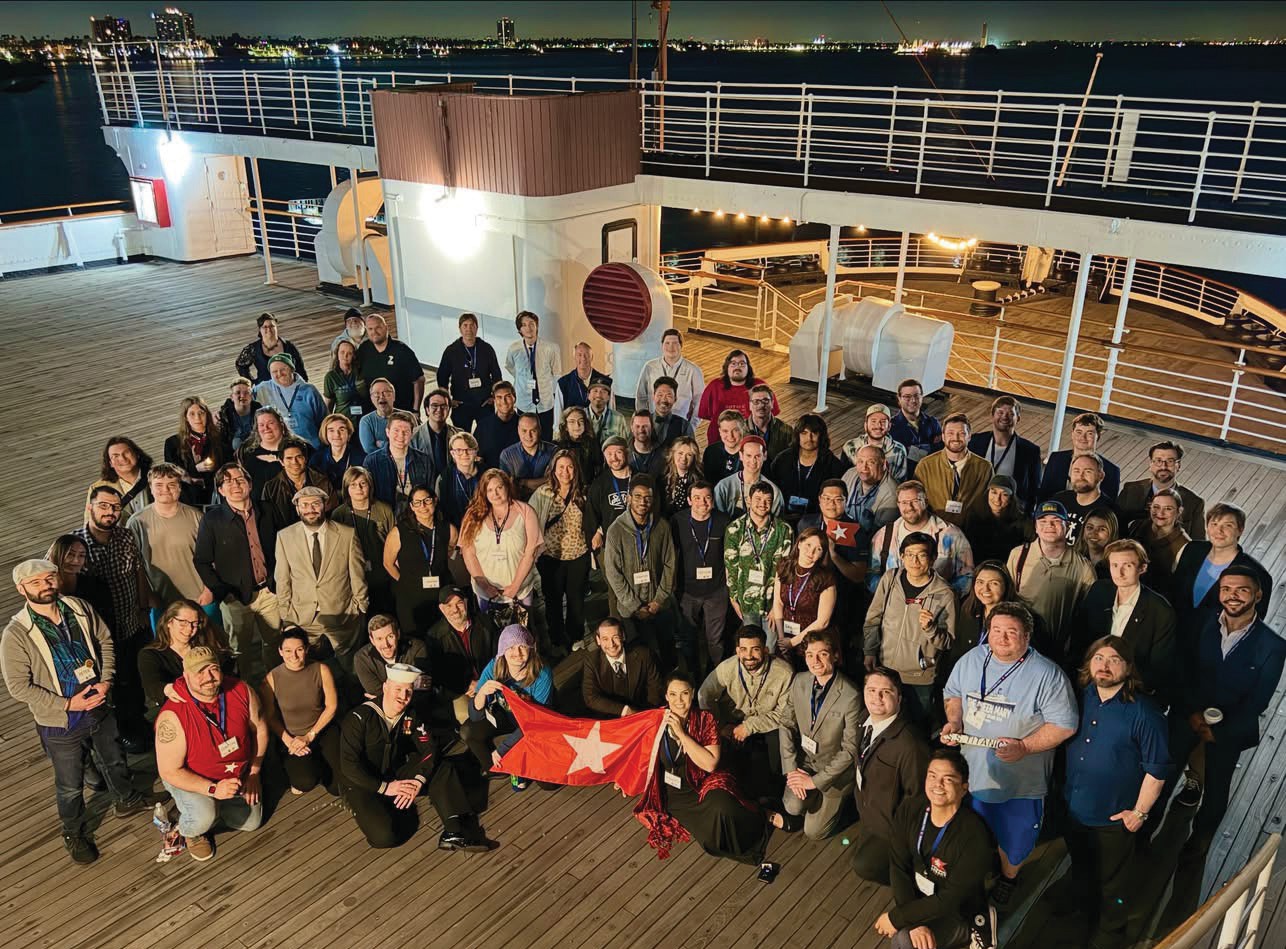
Carganilla wanted to take that digital connection into the physical world. When a small Titanic event at the Queen Mary in Long Beach was slated to be a oneoff gathering, he decided to pick up the torch—and what started with a modest gathering of 30 or 40 has grown under his organization.
By this past April, the event drew 150 attendees per day for four days.
With the Queen Mary now officially on board to help expand the programming, the event is poised to grow even larger, with dates already set for April 11-14, 2027.
“My favorite thing about life is connecting people who share the same passions,” he said. “Titanic is still bringing people together, which is pretty magical.”
Carganilla’s dedication goes beyond the microphone. His collection is a tactile archive of Titanic culture. He possesses rare items, including a piece of deck plating and coal from the wreckage, and even wax coffee cups used during the filming of the movie to create the illusion of cups floating in the sinking dining room.
Then there are the VHS tapes.
“I had the idea that I could become the savior of ‘Titanic’ VHS tapes and collect as many as possible,” he said with a laugh, telling a visitor that he’s amassed somewhere in the neighborhood of 130.
Impressive as that may be, he eventually discovered a TikTok creator who has enough copies to fill an ocean liner compared to Carganilla’s dinghy.
While eventually realizing he could not compete with the viral collector’s 6,000 copies, Carganilla’s reputation preceded him and now he receives unsolicited boxes of tapes from strangers across the country who want their collections to go to a good home.
Despite his love for the subject, Carganilla is a grounded voice in the fandom. He is quick to swat down the more nonsensical theories that plague the community— specifically the “Switch Theory,” which posits that the Titanic was swapped with her sister ship, the Olympic, for an insurance scam.
“It’s a bunch of baloney,” he said, noting that the facts simply do not support the conspiracy.
He prefers to keep the conversation focused on the reality: the mechanical failures, the human error, and the hubris that led to the catastrophe.
With an eye toward 2027, Carganilla has locked in key participants: celebrated Titanic historian Don Lynch and the creators of “Titanic: Honor and Glory,” who are working to reconstruct the entire vessel in a fully explorable digital environment.
Whether he is writing screenplays, analyzing films like “The Adjustment Bureau,” or meticulously organizing his collection, Paul Carganilla remains a man defined by his passions. By following his heart’s fire, he not only built a podcast, he bridged past and present—ensuring that the human stories of the Titanic continue to resonate long after the ship came to rest on the ocean floor.