
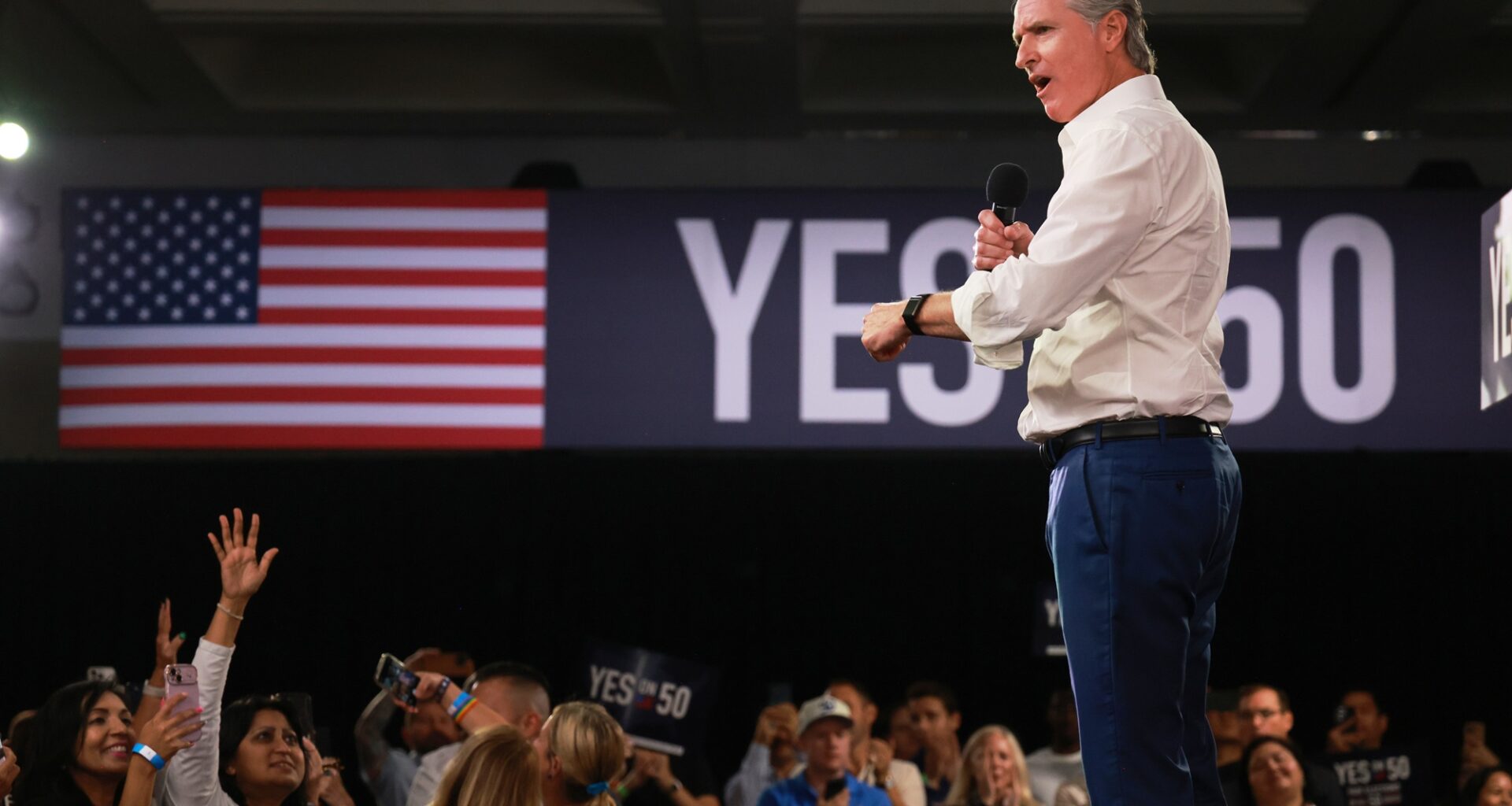
I will admit to some early skepticism that California Democrats could pull off sidelining the state’s redistricting commission, allowing them to partially offset Donald Trump’s gambit to immunize himself from voter anger in the midterm elections by cheating his way to more House seats. My doubt was really about the mechanics: I wasn’t certain that the commission allowed for a mid-cycle change, I thought the timing would be too arduous to get it in place before candidate filing, and I wasn’t sure how much you could squeeze from a map already tilted in Democrats’ favor.
I was wrong. And I knew I was wrong the day I showed up in the Little Tokyo section of Los Angeles a few months ago, when the Election Rigging Response Act was announced. I could see that anti-Trump framing was an easy sell to an electorate that wanted some agency to respond to the lunacy of this presidency. As I learned about the map, I noticed that it shored up Democratic swing seats as much as it created new districts to win, removing much chance of backfiring. And when I saw the limp Republican response, with ads trying to appeal to fairness when Donald Trump is their standard-bearer, I was sure this wasn’t going to be a contest.
The Republicans who bankrolled the effort were sure too. They gave their ads about a month and then pulled them. I received a grand total of three mailers about Prop 50, and none of them in the last month and a half. The opposition surrendered in the face of overwhelming evidence that California voters were dead set on countering Trump’s schemes. And so tonight’s resounding victory was assured when the campaign began. The race was called the moment that polls closed.
Democrats had the choice to grumble about the destruction of democracy or free themselves from the shackles that restrained them.
The win, combined with several mid-cycle surprises, has weakened Trump’s shield against accountability for his unpopular reign, although the Supreme Court really holds the key to whether we’ll have something approaching legitimate elections next year. Gov. Gavin Newsom deserves a lot of credit for leading the resistance to the Trump gambit, and pulling even reluctant Democrats into the battle. It should be a lesson for the whole party across a host of fights.
Changes to congressional maps in California and Texas now essentially cancel each other out. The Texas gerrymander does not guarantee five more Republican seats, as it’s dubiously predicated on the GOP maintaining Latino support across the state. The California maps, likewise, will not automatically lead to five Democratic seats, as a couple of swing-district battles are maintained. Yet on a good night, Democrats could gain a +1 or +2 advantage between the two states.
Republican legislatures have finalized new maps in North Carolina and Missouri that would likely give Republicans two seats total; success in Missouri depends on whether opponents can get a referendum on the maps on the ballot, which could nullify their use next year. Kansas and Indiana have initiated special sessions, aimed at redistricting another two seats to Republicans, but neither state appears to have enough votes yet to get it done. (In fact, late on Tuesday, Kansas threw in the towel because they lacked the votes.) New Hampshire’s Republican governor has rejected redistricting; Nebraska’s Republican governor expressed “openness” to it, but not much seems to be happening.
Ohio was always going to be a loss for Democrats, as maps had to be redrawn before next year per state law. But some political hardball mitigated the damage. Republicans were poised to draw a new map in the legislature that would have wiped out three Democratic seats; but when Democrats promised a referendum that would hold up or even nullify the maps, Republicans retreated to the redistricting commission, which eliminated the possibility of a referendum but gave Democrats a greater voice in the process. The new maps actually strengthened Rep. Emilia Sykes’s district while giving Marcy Kaptur a fighting chance to defy the odds once again and hold on in Trump country. Even Greg Landsman could hold on in a good year, leading to no changes in Ohio in 2026.
Plus there’s Utah, where a court forced the legislature to draw new maps that could yield one or two seats for Democrats; the court will make a final decision by next week. Add that all up, and you have changes that could range from a +5 Republican seats to +2 Democratic. That is nowhere near what Trump sought when he embarked on this gerrymander crusade.
That doesn’t count Democratic movement in the Northeast. Newsom’s stated goal was to bring others in his party off the sidelines, and this appears to be working, if only because of the jockeying for power within national politics. For instance, Maryland Gov. Wes Moore, who believes himself to be a presidential candidate, has kicked off the state’s redistricting process, aimed at squeezing out Freedom Caucus Rep. Andy Harris (R-MD), even though state Senate leader Bill Ferguson has resisted changes (though his latest objections have softened somewhat). I was told earlier this year that Moore and state House leaders would have to force Ferguson to the table, and that pressure campaign has begun in earnest.
More surprisingly, Virginia Democrats sped to pass the first of a two-stage series of votes, followed by a ballot referendum, that would allow for redistricting there. The process is similar to what just passed in California and could move two or three more seats into the Democratic column. Finally, New York voters have filed a lawsuit that could force changes to one Staten Island district held by Rep. Nicole Malliotakis (R-NY), New York City’s only Republican member of the House.
Only Illinois has been an outlier in resisting Newsom’s call. But if the active gambits work, up to five more seats could flip to Democrats, practically evening out the Republican gerrymander even in the worst-case scenario.
Lurking in the background, of course, is something Democrats don’t have many tools to counteract: the Supreme Court demolishing what’s left of the Voting Rights Act and allowing for gerrymanders that dilute minority representation throughout the Deep South. A dozen seats could be up for grabs in that scenario, and states like Florida and Louisiana are already preparing for this possibility. The justices seemed inclined to rule for conservatives in this case; the only question is when. Louisiana moved back its primary elections in case the Court rules soon; that timing will determine what benefit Republicans can reap immediately.
Absolutely nothing I’ve written here is good for democracy. Donald Trump drags everyone down into the gutter with him, and recreating the British Parliament’s 18th-century rotten boroughs and pretend elections engineered to deliver preordained results is an awful spectacle. But Democrats had the choice to grumble about the destruction of democracy or free themselves from the shackles that restrained them. They could go high or go low. Newsom opted for the latter, leading the counterattack and successfully getting most Democrats able to follow him to get in line.
This outcome also shows that Democrats can actually act to do something about the current debacle, as long as they possess the will to act. Niceties about decorum and norms have no place in Donald Trump’s America. Right now, a handful of Senate Democrats are figuring out which magic words will give them clearance to cave and hand Trump a government funding bill, even as he’s eagerly starving poor people out of spite. Every fight is different, of course. But what California did on redistricting, and how other Democrats are following suit, shows that preemptive surrender is not some law of the party universe.
Recommended Reading