
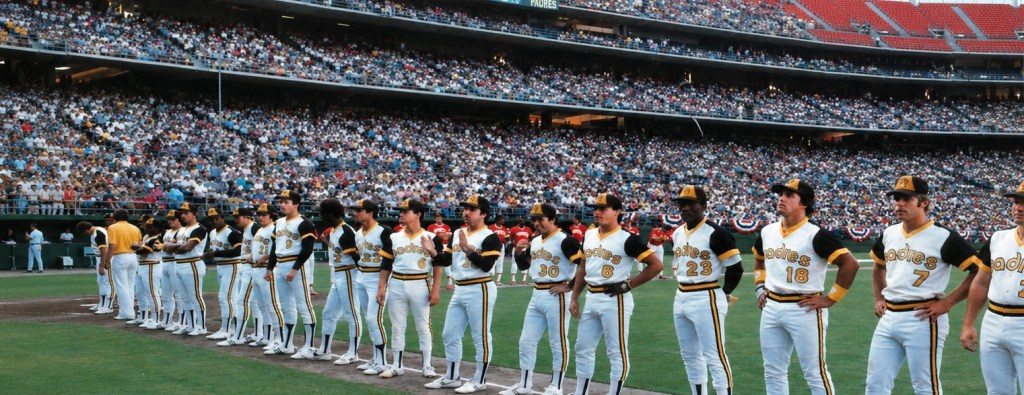
When I joined the Padres in 1975, every one of the 19 front-office employees shared this understanding: If one of them came up with a marketing idea that was deemed a success, team president Buzzie Bavasi would take the credit.
Conversely, any promotion ideas Buzzie came up with that didn’t work would be blamed on a member of the staff — more than likely me, because I was the last person hired.
Since we all adored Buzzie, we went along with his slant on the saying, “Success has many fathers, but failure is an orphan.”
Six years later, in 1981, the major-league baseball season came to an unprecedented halt on June 12.
By that time, I was in my seventh season working for the team and Buzzie was long gone from the Padres, now serving as executive vice president with the California Angels.
We had an emergency department head meeting. We were told by upper management that we shouldn’t call it a “strike” but rather use the term “an interruption of the season.”
We were then told to keep busy. “Reorganize your files” was one suggestion.
As each day without baseball painstakingly inched along, our game-day staff was bordering on dormant hibernation.
Then on June 23, we had a brainstorming session. We were encouraged to come up with ideas — and that no idea was a bad idea.
The Padres’ flagship radio station, KFMB, was taking advantage of the vacuum created by the absence of the baseball season.
The station was broadcasting “play-by-play” of fantasy Padres games from the stadium parking lot, which attracted throngs of Padres faithful. And those Padres were hot, heading into first place. (The real-life Padres were 23-33, dead last in the National League West.)
It soon became apparent that major-league baseball games would not be played on the Fourth of July, which was downright unpatriotic and against the unwritten rules of baseball — that is, unless your team played in Montreal or Toronto.
I suggested that we should celebrate the Fourth of July with a ballgame and a postgame fireworks show.
I then added, “Oh, the ballgame should be between two minor-league teams.”
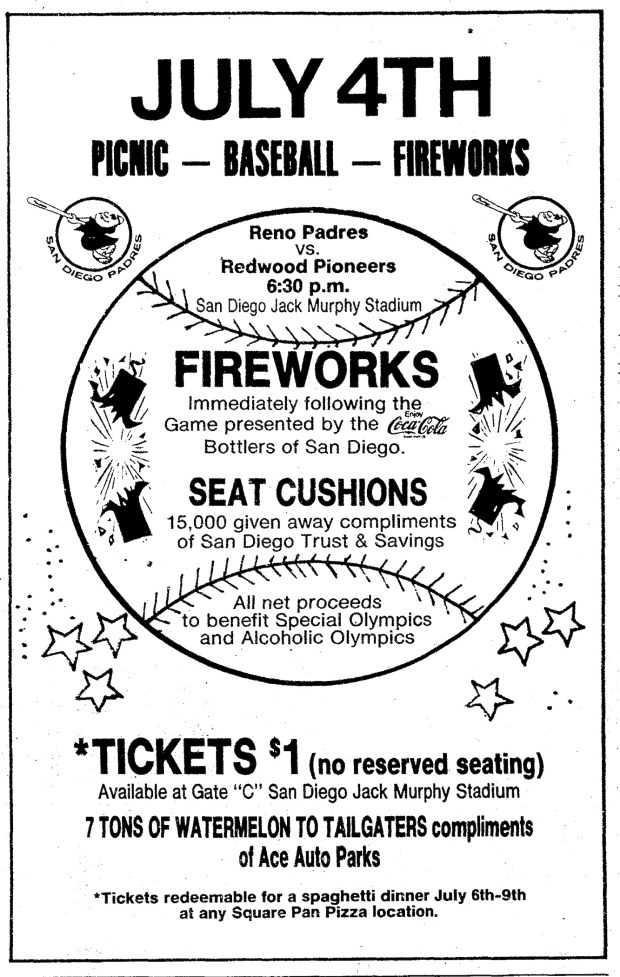 The Padres charged fans $1 to attend a July 4, 1981 minor-league game at San Diego Jack Murphy Stadium. More than 37,000 fans attended. (Andy Strasberg)
Padres director of business operations Elten Schiller instantly added, “OK, let’s put on a big tailgate party in the parking lot. We’ll give away slices of watermelon and Coca-Cola before the game.”
Jim Weigel, our director of minor-league operations, did the heavy lifting regarding the coordination of the two Class A California League teams: the Redwood Pioneers, an Angels affiliate, and “our” Reno Padres.
Weigel spoke to Joe Gagliardi, president of the California League, for cooperation in moving the July 4 game to San Diego.
Soon, a plan came together: The Pioneers would play Reno in Anaheim on Friday, July 3; and the next night they’d play in San Diego.
The Padres and Angels would split the cost of approximately $18,000 to transport and house the teams and reimburse the Reno club for its loss of home-game revenue.
The Angels sold tickets to the game at “The Big A” at value prices ranging from $2.50 to $5.50 and drew 9,556 fans. Reno won, 2-1.
Tickets for our home game at San Diego Jack Murphy Stadium cost only $1, with net proceeds going to the Special Olympics.
The first 15,000 fans received Padres seat cushions compliments of San Diego Trust & Savings Bank.
As done for previous Fourth of July games, I had the lower box seat railing draped with patriotic red, white, and blue bunting.
I heard that when our minor leaguers entered the Padres locker room one of the clubbies wrote “Welcome to your future home” on the clubhouse blackboard, which I thought was a nice touch.
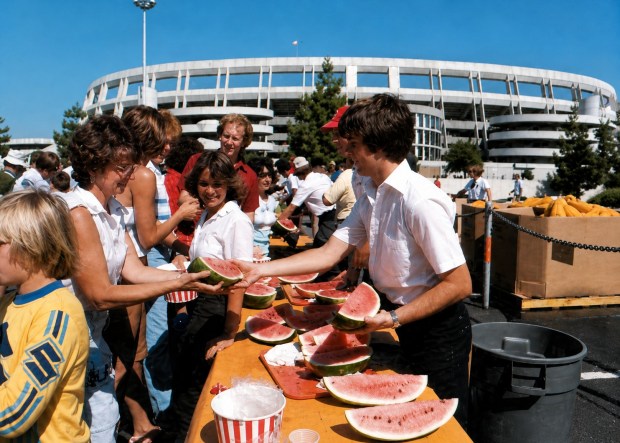 Fans who attended a July 4, 1981 minor-league baseball game at San Diego Jack Murphy Stadium received free watermelon and Coca-Cola. (Andy Strasberg)
We transformed our parking lot of 13,000 spaces into a county fairground, as Schiller had suggested. We gave away seven tons of watermelon and dispersed the contents of 196 five-gallon tanks of Coca-Cola.
The pregame ceremony had the appropriate bells and whistles: the Navy flag team, players on the foul lines for pregame introductions, and the singing of “The Star-Spangled Banner” with a preview of post-game fireworks when we all sang, “And the rocket’s red glare, the bombs bursting in air.”
Shortly after the game got underway, to the delight of the fans, The San Diego Chicken appeared.
He immediately went onto the field and ordered Reno Padres first-base coach Rusty Gerhardt to the dugout so that he could assume his position in the coaching box.
Most of the fans in attendance hadn’t seen this gag before, because The Chicken did it exclusively for minor-league games.
On a personal note, the highlight for me happened about halfway through the game.
I saw an opportunity to announce one batter over Jack Murphy Stadium’s public address system, thereby adding to my list of unique baseball experiences.
Rather than announce Reno’s (gulp) Randy Kaczmarski, I opted for Redwood Pioneers DH Ron Hunt.
Not Ronald Kenneth Hunt, whose big-league career began with the Mets in 1963. But Ronald Neil Hunt, who was in his second year of minor-league ball.
I told Bruce Binkowski, our PA guy, that I was going to announce one player, but it had to be a name that I could pronounce.
When Hunt was the next batter, without looking at “Bink,” I dramatically cleared my throat for him to appreciate my PA professionalism, which was his cue to move the mic in front of me.
I cupped my right ear with my right hand and lowered my voice by an octave: “Now hitting for the Pioneers, the DH, Ron Hunt, the DH.”
Then Bink’s phone rang. On the other end was Padres PR director Bob Chandler, who said, “OK, I’ll bite. Who was that?”
The game was played in 1 hour, 58 minutes. The Redwood Pioneers won 2-0, and the 37,665 fans who packed the stadium went home happy.
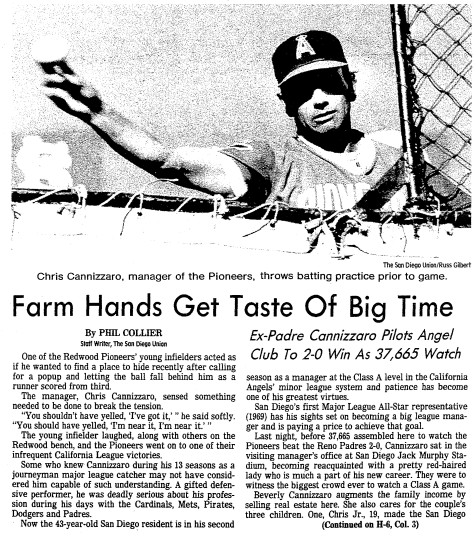 A headline in the July 5, 1981 edition of The San Diego Union. (San Diego Union-Tribune archives)
The strike — err, the interruption of the season — went on.
I was driving everyone in the office so crazy with my roller coaster of emotions that Schiller wisely told me to take my winter vacation — now.
My wife Patti and I flew back to my hometown of New York to visit with family and friends.
While back in New York, I visited a couple of old haunts, including Nicky’s Pizzeria, my go-to place for a slice.
Unbeknownst to me, my dad told Nicky that I was going to stop by. Then Nicky contacted the local Westchester newspaper, which dispatched a reporter and photographer.
I should have realized something wasn’t kosher when my dad suggested that for the pizzeria visit, I should wear a Padres jersey and cap.
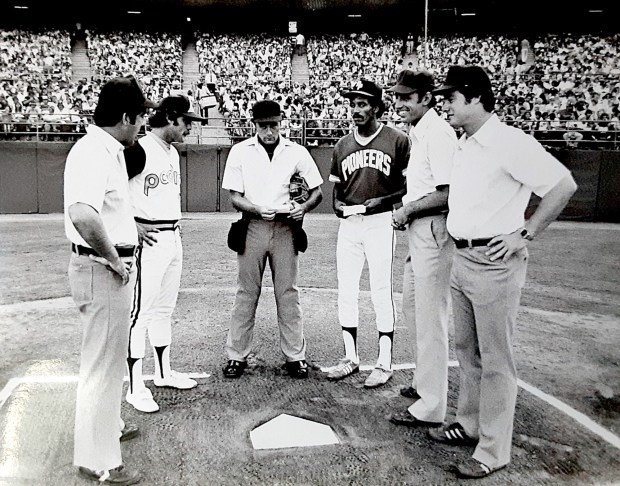 Coaches from the Reno Padres and Redwood Pioneers confer with umpires prior to the July 4, 1981 game betweent he two minor-league teams at San Diego Jack Murphy Stadium. (Andy Strasberg)
Then the July 13 edition of Sports Illustrated hit the stands.
Inside was a story by staff writer Ron Fimrite detailing what took place in Anaheim and San Diego.
Fimrite implied that it was the Angels’ Red Patterson’s idea to have a game played on July 4.
Now, I didn’t mind not getting full credit for my idea. But when someone else takes credit, other than my old boss Bavasi, that’s not fair.
It’s foul.
Baseball historian and former Padres employee Andy Strasberg is a longtime San Diego resident.