
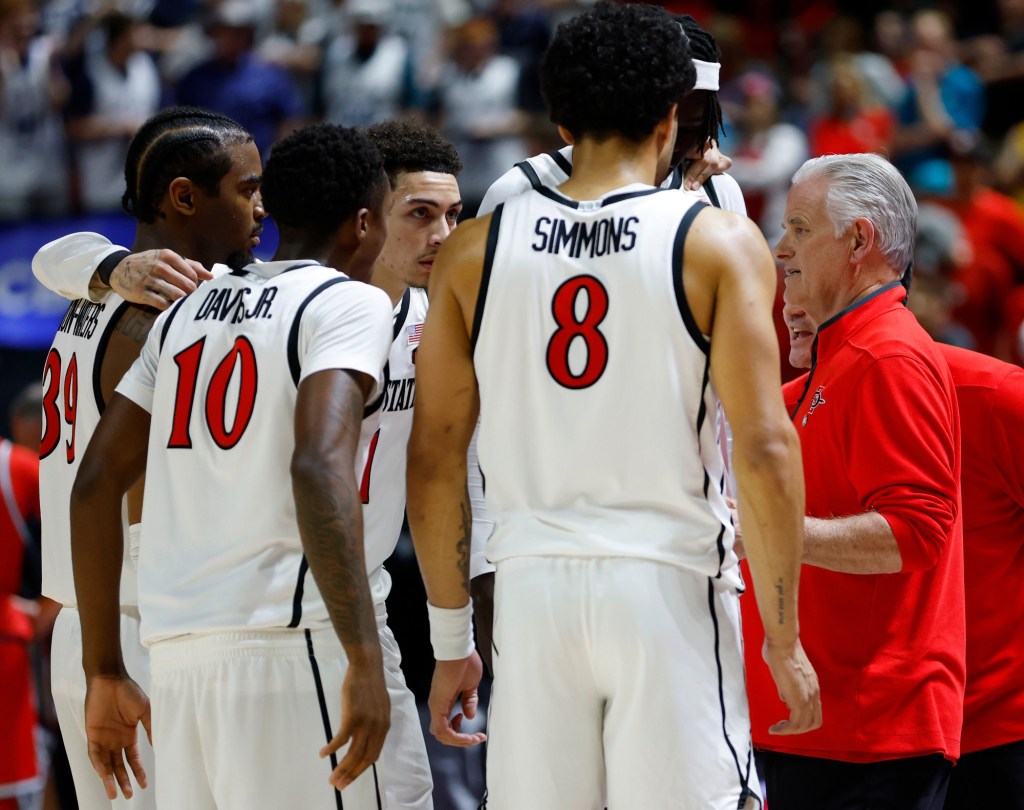
The second session of summer school at San Diego State begins Tuesday, which is when the men’s basketball team typically gathers and begins workouts ahead of the new season.
There will be players in the JAM Center practice facility. They just might not be playing much five-on-five.
Seven healthy scholarship players are here. Two others, Elzie Harrington and Nick Anderson, are rehabbing spring surgeries. And all three European pros remain in NCAA limbo, along with hundreds of others across the country.
Best-case scenario: The Euros get here in a couple weeks.
Worst-case scenario: Some or all of them don’t get here at all.
“You know me, I’ve dealt with it all,” Aztecs coach Brian Dutcher said. “I can’t change any of it. Maybe they’re going to try to regulate it a little more, but I don’t have any control over it.
“And this is not something I knew before the process started. No one did.”
Dutcher is referring to the NCAA guidance that hit inboxes on May 8 and still hasn’t been fully explained or resolved. The memo seemed to take a harder line on the recent influx of European pros, indicating the NCAA won’t clear those who “entered an agreement with, competed on or received compensation from a team that participates in a league with minimum compensation that exceeds actual and necessary expenses.”
Dutcher takes issue less with the content than the timing.
They landed Croatian wing Luka Skoric on April 27 and Italian guard David Torresani on May 4. Italian post Luca Vincini wasn’t formally announced until May 12, but he had privately agreed to terms with SDSU two weeks earlier and didn’t go public until his season ended.
“You add pieces, and then they hit you with legislation, it’s kind of tough,” Dutcher said. “Maybe they’re setting themselves up for a lawsuit anyway, because there are guys who were going to be playing and already on rosters.
“I can’t believe they’re going to get rid of those guys like at Illinois or Arizona. I can’t believe they’re going to say they can’t play this year, this late. It seems like they needed to take a stand earlier. Or do it for next year.”
The question becomes how narrowly the NCAA defines “actual and necessary expenses,” which technically has always been there but wasn’t strictly enforced.
“The NCAA also identified several international leagues in which participation by a prospect is likely to result in violations of NCAA rules and a loss of eligibility,” an NCAA statement to Sports Illustrated said, without specifying them. “The Association is modernizing the rule book in several ways to ensure college sports are played by college athletes and not used as a fallback for professional athletes.”
The EuroLeague, the international competition with the continent’s biggest clubs, has a minimum salary of $50,000 and most players make significantly more, sometimes well into seven figures. The same goes for Liga ACB, the Spanish first division widely considered the best domestic league outside the NBA, as well as top leagues in France and Italy.
Age could be a factor as well. Sports Illustrated reported that eligibility will be evaluated on a “case-by-case basis” and consider how long a player received a salary worth more than actual and necessary expenses.
Skoric played in Croatia, which generally is not among the highest-paying leagues in Europe. But he’s 23 and turns 24 during the college basketball season.
Torresani turned 21 last month but he played in Italy’s respected Lega Basket Serie A for four years.
Vincini turns 23 next month and played in Serie A, although only for the past two years. (Oregon State transfer Isaiah Sy is from France, but he attended a year of high school in the United States followed by a year at junior college and two with the Beavers, so the NCAA guidance does not apply to him.)
When he expanded his recruiting net to include overseas pros this spring, Dutcher admitted that he might not have them on the floor by early July and may have to wait until fall semester begins in late August. Besides NCAA eligibility approval, the process involves visas, international travel logistics and more complicated academic clearance.
In the meantime, they wait.
So does everybody else.
Does the NCAA ultimately clear everybody this year? Does it clear younger players but balk at older ones? Does it draw a line with the EuroLeague and ACB? Does it all end up in the courts anyway?
The NCAA may know the chaos — and legal recourse – that would ensue. But simply slow-playing eligibility reviews may serve a similar purpose.
Most coaches privately remain confident they’ll get their Euros … eventually.
“It’s going to be an interesting dynamic, because you’ve got these guys already over here that they didn’t have the rule on,” Dutcher said. “To flip it kind of late, you’ve already got guys committed. It’s kind of late for that guidance.
“Eventually I think the guidance will go through, because they don’t want you signing pros. But at some level, that’s all anyone is taking. Maybe they’re going to ask more questions and be a little more stringent, I don’t know. We’ll see.”