
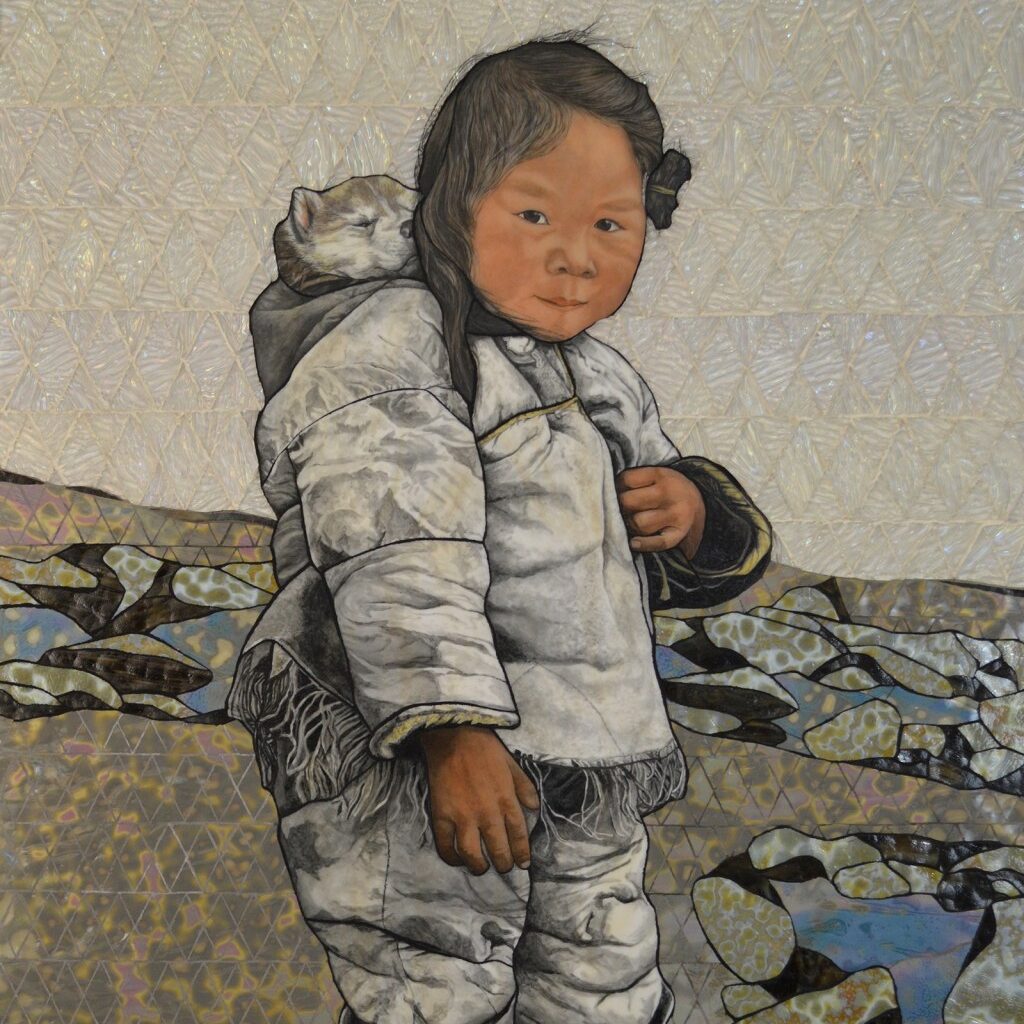
In the Curator’s Words is an occasional series that takes a critical look at current exhibitions through the eyes of curators.
In 2021, when Emily Hanna saw “Clearly Indigenous” at the Museum for Indian Arts and Culture in Santa Fe, she had just one word to describe it: “stunning.”
So when she joined the Mingei International Museum in Balboa Park a few months later, she knew she needed to persuade the museum to pursue the touring exhibition for a stop in San Diego.
Hanna, director of exhibitions and chief curator for the Mingei, talks about “Clearly Indigenous: Native Visions Reimagined in Glass,” which opened June 27.
Q: This exhibition is a touring show courtesy of International Arts & Artists out of Washington, D.C. How did it end up landing in San Diego?
A: I was attending Indian Market in Santa Fe in August of 2021. It’s an incredible gathering that takes place every August showcasing work by Native American artists who come from all over the country. It’s attended by hundreds of thousands of people, and the museums there always organize fantastic exhibitions in conjunction with the market.
I saw “Clearly Indigenous” at the Museum for Indian Arts and Culture there in Santa Fe. It had just opened a few months before. It was so stunning. I have followed the careers of many of the artists in the show for years, but it was so special to see all of the work together. I joined the staff of Mingei five months later and immediately asked if we could consider taking the show here. I thought it would be a perfect fit for the institution and something many people in San Diego may not have seen before. We had to get in line! Many museums wanted the show. But it’s finally here!
Q: “Clearly Indigenous” has been described as a “groundbreaking exhibition.” Tell us why.
A: It traces the story of how the practice of studio glass was introduced to Native American communities. It’s really kind of extraordinary. Many people know the name Dale Chihuly, the famous glass artist whose work is seen all over the country. We have an enormous Chihuly chandelier that hangs in the stairwell of our museum. Chihuly was brought to teach in a new art school called the Institute of American Indian Arts that had been established for Native Americans in Santa Fe in 1962. He created a glass hotshop and taught glass-blowing there. The school itself was so groundbreaking and offered Native American students the opportunity to work in new media and explore subject matter that they may not have considered before. The founder of the school, Cherokee artist and fashion designer Lloyd Kiva New, urged the students not to be confined by anyone’s pressure or expectation of what it meant to be an Indigenous artist. The flowering of creativity at the school was incredible. Native American artists carried the studio glass practice forward, and new Indigenous traditions were born.

Raven Skyriver, working on “Iguana,” is one of the many artists showcased in the Mingei International Museum’s newest exhibition, “Clearly Indigenous: Native Visions Reimagined in Glass.” (John Hogan)

“Raven Steals the Sun” by Preston Singletary is one of the many pieces in the Mingei International Museum’s newest exhibition, “Clearly Indigenous: Native Visions Reimagined in Glass.” (Russell Johnson)

“Killer Whale Totem” by Preston Singletary is one of the many pieces in the Mingei International Museum’s newest exhibition, “Clearly Indigenous: Native Visions Reimagined in Glass.” (Russell Johnson)

“Circus Warrior” by Preston Singletary is one of the many pieces in the Mingei International Museum’s newest exhibition, “Clearly Indigenous: Native Visions Reimagined in Glass.” (Mingei International Museum)

“Aunt Fran’s Basket” by glass artist Dan Friday is one of the many pieces in the Mingei International Museum’s newest exhibition, “Clearly Indigenous: Native Visions Reimagined in Glass.” (Mingei International Museum)

“Dancing Wolf Headdress” by Preston Singletary is one of the many pieces in the Mingei International Museum’s newest exhibition, “Clearly Indigenous: Native Visions Reimagined in Glass.” (Mingei International Museum)
Show Caption
1 of 6
Raven Skyriver, working on “Iguana,” is one of the many artists showcased in the Mingei International Museum’s newest exhibition, “Clearly Indigenous: Native Visions Reimagined in Glass.” (John Hogan)
Q: This is quite a large exhibition, with about 120 glass artworks featured. Logistically speaking, what is the most challenging part of getting this exhibition from one place to another?
A: It’s quite an undertaking. The glass has to be so carefully packed and crated. The exhibition casework is also traveling with the show, and the entire contents occupy three tractor trailers. The planning document created by our registrar is 14 pages long with color-coded calendars and maps of the gallery. The casework and pedestals have to be placed into position, and the works unpacked. Each object has to be carefully examined for condition, and then the objects are moved to their respective cases and mounts. Our registration team describes it as a kind of tetris. By the time the show opens, all the crates will be hidden from view, and visitors will just see a gorgeous show.
Q: What can visitors expect to see when they view this exhibition?
A: The show is divided into several sections. One focuses on animals of the air, land and sea. Some of these objects are quite naturalistic, and others reflect mythological animals and stories, such as the story of Raven stealing the sun. Another section looks specifically at utilitarian objects that have been rendered in glass — for example, traditional basketry, pottery, boxes, blankets and tools rendered in glass. One area examines the importance of history, ancestral knowledge and sacred symbols and includes a beautiful totem pole. The exhibition is visually beautiful but also so full of meaning.
Q: It’s probably not a fair question to ask, but we’ll ask it anyway: Do you have a favorite piece of artwork?
A: The story itself is so thrilling to me. That a small art school established for Native American students in 1962 has been such an incubator for creativity and innovation. The show is filled with examples of collaboration between artists — those may be my favorite works. (You’re right, I can’t choose just one). I will say that Mingei is so excited to have purchased work from some of these artists for our own collection, and these works will be on view.
Q: If one is new to glass artwork, can you share a few things a viewer should look for when visiting this exhibition?
A: Glass is not an easy medium to work with. In case you’ve never been in a glass hotshop, we’ve included plenty of large photographs so that you get the picture. Blowing glass requires teamwork, and it’s blazingly hot and dangerous work. It’s miraculous to see a blob of molten hot liquid glass result in the form of a delicate basket or a sea turtle. I hope our visitors are filled with a sense of wonder at the variety of forms that have been created, the level of technical achievement, and at the ways in which Indigenous artists have shared important aspects of their culture with the world.
Mingei International Museum presents “Clearly Indigenous: Native Visions Reimagined in Glass”
When: Through Sept. 20
Where: Mingei International Museum, 1439 El Prado, Balboa Park, San Diego
Admission: Free to $15 (various discounts available)
Phone: 619-239-0003
Online: mingei.org