
As thousands of Southern Californians drove to Fourth of July parties, they passed a patriotic display enjoying its own anniversary.
The 664-foot-wide by 120-foot-tall Prado Dam Bicentennial Mural, located near the intersection of the 91 and 71 freeways near Corona, turned 50. The mural message is easily seen from the highway roughly 750 feet away: “200 Years of Freedom, 1776-1976.”
“The fact it’s still here is a point of pride for many people in the Inland Empire,” said Peter Schaefer, who co-designed the mural along with the recently deceased Ron Kammeyer. “It’s our tribute to America.”
The one-time fading mural was saved from destruction after a nine-year battle by local residents, civic leaders, businesses and governmental agencies, who celebrated its restoration in 2023.
You’re reading the Essential California newsletter
Sign up to start every day with California’s most important stories.
By continuing, you agree to our Terms of Service, which include arbitration and a class action waiver. You agree that we and our third-party vendors may collect and use your information, including through cookies, pixels and similar technologies, for the purposes set forth in our Privacy Policy such as personalizing your experience and ads.
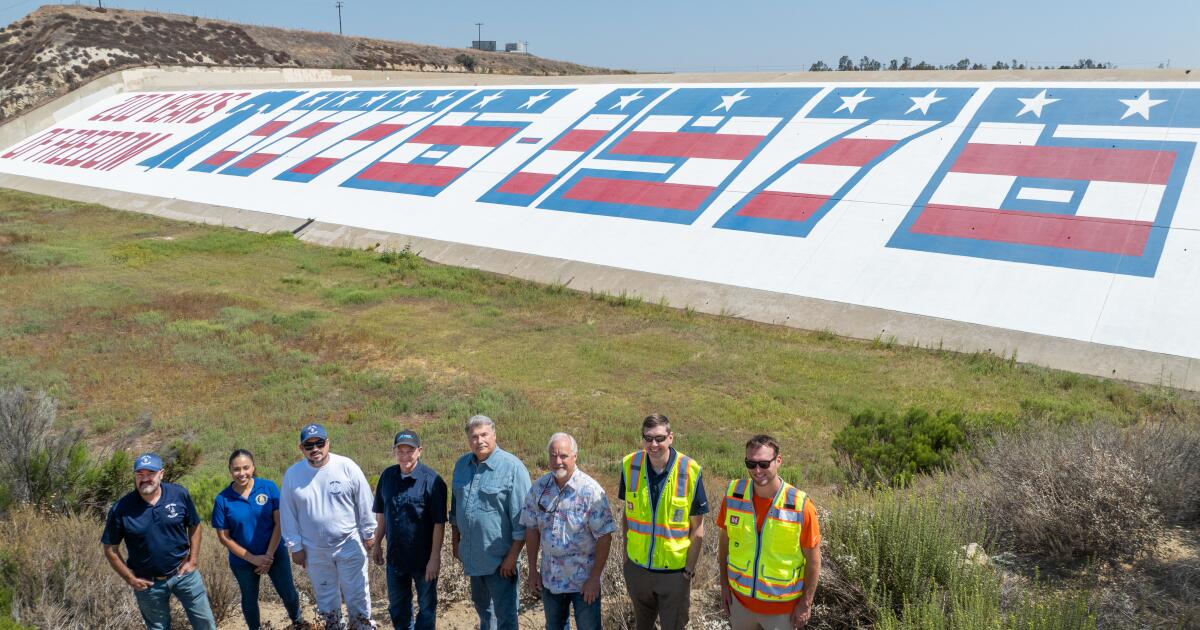
Several leaders from that movement reunited for the first time in three years, sharing memories along with the mural’s meaning this Fourth of July weekend.
Here’s a look at their efforts.
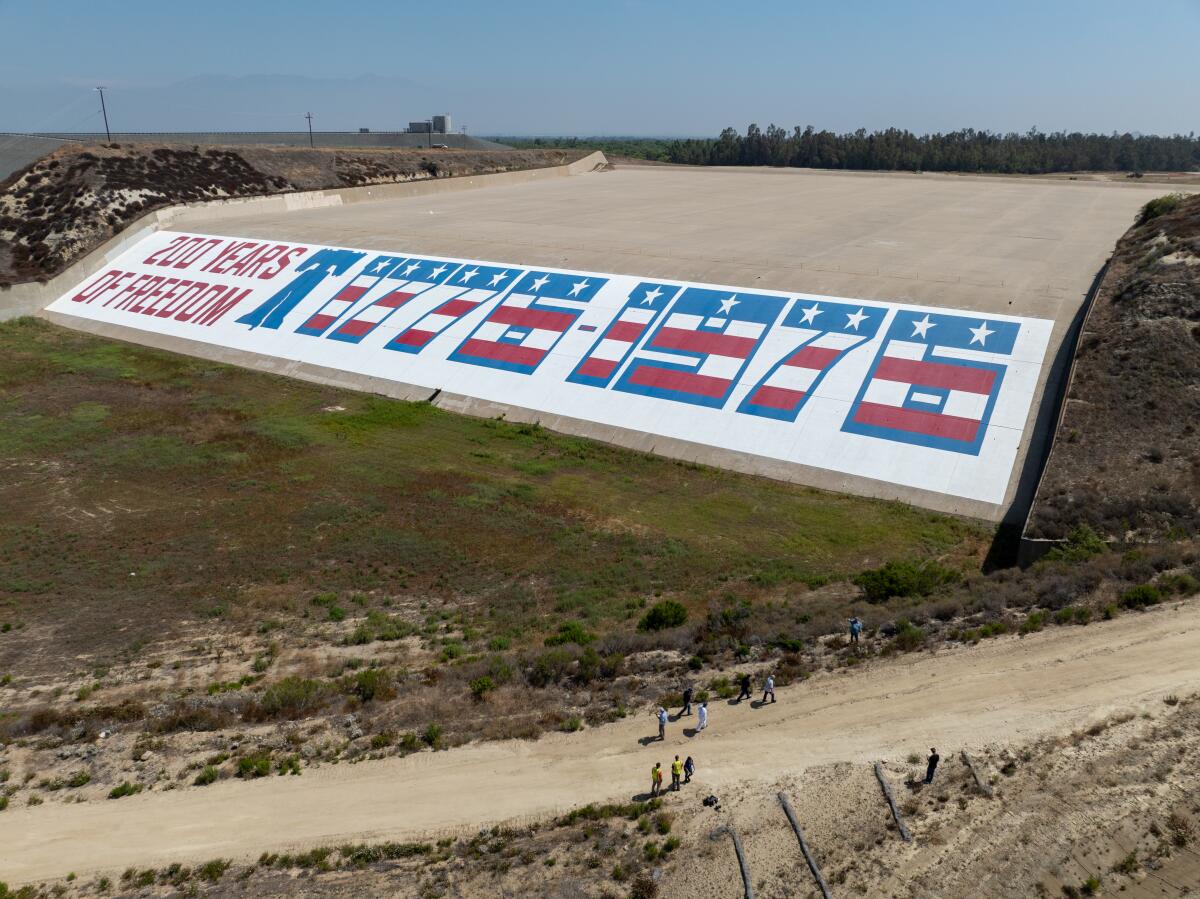
An aerial view of community coordinators visiting the Prado Dam Bicentennial Mural at Prado Dam.
(Allen J. Schaben / Los Angeles Times)
Prado Dam
Inland Empire students, mostly from Corona High School, painted the bicentennial mural on the 1000-by-1000 Prado Dam Spillway in the lead-up to America’s 200th celebration in 1976.
The Dam and adjacent reservoir sit about two miles west of Corona and regulate the Santa Ana River, providing flood risk management.
The words “200 Years of Freedom” were painted in red, while the digits “1776-1976” included red, white and blue stripes with white stars at the top. The mural includes what Schaefer called the largest “depiction of the Liberty Bell in the United States.”
“If you grew up anywhere close to the dam, this was something you took pride in,” said Peter Usle, former president of the Bicentennial Freedom Mural Conservancy, a group tasked with saving the mural.
One drawback with outdoor art is decay, and the mural was fading into the 2000s.
“There was graffiti, and you couldn’t really make out most of the numbers and letters,” said Jim McCabe, a mural preservationist.
By 2014, the Army Corps of Engineers declared its intent to remove the mural with no immediate plans for restoration.
Shortly after, Usle, the McCabe family and other community members founded the Friends of the Prado Dam Mural, a group dedicated to the painting’s preservation.
Usle’s group created a petition in 2015, hoping to convince the Army Corps of Engineers and local politicians to halt the mural’s destruction.
That petition raised nearly 38,000 signatures and had hundreds of pages of supportive comments. The effort preceded several rounds of town hall meetings.
“Our lives were full of meetings,” Usle said.
Meanwhile, Kammeyer, the mural co-designer, sued the Army Corps of Engineers. But courts backed the plan to remove the mural on multiple occasions.
Then the tides seemed to turn: In 2015, a judge issued an injunction, preventing the mural’s destruction until all legal issues had been resolved.
But the victory didn’t last. The mural failed to gain historic status, and the injunction expired in 2019, leaving the mural subject to destruction.
An unexpected twist
In 2022, the Army Corps of Engineers reversed course. It agreed to restore the mural thanks to $2.5 million in federal funding that Rep. Ken Calvert (R-Corona) helped secure.
A recently created Bicentennial Freedom Mural Conservancy was tasked with raising an additional $140,000 for the restored mural.
Groups, businesses and several families sponsored individual parts of the mural. Letters were $2,000 each, while numbers were $10,000. The stars were $1,000, and the Liberty Bell was $12,000.
“Most of us weren’t around when the first mural went up,” Jim McCabe said. “This was our chance to join the legacy.”
A groundbreaking was held in September 2022, while the restored mural was re-introduced June 2, 2023.
“This was about celebrating our patriotism and joining with those who originally took part in this mural,” he said, “while also handing something down to the next generation.”
The week’s biggest stories 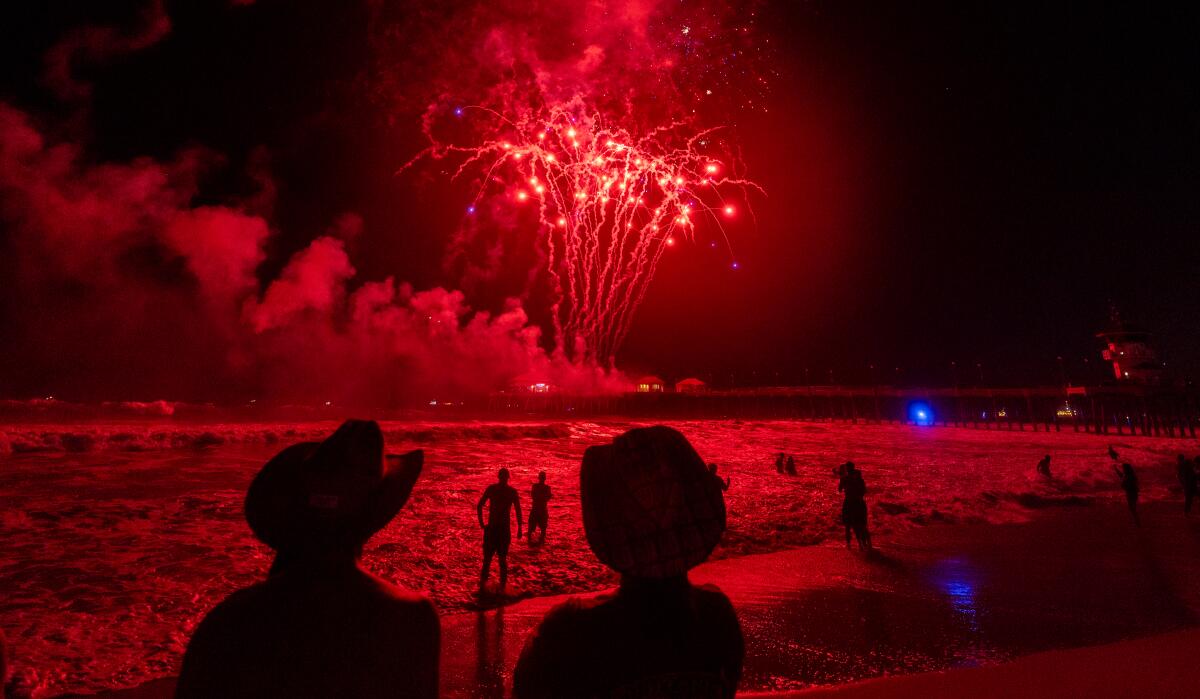
Michael Marshall, left, of Paso Robles, and Dalton Smith, center, of Templeton, watch the sky light up with fireworks over the ocean and pier in Huntington Beach on July 4, 2024.
(Allen J. Schaben / Los Angeles Times)
Fireworks may bring ‘hazardous’ air quality to SoCalSoCal’s housing market growthLeBron leaves the LakersWhat else is going onMust-readOther must-readsFor your downtime 
(Illustrations by Lindsey Made This; photograph by Richard Shotwell / Invision / AP)
Going outStaying inL.A. Affairs
Get wrapped up in tantalizing stories about dating, relationships and marriage.
Have a great day, from the Essential California team
Hailey Branson-Potts, staff reporter
Hugo Martín, assistant editor, fast break desk
Kevinisha Walker, multiplatform editor
Andrew J. Campa, weekend writer
Karim Doumar, head of newsletters
How can we make this newsletter more useful? Send comments to essentialcalifornia@latimes.com. Check our top stories, topics and the latest articles on latimes.com.