
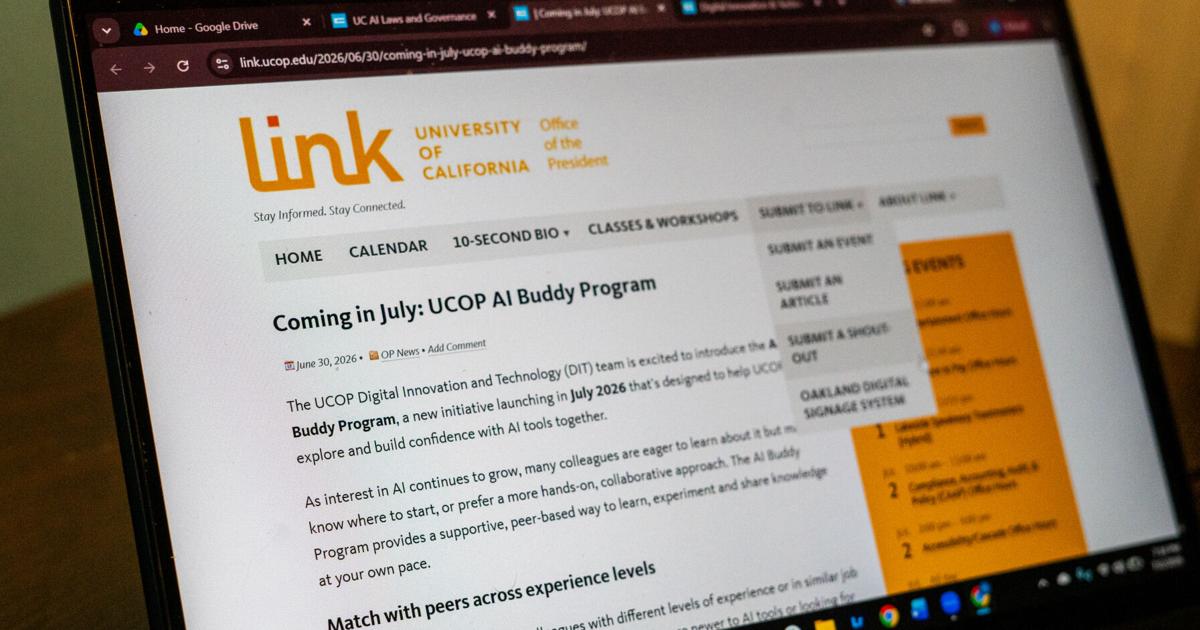
UC Office of the President is launching its AI Buddy Program this month to help its staff members explore and build confidence with AI tools.
The peer-to-peer program aims to connect UCOP staff colleagues with different levels of AI experience or similar job roles, according to the UCOP article. AI-experienced participants will be partnered with less-experienced colleagues. More proficient AI users will be “comfortable helping others navigate use cases, answer questions and share practical tips.”
“The AI Buddy Program is an internal, voluntary program to facilitate collaborative learning of AI tools for UCOP staff,” said UCOP spokesperson Stett Holbrook in an email.
The program sign-up form allows staff to select which AI tools interest them, with options such as ChatGPT, Claude, Google Gemini and more. Staff can also select topics of interest such as “AI for teaching and learning,” “Evaluating AI outputs and fact-checking” and more.
According to Haas School of Business professor Mathijs de Vaan, workplace initiatives that focus on developing AI literacy are “necessary but not sufficient.”
He noted that, ideally, organizations could help staff identify when to use AI in their work and lower barriers to adopting AI tools through strategies such as specific training.
“If the folks that are initially skeptical see that there’s more and more people in the organization using the tool,” de Vaan said. “And using the tool in such a way that they can actually do their work better and they enjoy work more — then the likelihood that these initial skeptics will come around will also increase.”
De Vaan added that peer-to-peer initiatives have been “really effective” for the adoption of other technologies in the past.
Because UCOP staff members are not required to participate in the program as it “may involve stepping away from regular responsibilities,” participants are encouraged to discuss participation with their supervisor in advance, according to the UCOP article.
According to de Vaan, voluntary workplace AI integration programs risk widening the gap between staff members willing to adopt AI in their work and those who are not initially interested. However, he added that mandatory implementation strategies may risk “internal resistance.”
“I think it’s very obvious that there are things that (large language models) can do that we couldn’t do very efficiently before them,” said Keanan Joyner, an assistant professor in UC Berkeley’s psychology department. “I just don’t know if that’s necessarily a good trade-off to the negative potential effects that AI has on folks. And I think that’s largely a function of LLMs … not (being) able to communicate uncertainty.”
Joyner said the use of AI tools such as large language models in the workplace can improve efficiency, but risks staff “feeling more burnt out” as they may need to spend time repeatedly reviewing and reiterating the product of work that was intended to be offloaded to AI tools.