
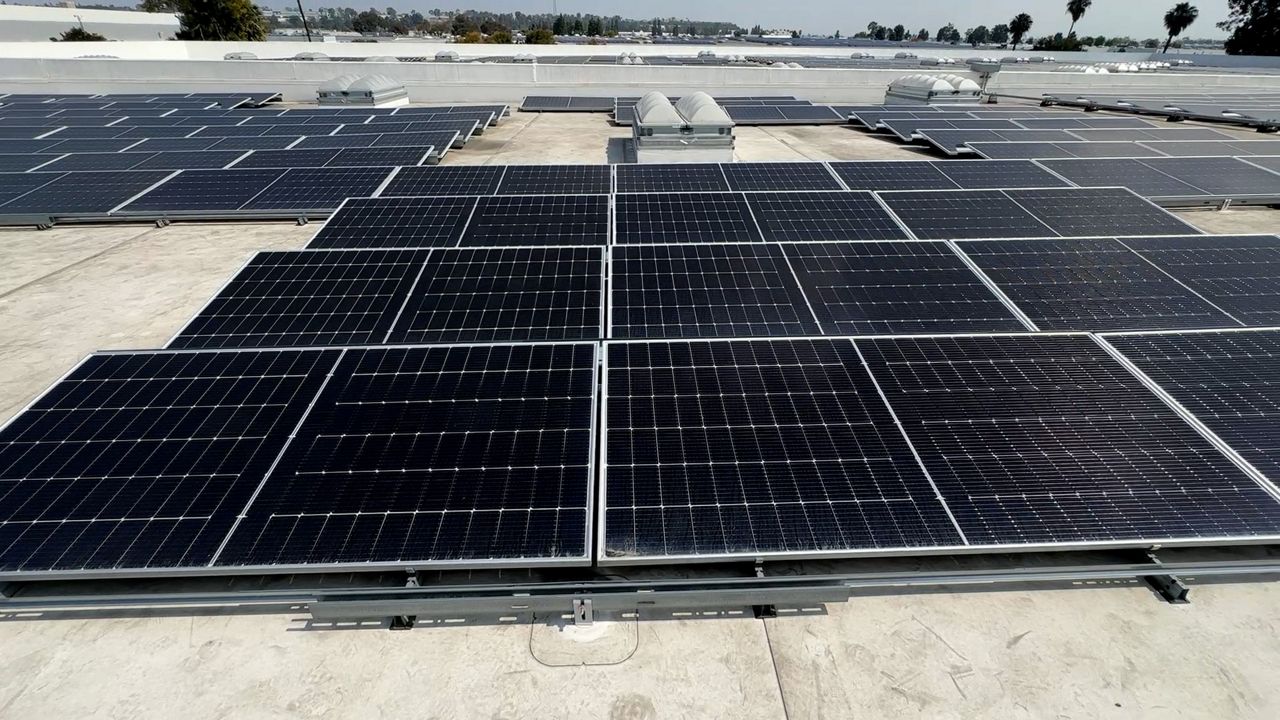
CARSON, Calif. — With rising energy costs, the city of Carson is embracing change.
What You Need To Know
Data from LA County shows that roughly 10% of households in Carson live below the federal poverty line
A study by Stanford University finds that over 25 years, solar energy avoids between 15,000 and 20,000 pounds of carbon dioxide per household compared to regular power
Clean Power Alliance is working with cities across California to spearhead community solar projects
The city is working with Clean Power Alliance, a local non-profit electricity provider that is implementing new community solar projects around Southern California.
CPA said solar power helps households save money on their electricity bills and helps combat climate change.
“This isn’t the only solution,” said Ted Bardacke, the CEO of CPA. “We also need to build stuff out in the desert, where it’s super low-cost, mass economies of scale and that is going to require more transmission. So it’s not like one solution is better than the other, we need to bring everything to bear on our climate crisis.”
A study by Stanford University finds that over 25 years, solar energy avoids between 15,000 and 20,000 pounds of carbon dioxide per household compared to regular power.
The technology works differently than the standard power options available in California.
“This power being generated here does not go back into the building,” said Bardacke. “We’re just using the roof space and instead it’s going back into the grid and serving homes and households in the neighboring area.”
CPA says another benefit for communities and customers is the cost. The community solar project in Carson is helping low-income customers with their monthly electricity costs.
“A low-income customer for whom this project is serving is going to get about between $120 and $150 a month of an electricity bill,” Bardacke said. “And they’ll get 20 percent off that.”
The National Energy Assistance Directors Association says Americans will pay roughly 10.5% more for electricity this summer because of rising energy costs, and the city of Carson wanted to look at ways to help cost-burdened residents.
“Energy rates were skyrocketing, and we wanted to bring something to our residence to lower the cost,” said Carson Mayor Lula Davis-Holmes. “We have a large senior population here, on a fixed-income, what better way to assist them than to provide a service that will lower their energy cost?”
Prewsident Donald Trump’s administration has cut funding for solar projects, with roughly $15 billion being moved or canceled for clean energy projects. But in California, government officials are embracing new technology.
“Our grid is evolving, and we’re using more and more clean energy,” said Molly Sterkel, who is the director in the energy division at the California Public Utilities Commission. “And we’re finding that our clean energy future can be both safe, reliable, and affordable for all customers.”
Bardacke says he wants to continue to bring knowledge about solar energy to communities in need around Southern California.
“When you put on a solar panel, you’ve locked in your fuel source for a generation or two, which is right up there with the sun,” he said. “I see this as climate change, and for our kids, but also for right now, this is the most secure energy we can have in the world.”