
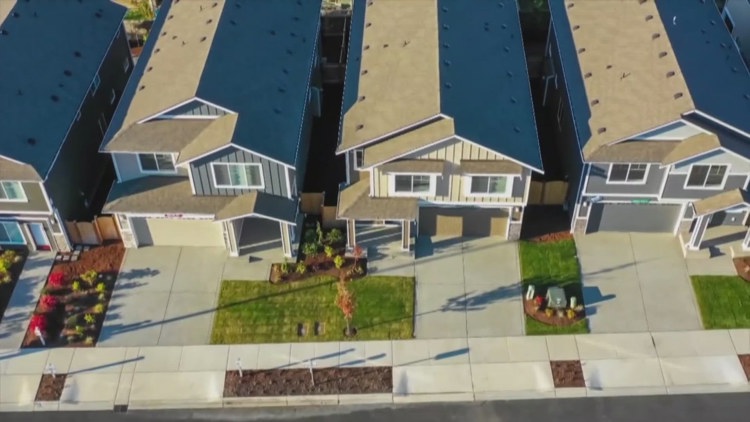
Housing affordability remains a challenge with little movement from lawmakers at either the state or federal level.
Congress is on recess for the Fourth of July, and the California Legislature is on summer recess until early August.
At the center of both efforts is a shared concern that large corporations are buying affordable single-family homes, leaving fewer options for average families and first-time homebuyers.
“The cost of housing is one of those things that cripples American families’ debts,” Democratic Bay Area Assemblymember Alex Lee, who is at the center of the state effort, said.
For years, Lee has pushed legislation to limit how many single-family homes large corporations can own in California. His latest proposal, Assembly Bill 1240, passed the Assembly but died in the state Senate Judiciary Committee.
The bill would have barred corporations from owning more than 1,000 single-family homes.
“So if you’re trying to buy a starter home, guess what, now Wall Street is also competing for those same starter homes,” Lee said of why he drafted such a bill.
Lee said business entities such as firms, corporations and limited liability companies buy homes and convert them into rental properties for profit.
It is an issue Gov. Gavin Newsom and President Donald Trump have both said they want to address.
“It’s shameful that we allow private equity firms in Manhattan to become the biggest landlords in many of our cities… That means more oversight and enforcement and potentially changing the state tax code to make this work,” Newsom said during his January State of the State address.
Since that January State of the State address, however, no additional details have been released. Newsom’s office did not respond to requests for comment Monday.
“He never followed up with any action, whether it be in the budget or policy. It’s very disappointing,” Lee said of Newsom.
There has also been little movement in Washington.
President Trump has yet to act on a bipartisan bill passed by Congress that aims to improve housing affordability by increasing supply and homeownership opportunities. If he neither signs nor vetoes it within 10 days, the bill will become law.
“Let’s hope that the president signs it and that the governor catches up with Congress,” Lee said, adding that because the federal bill would set the ownership cap at 350 homes, it would be a stronger proposal than his California measure.
In the Legislature, some fellow Democrats opposed Lee’s bill, saying it could eliminate benefits provided by build-to-rent projects.
“I do think we have to address that issue, but you don’t address an issue by limiting property rights,” said Democratic Assemblymember Lori Wilson of Suisun City. She also noted limiting the property rights of one group sets a dangerous precedent.
“There are so many other things the Legislature should be tackling that we’re not,” Wilson added, pointing to the need for an updated escrow process in the state, as well as boosting incentives for homebuyers, streamlining the permitting process and speeding up new home construction.
Wilson emphasized while she too wants to expand homeownership opportunities for the average Californian, Lee’s ban is not the solution.
Affordable housing expert David Garcia, of the nonpartisan UC Berkeley Terner Center for Housing Innovation, said while it is true large investors own a certain percentage of homes, the number must be put into context. Garcia said California has historically low housing inventory; hence, the piece of the pie corporations own appears larger than it is.
“The fact is that we simply haven’t been building enough homes across the spectrum or typology of homes,” Garcia said.
“Those institutions will put those homes on the rental market. And so someone is still living there,” Garcia said of some benefits. “If you want to live in a single-family home, but you can’t buy it, being able to rent it, typically in a neighborhood that has good schools or access to amenities really is a benefit.”
Meantime, California Congressman John Garamendi is expected to urge President Trump to sign the federal housing bill Tuesday at a press conference. One of Garamendi’s provisions to provide more federal funding for affordable housing units was included in the final bipartisan housing bill.
At the state level, Lee said he is still weighing his next steps.
WATCH ALSO: