
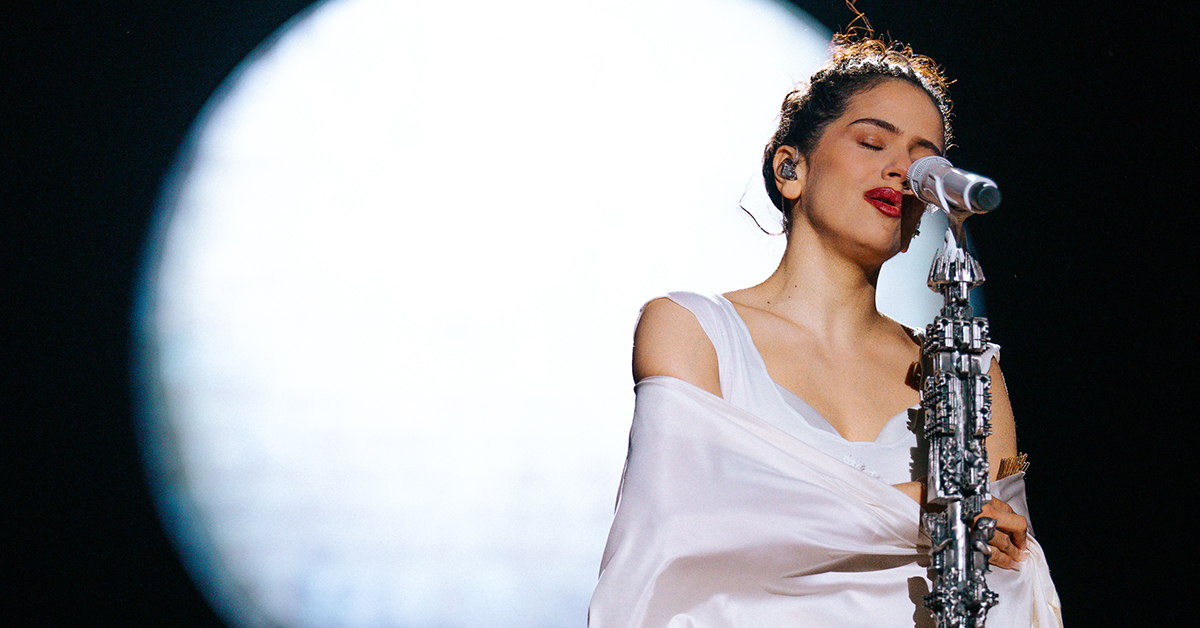
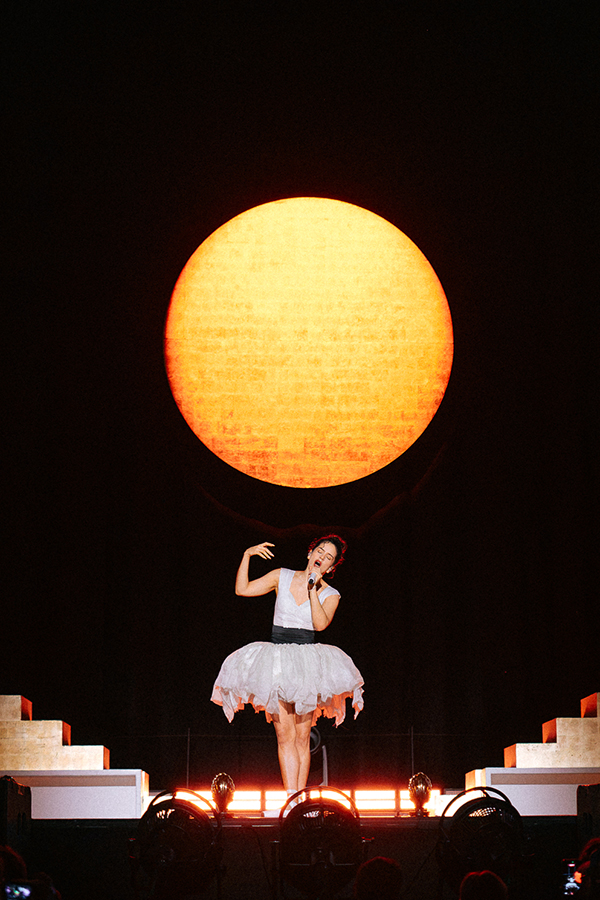
 Rosalía performs at Kia Forum in Los Angeles on June 29, 2026. Photos: Beth Savaro.
OAKLAND — Rosalía had never played Oakland before Monday night, a fact she acknowledged from beneath a floor-length veil — right after greeting the room with “Good evening, San Francisco.”
The crowd forgave her instantly. The two-time Grammy winner brought her Lux Tour to the East Bay. If Motomami Tour’s production was an exercise in minimalism, this one is its maximalist counterpart: an orchestra, army of dancers, custom design costuming and enough saintly references to fill a reliquary.
The audience came dressed for the liturgy. Taking a cue from the religious iconography of 2025’s Lux, attendees arrived in white, lace, veils and even some nun habits; a congregation of Rosalía clones spanning all ages.
Rosalía Vila Tobella performed like someone hyper-present in the moment. After an orchestral overture opened the show and led into “Sexo, Violencia y Llantos,” she perched on a staircase during “Reliquia,” looking fragile, spinning notes as thin yet strong as spider’s webs. Then, “Porcelana” lifted her — literally — like a doll inside a jewelry box, dancers rotating her as she walked en pointe across the stage past bodies clad in white, her tutu catching the light as her arms moved like a swan’s wings. The song’s ending grew intense with heavy bass and erratic choreography. Her vocals got a bit lost when she dropped her register, one of the few cracks in an otherwise airtight opening.
For “Divinize,” a long hanging ribbon, blown upward from the stage floor, wrapped around her while dancers draped her in gauze. Then came an unexpected, slowed-down version of Dido’s “Thank You,” before she was picked up and spun like a doll through the conclusion.
The Spanish artist’s banter was disarmingly sincere.
“I’ve never played in a place this big here,” she said while wrapping her veil’s fabric around herself. “Being around the ocean brings me peace. A psychic told me once I would always have to live close to the sea in order to be happy. I think she might’ve been right.”
She introduced “Mio Cristo Piange Diamantes” as being rooted in Italy and inspired by Puccini, her favorite composer. The lyrics scrolled above the stage as white light and wind machines sent her veil and hair flying behind her. She looked on the verge of tears. Her voice, however, didn’t waver and the arena became an opera house. Right after, a video interlude of her dancers attempting the song’s high notes — towels wrapped around their heads — supplied the comic relief.
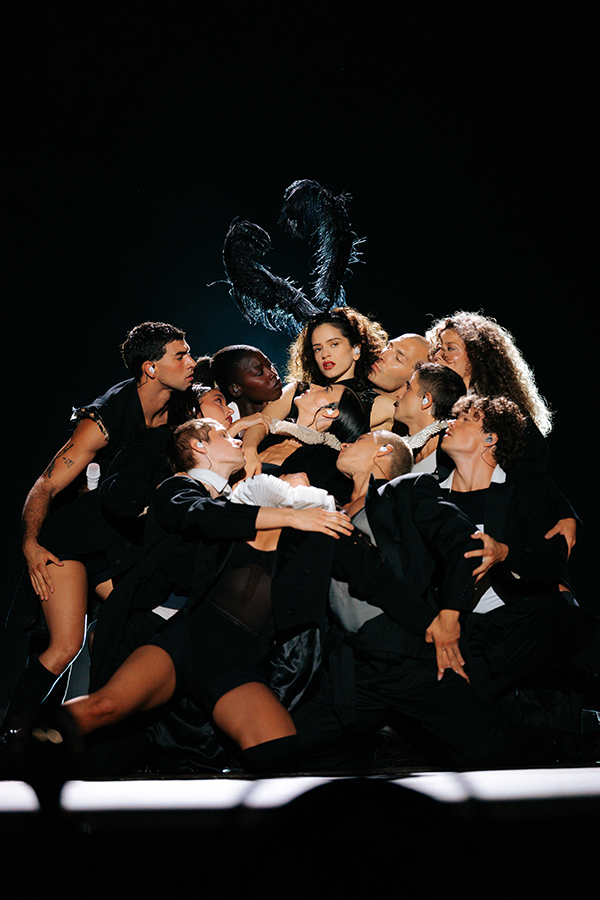 Rosalia performs at Kia Forum in Los Angeles on June 29, 2026.
In a second act, Rosalía reemerged in black under a headdress evoking an extravagantly coiffed bird. Dancers pushed her slowly, almost mournfully, across the stage before stripping away her attire. On “Berghain” (performed with the now-famous remix), Björk’s prerecorded vocals emanated as dancers swirled around Rosalía, then collapsed to the ground as if shot, before the breakdown gave way to electronic chaos. Her voice still cut through the production.
“You didn’t come to this show just to cry,” she said. “I’m sure you came to shake some ass, too. Vamos, es que yo sé que tienen mucho saoko también.”
The Motomami stretch that followed — “SAOKO,” “LA FAMA” (dedicated, after a poll of the room, to “any local mommies in the house”), “LA COMBI VERSACE” and “De Madrugá” — shifted the energy entirely. Rosalía’s vocals turned punchy, high-pitched, precocious, though her voice got a little lost when she sang fast on “La Combi Versace,” a nod to her reggaeton collaborations. “De Madrugá” featured some of the night’s most interesting blocking. This section was made for visuals; the camera work was so dynamic that the screens threatened to be more interesting than the reality.
Stretches of the show courted the camera openly. What kept it from tipping into pure broadcast was the voice, which no amount of production could bury.
In the third act, Rosalía sang “El Redentor” from a staircase landing as if summoning something. The sound of footsteps and crashes built tension behind her sinewy vocalizations. Then the set transformed into a landscape painting: Rosalía in a white floor-length dress and red gloves, framed like a portrait, a crowd of actors below gawking up at her with phones held out. She stepped out of the frame and into the crowd of spectators for a cover of Frankie Valli’s “Can’t Take My Eyes Off You.”
Then came the night’s biggest surprise.
“I don’t think you’re ready for tonight’s confessionario,” she said. “She’s fearless and incredibly talented. And so fucking irreverent. Es una reina, coño.”
Chappell Roan — who flew in from Missouri — appeared in the confession box, setting the arena roaring. The screens showed the two talking through the booth.
Asked if she had anything to get off her chest — “sacarte del pecho” — Roan confessed to a pandemic-era songwriting flirtation that turned into an online romance, a first date in L.A., a kiss, then four days of silence before learning the other person had met someone else.
“They said it was casual,” Roan recounted. “They can turn their emotions on and off like a faucet.”
The story became a song, she said, though she’d never told the story before.
Rosalía had the perfect response.
“We have a word in Spain — ‘una perla’ — someone who’s a real piece of work, un cabrón,” she said. “I wrote a song called ‘La Perla.’ I think it’s the perfect one to dedicate to your perla. You deserve someone much better.”
Rosalía performed it in one of the night’s most striking visuals. Despite already having sung a good number of songs, her voice never strained. She slowly removed one glove, then another and kept shedding layers as she sang. Dancers surrounded her to remove more articles of clothing in an intricate optical illusion.
Rosalia performs at Kia Forum in Los Angeles on June 29, 2026.
Reading fan letters from the stage, she downed a glass of wine handed up by her pianist, set it atop the piano, and slid into “Sauvignon Blanc” amid cellphone lights and glittery flakes drifting through the air.
For “La Yugular,” she climbed the stairs and smashed her face against a camera mounted beneath the landing, emotion rippling through her voice. At center stage, she sang “Dios Es Un Stalker” and the hand-clapped “La Rumba del Perdón,” which gave way to a true switch-up: “CUUUUuuuuuute,” under a pendulum of smoke, with a snippet of Eurythmics’ “Sweet Dreams” mashed into EDM.
“BIZCOCHITO” arrived styled like a Victoria’s Secret runway — Rosalía in a white feathered boxers-and-bra set with feathery wings against a draped background as she jumped around. On “DESPECHÁ” the choreography turned more Latin-inflected while the backup angels staged a pillow fight. The audience danced along.
“Focu ‘ranni” closed the main set, and “Magnolias” served as the encore.
What made the show intriguing is that its excess never competed with Rosalía’s voice. Every ribbon, wind machine and collapsing dancer added another register of expressiveness and the instrument underneath proved unimpeachable.
A congregation dresses like its saint because it believes. Two hours of orchestra, thousands of voices singing every word and the one unwavering voice above them all made believing easy.
About The Author

Sery Morales grew up in a small town that only had three radio stations: country, Christian and classic rock. Her tastes are much wider. She plays the flute, piano, recorder and electric guitar—though not very well. To make up for her mediocre skills, she befriended musicians around Oakland for the last 10 years; not because they were musicians, but because they laughed at her jokes.
Sery Morales grew up in a small town that only had three radio stations: country, Christian and classic rock. Her tastes are much wider. She plays the flute, piano, recorder and electric guitar—though not very well. To make up for her mediocre skills, she befriended musicians around Oakland for the last 10 years; not because they were musicians, but because they laughed at her jokes.