
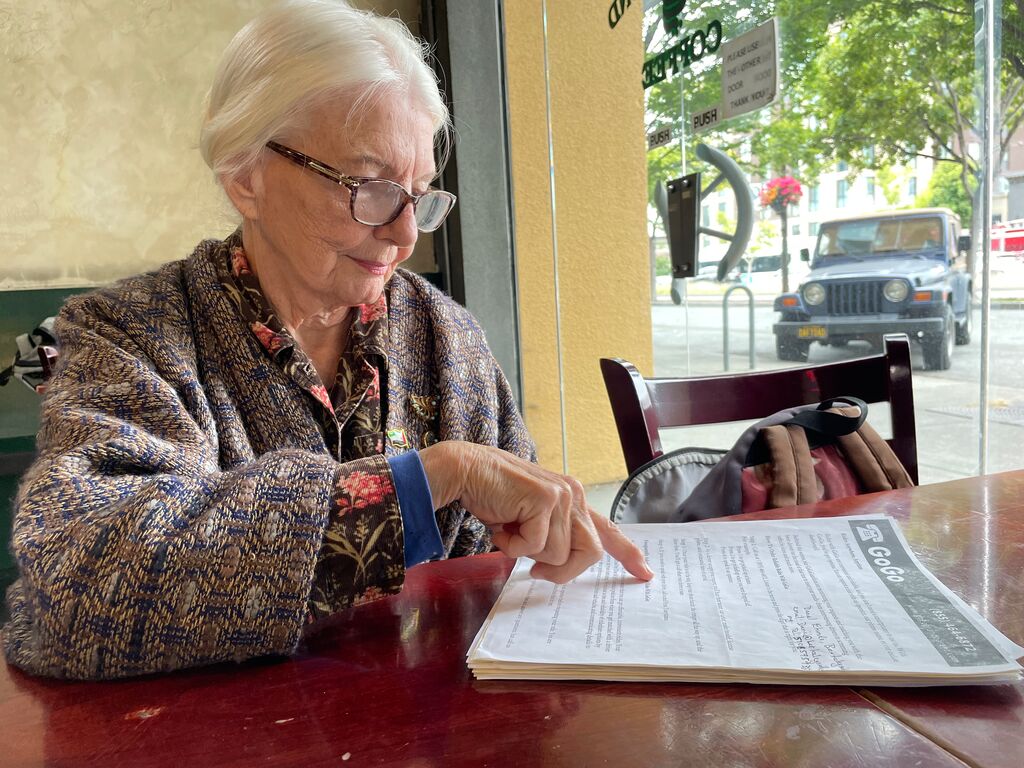
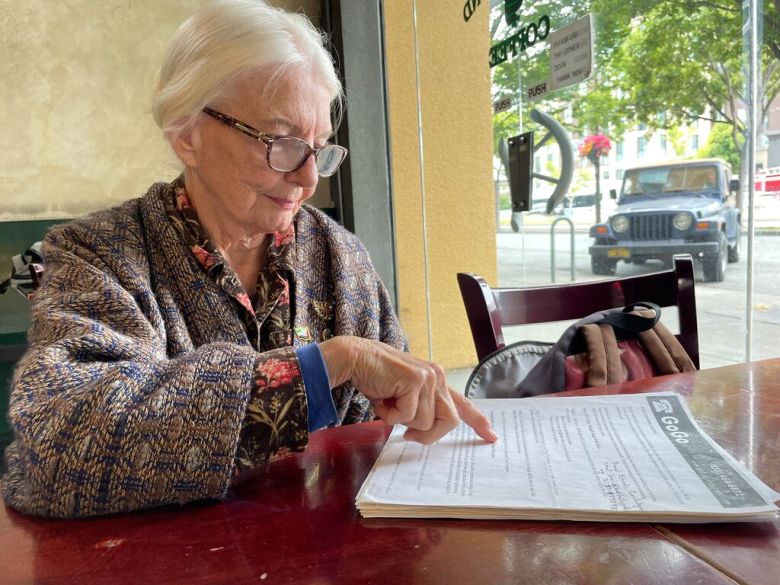
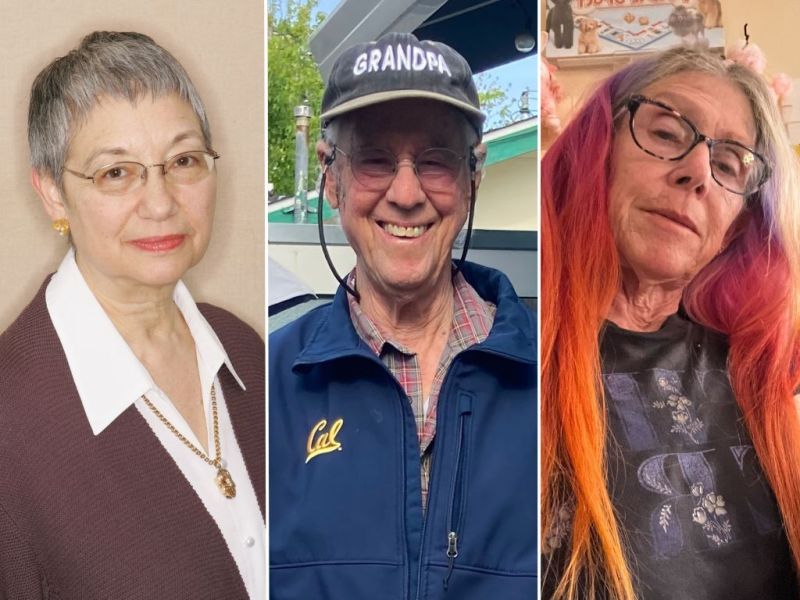
 Barbara Henninger, a long-time Berkeley resident, said she has found it difficult to use a city ride service for seniors and people with disabilities which now uses exclusively a third-party system called GoGo. Credit: Daniel Ekonde/Berkeleyside
For the past four years, Barbara Henninger, 78, a longtime Berkeley resident, has taken advantage of the city’s free rides program to go to the beach, grocery stores, and sometimes to the Berkeley Adult School, where she took a ceramics class. The program used taxis, Ubers and wheelchair-accessible vans and worked on a voucher system.
Earlier this year, however, the city significantly cut back the benefits senior and disabled participants received through the free transportation service, due to what it said were surges in applications and ridership costs. And, since then, Henninger has reverted to driving her car when going to a farther destination, walking if she’s going downtown, or boarding AC transit for shorter distances.
She gave up using the restructured program when she saw the new out-of-pocket cost. “I can’t pay $4 every time I want to go somewhere,” said Henninger, who lives on a $1,230 monthly retirement benefit, which covers the $900 per month rent of her apartment on Channing Way.
New rides system exclusively uses third-party app GoGo
This month, the Berkeley Rides for Seniors and the Disabled (BRSD) program switched from offering a free taxi voucher program to exclusively using a third-party app called GoGo. Users order up a ride with Uber or Lyft by calling a toll-free phone number. GoGo claims on-demand rides arrive in 15 minutes or less, and users need to pay a $4 copay per ride.
Before 2025, users could get $600 worth of taxi vouchers and $480 in GoGo rides. Now, with taxi rides out, they are eligible for just $384 in GoGo rides a year. The new model caps the city’s contribution per ride to $16, allowing individuals up to 24 rides and up to 32 paratransit rides a year. Those with significant healthcare needs can get 12 additional GoGo rides and 16 additional wheelchair-accessible rides. Users incur an annual copay of $96 if they use all 24 rides. Berkeley joined Hayward, Fremont, Alameda, and Oakland in introducing a new system which includes a copay. Oakland and Fremont still include taxi vouchers in their transportation for seniors program.
The changes to the program, which is funded by Alameda County’s Measure BB, are outlined in a February report by City Manager Paul Buddenhagen, who said it will “help BRSD continue supporting older adult residents, serve those on the waitlist, and accept new applicants in FY [financial year] 2027 while staying within budget and in compliance with Measure BB.”
Buddenhagen’s report said taxi rides are more expensive than those booked through GoGo, requiring the printing of vouchers and staff to help drivers cash in scrips. It also said the system was prone to fraud.
There are currently 960 active users of the program, a number reached after BRSD asked 1,756 enrolled members to recertify last year, after the program saw a 54% increase in enrolled riders and a 58% hike in the number of rides taken. Even with the reduction, there are 170 people on the program’s waitlist, which is now closed. Demand for the program, which is offered to those who are 70 and older and disabled people certified by East Bay Paratransit, may continue to grow given that Berkeley’s older population is projected to double by 2030, by which time 1 in 5 adults will be over 65. According to the latest U.S. Census data, 16.7% of Berkeley residents are seniors age 65 and older and 7.7% are people with disabilities under the age of 65.
The taxi vouchers cost BRSD $230,400, almost half of the almost $500,000 it spends on the program, whose budget is set to increase by 4% in 2027.
Some riders find GoGo system difficult to use
Henninger, who has lived in Berkeley since 1968 and used to work as a plant technician, said she’s faced many challenges using the GoGo service. “You call a number and you wouldn’t talk to a real person, you would be talking to a robot, [an] AI,” said Henninger, who added that the automated system would provide a long phone menu that was cumbersome to understand. She said she would have to contact a human operator to help her book the ride. Sometimes, the robot would misunderstand her when she gave an address, directing the Uber or Lyft driver to another location.
She said the taxi voucher program “was really extremely convenient, because it was just like I would call you [the taxi driver] up as a friend and say, ‘Can you come and pick me up and take me somewhere?’”
Lilian Gould, 74, said taxis came “pretty fast” when she used taxi vouchers, but with GoGo rides “you don’t know who’s coming and they keep switching [drivers] sometimes.” She said one day her driver was reassigned four times when she booked the service. Gould has glaucoma, which prevents her from driving when it’s dark. That’s when she uses GoGo rides.
But, while it was difficult for Gould to understand the GoGo system initially, she said now “they have my account number here. So, when I call with my cell phone, they recognize me right away.” She said GoGo notifies her of the driver’s estimated arrival time and identity, then follows up with a confirmation call to verify if she still needs the service.
Paula Martin, 75, said she would miss the taxi vouchers, because it was easier to call drivers and hand them vouchers to ride her to the hospital, theater or grocery store. The South Berkeley resident, who has undergone two knee and two hip replacements, said she supports BRSD’s restructuring so long as it keeps the program running. “It’s still a benefit, because it’s saving us 16 bucks a ride,” Martin said. She said she could see how the taxi scrip system could come with additional operational costs for BRSD, especially printing the vouchers.
But Martin has had unfortunate incidents with GoGo rides. One day she was abandoned in a four-way intersection when she and her sister accidentally entered the car of a driver who had canceled their appointment to pick up another person in the same location, which they weren’t aware of. “We told him [the driver] we got in the car with this license number,” Martin said.
Another time GoGo canceled her ride because her destination was close to her pick-up point. Martin said she got somebody to take her home because it was dark and her medical condition didn’t permit her to walk alone.
But Martin has praise for the GoGo ride operators generally. She said the ride-hailing drivers might not be patient with BRSD users, but the GoGo phone operators are. “I commend them highly,” Martin said. “They are on the phone with you and are very helpful.” Martin said she uses the GoGo program every two or three weeks. She relies on friends for frequent rides as well as the paratransit, which takes her to San Francisco and back for $8.
City admits there is still a learning curve
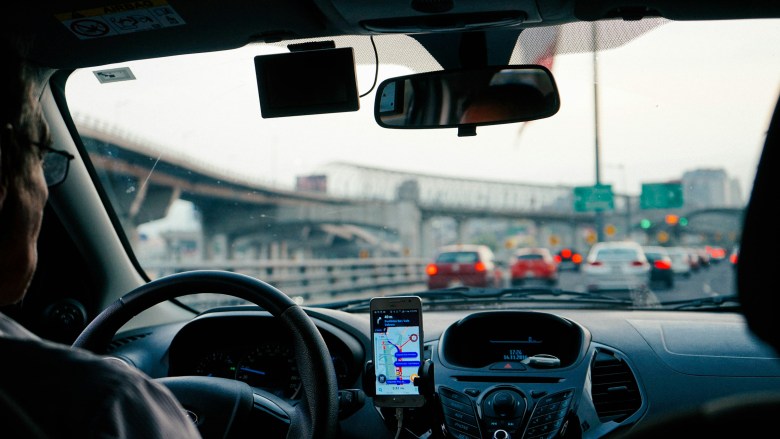 Berkeley introduced GoGo rides as a pilot program in 2019 and many riders have appreciated the program, transportation services coordinator Mary Triston said — but she allowed that there is still a “learning curve.” Credit: Dan Gold/Unsplash
Mary Triston, who, as transportation services coordinator for the city, manages daily BRSD operations, said Berkeley organized two learning workshops for riders on how to use the GoGo system last month. “In addition, BRSD recently provided in-person orientation sessions at several local senior residences and will continue to do so over the next couple of months,” she said.
The city introduced GoGo rides as a pilot program in 2019 and many riders have appreciated the program, Triston said, admitting there is still a “learning curve.”
When BRSD reduced the benefits participants in the ride program received last year, the Center for Independent Living opposed the move and rallied older adults to make their opposition to the cuts “loud and clear” to local leaders.
“The first cuts were incredibly impactful,” said Lucky Maxwell, a transport specialist at CIL, referring to April 2025 when BRSD reduced the number of taxi and GoGo rides to minimize cost. “Now these additional cuts are changing the program structurally, and more of the responsibility for payment is now falling [on the limited number of participating clients].”
Maxwell said CIL has a client with visual impairment who used the taxi voucher-based program to get around. The client is distressed because he doesn’t believe the Uber and Lyft drivers who work through GoGo will be as patient helping him get into the car as taxi drivers were. “People will be more home-bound, because they rely solely on these transportation services to meet their basic needs,” Maxwell said.
Triston said GoGo’s GoGoGuardian feature lets riders with special needs alert drivers before pick-up that they need help with a foldable wheelchair or in-and-out-car assistance, for example.
Related stories
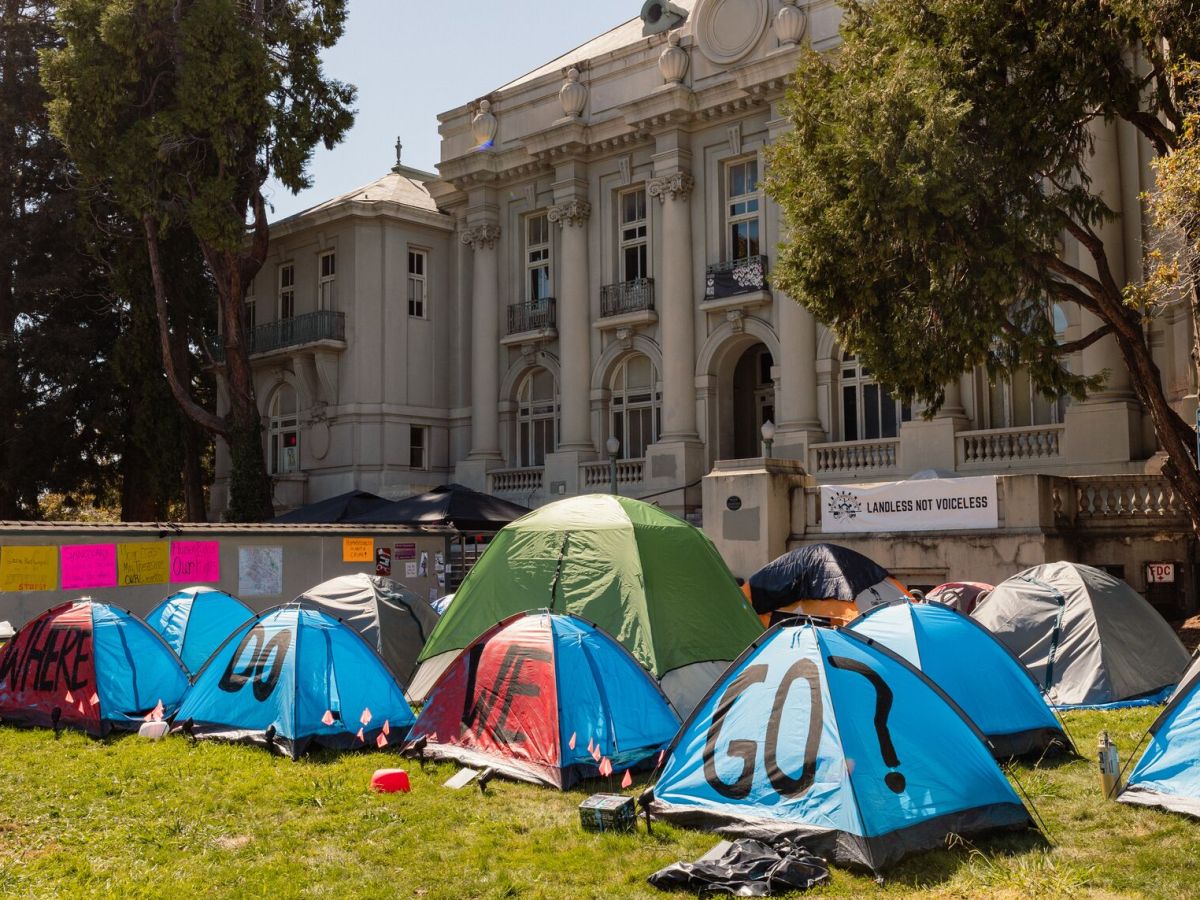
Berkeley slashes 2 safety net programs — a mental health crisis team and a homeless shelter
July 6, 2026July 6, 2026, 4:28 p.m.
May 2, 2025May 4, 2025, 9:03 a.m.
Berkeley cuts back free rides program for senior and disabled residents
April 8, 2025April 10, 2025, 5:29 p.m.
We know that most readers don’t get to the end of the article. But you did! To support our in-depth, rock-solid reporting, please consider making a donation to our nonprofit newsroom today. We rely on our readers — particularly the ones who read the whole story!
“*” indicates required fields