
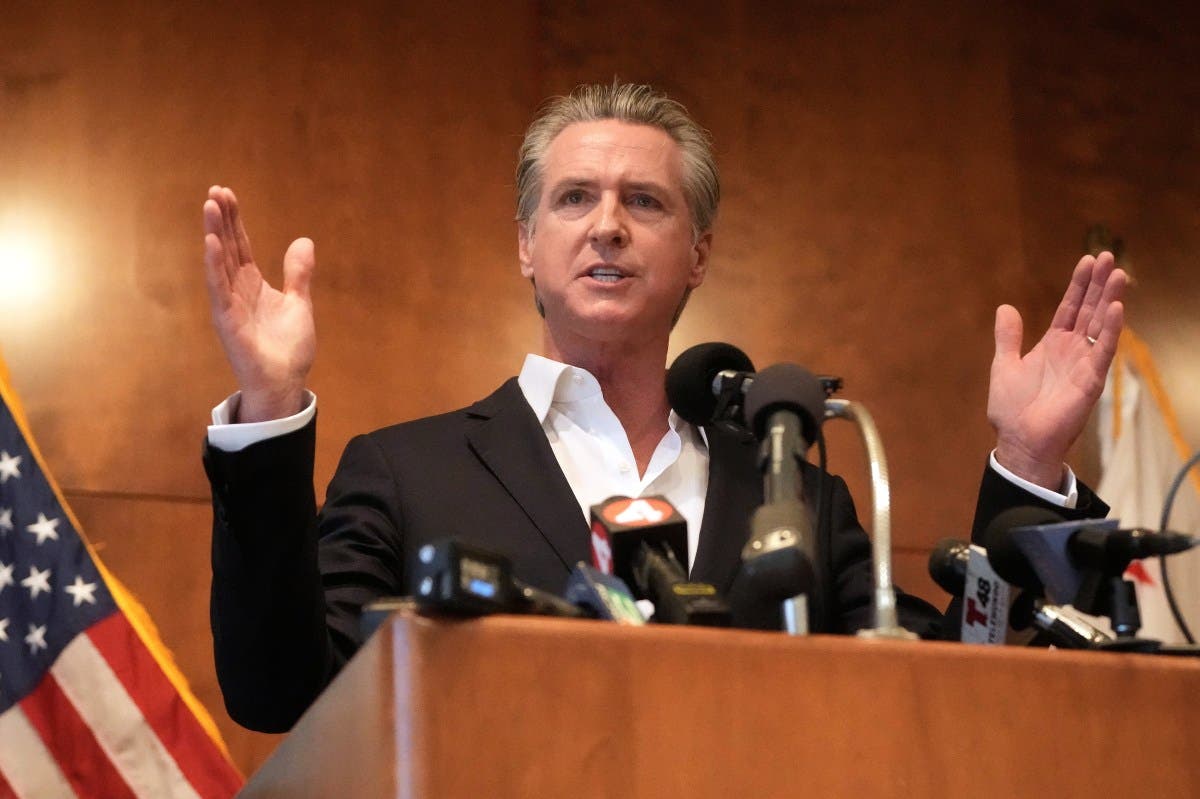
California voters passed Proposition 50 on Tuesday, in a major win for Governor Gavin Newsom and the Democrats.
Under the proposal, districts such as CA-01, CA-03, CA-22, CA-41 and CA-48 are set to shift by shedding conservative-leaning counties and absorbing more Democratic-leaning areas.
In a speech after the vote, Newsom said the passage delivered a powerful message to President Donald Trump, and hailed the result as a victory for “the principles our Founding Fathers lived and died for.”
Why It Matters
The new congressional map will create more Democratic seats in California, potentially neutralizing a Republican-favoring redistricting plan advancing in Texas.
If there are more California Democrats, this would also help the party more broadly in the November 2026 midterms. Republicans hold a narrow 219-213 House majority, meaning a net loss of just six seats would cost them control of the chamber.
If the Democrats gain the House, they will be able to control the passage of key legislation and act as a roadblock to the Trump administration’s priorities.
What To Know
Proposition 50 will authorize California to adopt a new congressional map created under Assembly Bill 604 (AB 604), replacing the current boundaries drawn by the state’s independent Citizens Redistricting Commission in 2021. The new map will be used for the 2026, 2028, and 2030 elections, after which the commission will resume its role and draw fresh districts in 2031 following the 2030 census.
Under the existing map, Republicans dominate much of inland California, while Democrats control the coast and major cities. The new map, however, shifts several inland and southern districts toward Democrats, consolidating Republican voters into fewer, larger districts.
According to the new boundaries, Districts 3 and 5—respectively, Republican-leaning and solidly GOP seats—will be combined into a single strongly blue district. Meanwhile, several formerly red districts in the Central Valley, Inland Empire, and Orange County will become more competitive or tilt Democratic.
Northern California will also see a major change, with large Republican-leaning areas set to be redrawn to include more Democratic territory, further reshaping the state’s political balance.
The plan is designed to give Democrats a stronger advantage in several key congressional races. According to political analysts Kyle Kondik and J. Miles Coleman, the new boundaries could help Democrats gain up to five additional seats, targeting Republican Representatives Doug LaMalfa (CA-1), Kevin Kiley (CA-3), and Ken Calvert (CA-41), with two others—David Valadao (CA-22) and Darrell Issa (CA-48)—seen as tossups.
Newsom has framed Proposition 50 as a direct response to recent redistricting moves by Republican-led states. “They’re not screwing around. We cannot afford to screw around either,” Newsom said. “We have got to fight fire with fire.”
It also includes symbolic language urging Congress to support independent, nonpartisan redistricting commissions nationwide, framing the proposal as part of a broader call for “fair and independent” map-drawing across the country.
Newsom’s proposal follows a new redistricting law passed in Texas on August 22, which, according to The Texas Tribune, could give Republicans up to five additional U.S. House seats. The Texas plan was advanced after the Justice Department said four districts were unconstitutional racial gerrymanders. GOP lawmakers, including State Representative Todd Hunter and State Senator Phil King, said the goal was to “improve Republican political performance,” while Trump endorsed the plan, saying the Lone Star State was “entitled to five more seats.”
Newsom said that California’s ballot measure “will nullify what happens in Texas,” predicting it could allow Democrats to gain five seats—but, he noted, “with the consent of the people,” since voters must approve the measure.
Similar efforts have emerged in Missouri, where the state legislature passed a new map dividing Kansas City among three congressional districts. Trump praised the plan as a “gigantic victory” for Republicans, while Democratic Representative Emanuel Cleaver called it an “unconstitutional attack” on democracy.
What People Are Saying
California Governor Gavin Newsom said on Tuesday night: “We stood firm in response to Donald Trump’s recklessness, and tonight, after poking the bear, this bear roared with unprecedented turnout in a special election with an extraordinary result.”
He added: “What a night for the Democratic Party. A party that is in its ascendancy. A party that is on its toes, no longer on its heels. From coast to coast, sea to shining sea. But it was not just a victory tonight for the Democratic Party, it was a victory for the United States of America, for the people of this country, and the principles our Founding Fathers lived and died for.”
California Republican Representative Kevin Kiley said in a video message on X: “I believe fighting fire with fire burns everything down. With California’s new gerrymander, the redistricting arms race has no end in sight.
“It’s a race to the bottom. It degrades democracy everywhere. It’s about a symptom of our country’s political divisions, and a troubling new trend that is sure to make that division even worse. Tonight, more than ever, I believe excessive partisanship is one of the biggest challenges facing our country.”
Voto Latino said in a statement: “By approving Proposition 50, California voters just sent a clear message to the nation: fair representation and transparency are nonnegotiable. Californians have chosen to defend and strengthen the foundation of our democracy.
“California will now be able to temporarily and legally update its congressional maps, ensuring representation remains fair and reflective of the electorate.
“There is an unprecedented and coordinated assault on our democracy by Republican states like Texas and others to manipulate congressional maps to favor one party and silence communities of color. Proposition 50 is California’s answer to that threat, through their commitment to achieving equal representation for all.”
What Happens Next
Districts will be redrawn ahead of the November 2026 midterms.