
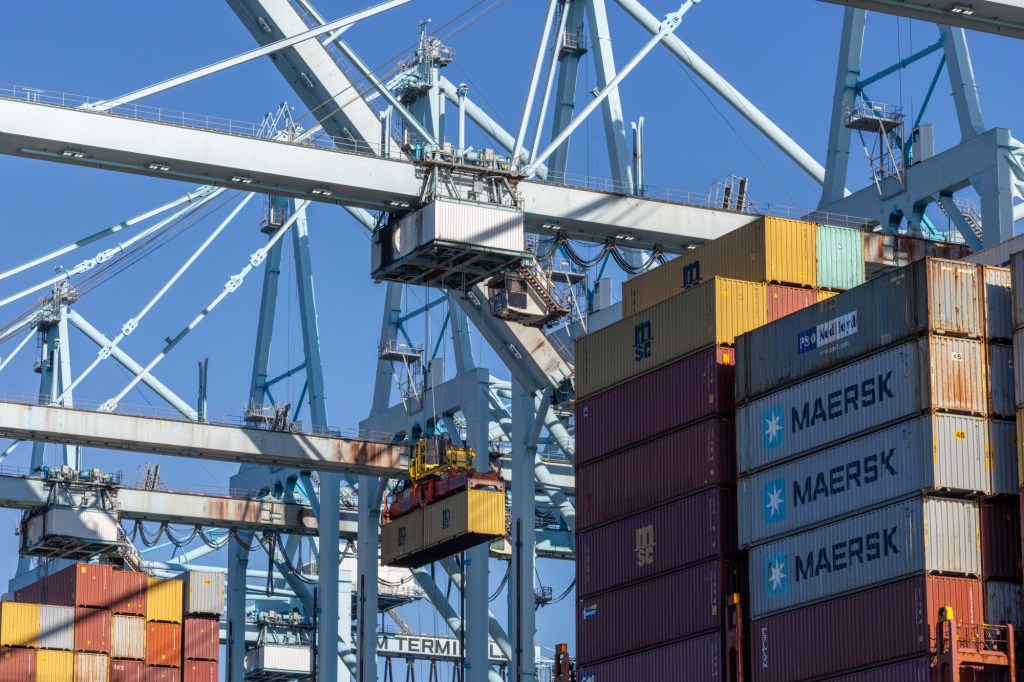
The National Retail Federation announced this week that an import cargo surge is expected to continue this month at U.S. ports as retailers stock up ahead of expected August tariff increases.
The projections, which also forecast imports to hit a new all-time record this month, were released Wednesday, July 8, and were based on the Global Port Tracker and Hackett Associates.
“This year’s early peak season is expected to continue through July as retailers and other importers prepare for potentially higher tariffs beginning in August and other trade uncertainties,” Jonathan Gold, NRF’s vice president for supply chain and customs policy, said in a written statement.
Continued supply chain impacts are also emanating from the ongoing conflict with Iran, Gold added.
“The busy back-to-school selling season has already started, and the winter holidays won’t be far behind, so retailers have been working to get products into the U.S. and ready to go before new tariffs can potentially drive prices higher,” Gold said. “Despite ongoing economic headwinds, consumers are continuing to spend, but affordability is a key factor affecting their spending habits.”
Temporary 10% global tariffs that took effect in February, the NFR report said, are set to expire July 24. But a new round of tariffs regarding forced labor are expected to be imposed by the Trump administration as early as next month.
“Import volumes have risen sharply, with strong growth likely continuing into July,” Hackett Associates Founder Ben Hackett said in a written statement. “Much of this increase reflects front loading ahead of expected tariff increases.”
Neither the Port of Los Angeles nor the Port of Long Beach has released June cargo numbers yet.
But a spokesperson for the Port of Los Angeles, which will announce its June cargo volume next week, said the port is “expecting strong results.”
Port of Long Beach CEO Noel Hacegaba said that his port is seeing brisk business.
“Our docks are busy as shippers frontload goods to get ahead of tariff disruption, triggering an early peak season here in Long Beach,” Hacegaba said in a written statement. “We’re seeing ocean carriers add services to meet the demand and bringing more unscheduled ships to port – known as extra loaders – to either import more cargo or remove empty containers to clear the docks and create more space on our terminals.
“Our conversations with retailers, manufacturers and cargo owners,” he added, “suggest businesses continue to diversify sourcing, adjust inventory strategies and build flexibility into their supply chains rather than betting on a single policy outcome.”
Overall, U.S. ports covered by Global Port Tracker handled 2.24 million twenty-foot equivalent units — one 20-foot container or its equivalent — during May, the latest month for which final numbers are available. That was up 14.9% from the same month last year, when imports were down sharply because of last year’s “Liberation Day” tariffs, and up 10.1% from April.
In May — and with an earlier “peak” shipping season hitting this summer — both the ports of Los Angeles and Long Beach experienced busy months, with strong cargo numbers despite continued economic and political uncertainty.
The Port of Los Angeles processed 840,165 TEUs in May, 17% above the same month of last year, as import volume increased amid continued uncertainty surrounding trade policy and global supply chains.
The Port of Long Beach, meanwhile, moved 842,030 TEUs in May, up 31.7% from the same month in 2025 — making it that port’s third-busiest May on record.
The Global Port Tracker projected the month of June for all U.S. ports at 2.33 million TEUs, up 18.7% year over year. That would bring the first half of 2026 to 12.77 million TEUs, up 2% from the same period in 2025.
July is forecast nationally at 2.47 million TEUs, which would be up 3.3% from last year and would top the previous monthly record of 2.4 million TEUs, set in May 2022 as the economy bounced back from the COVID-19 pandemic. Imports are expected to drop to 2.22 million TEUs in August, down 4.5% year over year. September is forecast at 1.99 million TEUs, down 5.7% year over year; October is at 1.99 million TEUs, down 3.8%, and November is at 1.92 million TEUs, down 5.2%.
The May through July numbers at U.S. ports are expected to be the highest of the year. The peak shipping season, which historically centered around October, has moved up in recent years amid reasons ranging from port labor disputes to expected tariff increases.
Imports at U.S. ports totaled 25.4 million TEUs in 2025, down 0.3% from 25.5 million TEUs in 2024.